The 2026 Carbon Intelligence Window: How European Shippers Can Turn CSRD Compliance Into Strategic TMS Advantage Before Reporting Deadlines Transform the Competitive Landscape

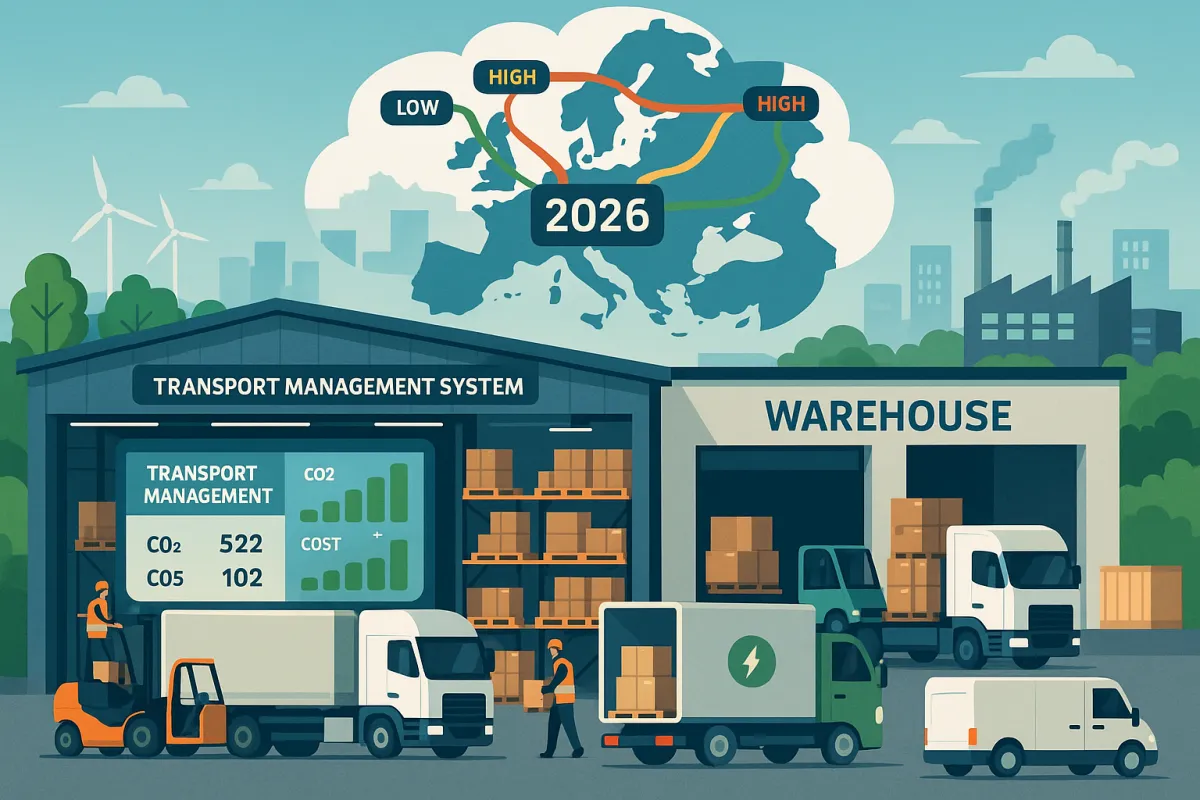
The wave of European companies entering CSRD scope in 2026 - those meeting two out of three criteria (250+ employees, €25M+ balance sheet, or €50M+ turnover) who must report on their 2025 fiscal year - represents the largest-ever corporate sustainability reporting expansion. But here's what most supply chain directors miss: this isn't just about compliance. Companies that were not previously obliged to prepare a non-financial statement and employ more than 1,000 employees and have more than €450 million in annual net sales revenue should use the time gained by the "Stop-the-Clock" Directive in the 2026 financial year to build robust reporting structures.
The regulatory landscape extends far beyond CSRD. Verification of emission reports by an independent accredited verifier is required from 2026 (for 2025 emissions), while ETS2 puts the point of regulation upstream on fuel suppliers, with monitoring and reporting of emissions starting on 1 January 2025. This creates unprecedented pressure for accurate, automated carbon tracking in your carbon tracking TMS before these deadlines transform competitive dynamics.
Manual Carbon Data Won't Scale to 2026 Requirements
Most European manufacturers still track transport emissions through spreadsheets. This approach breaks down completely under CSRD's double materiality lens, considering both impact and financial materiality. Companies now need deep, accurate insight into emissions generated throughout the value chain, as Scope 3 emissions – the indirect emissions generated by upstream and downstream activities become mandatory reporting elements.
The data complexity is staggering. Accurate Scope 3 understanding requires insight into each truck's engine size and fuel type, tracking whether carriers are using biofuel or Electric Vehicles for last-mile delivery, and computing overall cargo weight to understand specific CO2 emissions for each journey. Manual processes simply cannot handle this granularity across thousands of annual shipments.
Leading companies are implementing sustainable transport management system architectures that automatically collect this data. Modern systems calculate estimated CO2 emission for each carrier and mode of transport before transport decisions, with integration capabilities varying significantly as leading platforms connect to major emissions databases and carrier APIs for real-time data.
Your TMS as Carbon Intelligence Platform
The most sophisticated European shippers are positioning their TMS as their primary carbon intelligence hub. Calculation methodology certified by international standards such as ISO 14083 and in alignment with the GLEC Framework ensures calculations are consistent, reliable, and in compliance with sustainability regulations like the CSRD.
Current TMS vendors have added carbon tracking capabilities with varying degrees of sophistication. Modern systems like Blue Yonder and Alpega have "Green Logistics" modules that calculate CO2 emissions based on the mode of transport and distance traveled. Meanwhile, platforms like Cargoson offer CO2 emissions calculation alongside price and transit times comparison in one cloud-based system, while traditional enterprise vendors often separate sustainability modules.
Oracle TM, Manhattan Active, and Descartes have enterprise-grade carbon tracking, but implementation complexity can be significant. Cargoson TMS introduces a new level of transparency, multi-carrier management, and an online price, transit time and pre-calculated CO2 calculator that revolutionize logistics operations with sophisticated features designed to foster informed decision-making.
The key advantage is real-time carbon consideration. Modern TMS platforms like Cargoson, MercuryGate, and Descartes now offer built-in carbon calculators that provide pre-calculated CO2 emission estimation before making transport booking, shifting carbon consideration from post-hoc reporting to proactive decision-making.
Modal Shift Integration for Carbon Optimization
European transport is experiencing a significant modal shift as companies optimize for both cost and carbon performance. The good news is that optimizing logistics to reduce costs should also reduce emissions. Using a Transport Management System (TMS) to minimise the number of trucks required and cut miles, opting for ocean transport rather than air, not only minimises costs but also emissions.
This trend drives demand for TMS platforms with multimodal coordination capabilities. Rather than measuring carbon after the fact, sustainability feeds directly into transportation planning, balancing cost, speed, and environmental impact for shipments across lanes and modes. Alpega, nShift, and Cargoson lead in providing integrated multimodal planning that automatically suggests lower-carbon alternatives during routing decisions.
Route optimisation and load consolidation reduce empty miles by 20-30%, cutting both fuel costs and carbon emissions. Advanced platforms can model these optimizations in real-time, showing carbon impact alongside traditional cost and time metrics during carrier selection.
The 90-Day Carbon TMS Readiness Framework
Phase 1 (Days 1-30): Data Audit and Baseline Establishment
Start by establishing baseline carbon footprints for your current transport operations to get benchmark data for measuring improvement and identifying the highest-impact optimization opportunities. Map your current data sources - carrier invoices, route planning systems, fuel consumption records - and identify gaps in Scope 3 emissions tracking.
Document your transport patterns: annual freight spend by mode, average shipment weights, primary trade lanes, and carrier mix. This baseline becomes the foundation for measuring post-implementation improvements and satisfying CSRD reporting requirements.
Phase 2 (Days 31-60): TMS Vendor Evaluation with Carbon Focus
Evaluate platforms including Cargoson, Oracle Transportation Management, SAP Transportation Management, and specialized solutions like IntegrityNext that focus specifically on carbon compliance. Look for systems offering automated supplier integration, real-time emissions calculation, and API connectivity.
Prioritize vendors offering emissions API that integrates directly with existing TMS or supply chain software, with BigMile providing integration with over 30 transport management and supply chain systems as an example of the integration depth available.
Phase 3 (Days 61-90): Integration and Testing
Cloud-based TMS implementation typically takes 1-4 weeks, but carbon functionality requires additional testing. Run parallel calculations against your existing methods to validate accuracy. Test carbon reporting outputs against anticipated CSRD disclosure requirements.
Start 12–18 months before your first reporting period to give you a full cycle to set boundaries, run a double materiality assessment, stand up data pipelines, and trial assurance. This 90-day window positions you for comprehensive testing before 2025 data collection begins.
Market Positioning for 2026 Competitive Advantage
European transport costs remain elevated, making carbon-intelligent optimization doubly valuable. Industry analysts expect lighter recovery for European road haulage in 2026, meaning freight rates will stay high while carbon compliance costs increase.
Early adopters gain significant competitive advantages. Customer relationships increasingly factor sustainability performance into procurement decisions. Companies with real-time carbon data can offer transparent emissions reporting to customers, differentiating their proposals in competitive tenders.
CSRD compliance drives legitimate TMS investment, but vendor sustainability markups exploit regulatory urgency. Your framework should secure both compliance and cost control through structured evaluation, realistic TCO modeling, and performance-based contracting.
MercuryGate, Transporeon, E2open, and Cargoson are positioned as leaders in sustainability-focused TMS capabilities. The key is selecting platforms that provide carbon intelligence without premium pricing for basic compliance features.
Beyond Compliance: Long-term Strategic Value
ETS2 coverage of road transport beginning in 2027, with fuel suppliers as regulated entities and monitoring starting in 2025 means carbon costs will directly impact transport pricing. Companies with carbon-intelligent TMS can optimize for these costs proactively.
With regulatory pressure intensifying and corporate ESG commitments becoming standard, TMS provides measurable environmental impact reduction while tracking and reporting sustainability metrics supporting regulatory compliance and corporate reporting requirements. This positions carbon tracking as becoming as fundamental as financial tracking for transport operations.
Calculate ROI by modeling transport cost savings from route optimization, improved carrier negotiations based on carbon performance data, and reduced compliance consulting fees. Companies that use carbon accounting software are 2.5x more likely to achieve their emission-reduction targets, indicating measurable business value beyond mere compliance.
The 2026 sustainability reporting deadline creates a strategic window for European shippers to modernize TMS infrastructure while competitors scramble for last-minute compliance solutions. Companies implementing carbon-intelligent TMS platforms now will be positioned for operational advantage when CSRD reporting begins and ETS2 costs impact every transport decision. The question isn't whether to invest in sustainable transport management system capabilities, but whether to lead the market or follow it.