The AI-TMS Implementation Paradox: How European Shippers Can Deploy Artificial Intelligence Features Without Joining the 76% That Fail to Meet Performance Goals

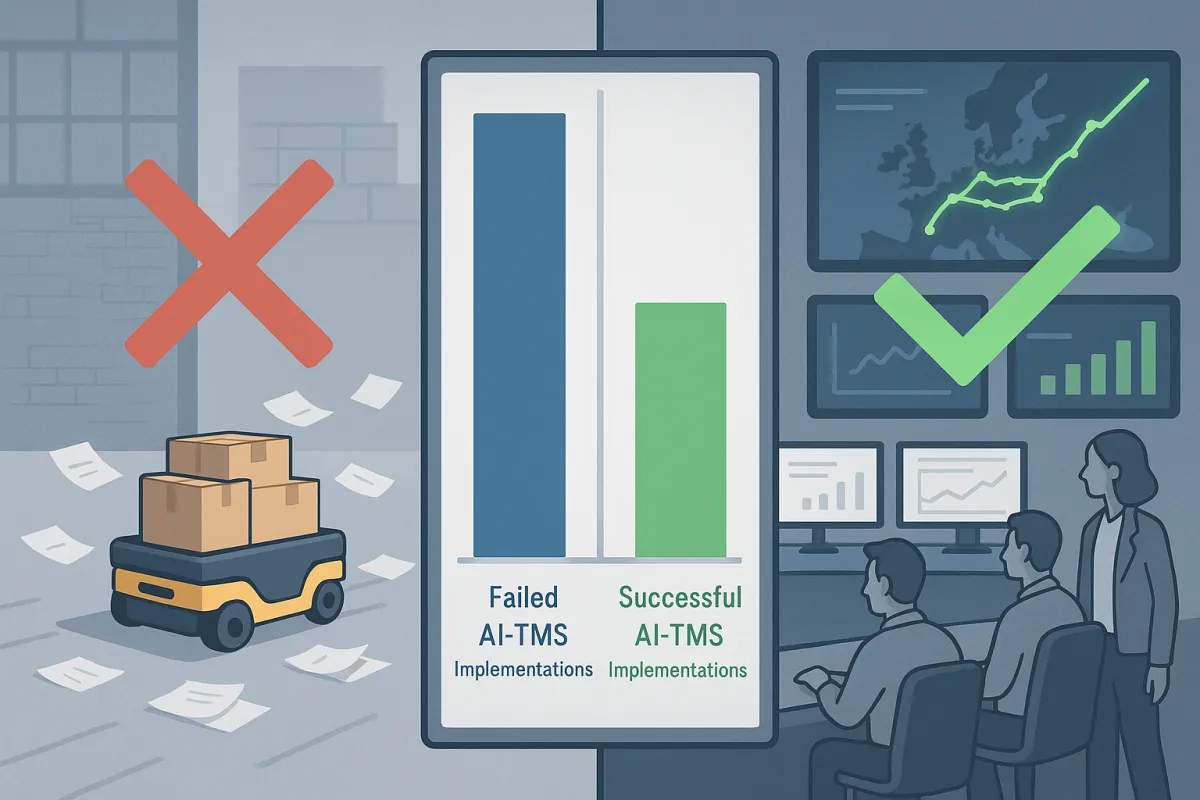
European manufacturers are pouring millions into AI-powered transport management systems, yet 72% of logistics AI implementations fail due to workforce resistance rather than technical issues, while 66% of technology projects end in partial or total failure. Despite the growing European TMS market reaching €1.4 billion in 2024 and growing at 12.2% annually, companies like the German automotive parts manufacturer mentioned in recent industry reports are discovering what an €800,000 AI TMS implementation disaster looks like after choosing platforms that couldn't integrate with their European carrier networks.
The artificial intelligence integration promises in transport management are compelling, but the execution reality tells a different story. This comprehensive guide examines why AI-powered TMS implementations fail at such alarming rates across Europe, and more importantly, how your organization can join the successful 24% that achieve their performance objectives.
The AI Implementation Reality Check: Why Most European Shippers Are Getting It Wrong
The current AI adoption statistics paint a picture of ambitious investment paired with disappointing results. Companies need to adopt a proactive and strategic approach to AI implementation for logistics transformation, yet most European shippers approach AI TMS features as technology purchases rather than business transformations.
Master data management issues plague 76% of supply chain organizations, with duplicate records, inconsistent formats, and missing fields undermining AI accuracy. Your TMS platform might feature advanced machine learning algorithms for route optimization, but if your carrier data contains inconsistent naming conventions across twelve European countries, those algorithms will produce inconsistent results.
The difference between AI hype and practical implementation becomes stark when examining vendor capabilities. Enterprise solutions like Manhattan Active and SAP TM approach AI through comprehensive data integration strategies, while newer European-native solutions like Cargoson focus on specific AI use cases such as cross-border carrier selection and automated customs documentation validation.
Companies with formal data governance programs report 3.2x higher success rates for AI initiatives. The message for European procurement teams is clear: AI implementation success depends more on data strategy than algorithm sophistication.
The €800,000 Mistake: Real Implementation Failures and What They Teach Us
A German automotive manufacturer's costly implementation disaster illustrates how AI-TMS projects fail when core requirements analysis gets bypassed in favor of impressive technology demonstrations. They chose a North American-focused platform six months before discovering their primary carriers couldn't integrate without costly custom development.
Common failure patterns emerge across European AI TMS implementations:
- Timeline miscalculations: Some TMS implementations took 18 months instead of 6. Others required expensive customizations not included in initial budgets
- Integration complexity underestimation: Only 34% of organizations report seamless data flow between physical equipment and AI decision systems
- ROI calculation errors: Companies project maximum theoretical savings instead of realistic benchmarks based on actual adoption rates
The financial consequences extend beyond initial implementation costs. On-premise solutions tend to have high costs for implementation and licensing, which can make up as much as 25% of the total cost of the solution. When AI features require additional data processing capabilities, these percentages increase substantially.
Successful implementations from vendors like MercuryGate (now Infios), Blue Yonder, and Cargoson share common traits: conservative ROI projections, comprehensive cost accounting, and phased deployment strategies that prove value before scaling.
The Three Critical Success Factors for AI-Powered TMS
User adoption targeting above 80% within the first year requires specific measurement strategies. Machine learning helps shippers save money, optimize their operations and provide higher levels of customer service, but only when transport coordinators actually use the AI recommendations consistently.
Specific AI use cases delivering measurable results include route optimization (showing 8-12% distance reductions), automated load matching (reducing manual carrier selection time by 60%), and predictive maintenance scheduling. Companies implementing cloud-native platforms like FreightPOP, Shippo, and Cargoson report deployment timeframes of 6-12 weeks versus 6-12 months for traditional enterprise implementations.
The implementation timeline difference stems from architectural decisions made years ago. Cloud-native solutions design AI features as integral components rather than bolt-on modules requiring extensive integration work with legacy systems.
Building Your AI-Ready Implementation Strategy
Successful AI TMS deployment starts with carrier network assessment. Most European manufacturers work with 20-30 regular carriers but access to AI-powered freight marketplaces expands this to 200-300 qualified providers through automated matching algorithms.
A phased approach proves most effective: pilot with one major lane, measure specific results (cost savings, delivery reliability, administrative time reduction), then expand systematically based on documented performance improvements. This methodology allows teams to refine AI model training with real operational data before committing to full-scale deployment.
Change management requirements intensify with AI-powered features because the systems make recommendations that challenge existing procurement relationships. Transport managers accustomed to working with preferred carriers need training on interpreting AI-generated carrier scoring and cost analysis.
Vendor selection becomes more nuanced in the consolidated landscape. The post-consolidation landscape reveals three distinct categories: global mega-vendors (Infios/MercuryGate, Descartes, SAP TM, Oracle TM, E2open/WiseTech), European specialists (Alpega, nShift, Transporeon/Trimble), and emerging European-native solutions (including Cargoson) that focus specifically on cross-border European operations.
Measuring Real ROI: Beyond Theoretical Savings
Concrete ROI measurement requires baseline establishment and ongoing monitoring. Current freight spend: €2.1M annually. Target reduction: €315K year one through route optimization and carrier selection represents the specificity level required for credible business cases.
The rule of thumb for TMS investments holds especially true for AI-enhanced platforms: for every euro spent annually on TMS licensing and implementation, expect at least €2 in direct savings and productivity gains within 18 months. Most companies see ROI within 6–18 months, depending on the scale of the implementation and initial investment.
AI-specific benefits require different measurement approaches. Route optimization algorithms might reduce total transportation costs by 5-10%, but the more significant savings often come from automated carrier selection reducing the time transport coordinators spend managing spot quotes and emergency shipments.
Tracking methodology should include cost savings (freight rates, fuel surcharges, accessorial charges), efficiency improvements (shipment processing time, carrier onboarding speed, invoice reconciliation automation), and user satisfaction metrics measured through system usage patterns and feedback surveys.
The European Advantage: Why 2025 is Your Window
Current European transport market conditions favor shippers negotiating TMS platform terms. 426,000 unfilled truck driver positions across Europe, while heavy goods vehicle registrations fell by 16% between Q1 2024 and Q1 2025, create capacity constraints that make AI-powered carrier optimization more valuable than in balanced markets.
European-native vendors hold distinct advantages for regulatory compliance. The eFTI regulation, carbon reporting requirements under the European Green Deal, and Smart Tachograph integration requirements favor platforms designed from inception to handle cross-border European complexity rather than North American solutions adapted for European markets.
Pricing model benefits currently favor implementation decisions. Cloud TMS platforms typically charge €1-4 per shipment processed, compared to fixed infrastructure costs that can exceed €50,000 annually regardless of transaction volume. AI features often add €0.50-€1.00 per shipment for advanced route optimization and carrier matching capabilities.
The vendor consolidation wave creates urgency around procurement decisions. WiseTech's acquisition of E2open in 2025, Descartes' purchase of 3GTMS for $115 million in March 2025, and Körber's transformation of MercuryGate into Infios represent just the beginning of market restructuring that's eliminating independent alternatives and reducing negotiating leverage for future contracts.
Your 90-Day AI-TMS Success Blueprint
Month 1: Assessment and vendor selection criteria - Document current transport processes, identify AI use cases with quantifiable benefits, and establish vendor evaluation criteria emphasizing European carrier integration capabilities over feature lists.
Month 2: Pilot implementation and initial measurement - Deploy selected platform on one major shipping lane, train core users on AI recommendation interpretation, and begin collecting performance data for cost, delivery reliability, and user adoption metrics.
Month 3: Scaling and optimization - Expand to additional lanes based on pilot results, refine AI model parameters with operational feedback, and document expansion business case for broader organizational deployment.
Success metrics documentation should include baseline comparisons (pre-implementation costs and processing times), AI recommendation accuracy rates (percentage of system suggestions that prove beneficial), and user engagement levels (frequency of AI feature utilization by transport coordinators).
The companies that will thrive with AI-powered TMS implementations in 2025 are those that treat artificial intelligence as a tool for enhancing human decision-making rather than replacing transport expertise. Your procurement strategy should prioritize vendors demonstrating proven European market success, transparent pricing models, and implementation methodologies that deliver measurable value within 90 days rather than promising transformational benefits after 18-month projects.