The Carbon Cost Analytics Revolution: How AI-Powered TMS Freight Audit Is Helping European Shippers Turn Fit for 55 Compliance Into Competitive Advantage


Here's the carbon pricing reality hitting European shippers right now: the EU ETS will be introduced gradually, starting at 40% of emissions in 2024, rising to 70% in 2025 and then 100% from 2026 onwards. While you're still calculating what this means for your freight spend, estimates from industry representatives like Maersk, Hapag-Lloyd and CMA CGM foresee an increase of €7 to €105 per TEU after the introduction of the EU ETS expansion. That's not a rounding error on your freight invoices.
The problem runs deeper than new surcharges. For the whole Union, it went from 18.5% to 16.9%, showing how the EU's modal shift policies are failing when looking at rail freight modal share between 2005 and 2023. Meanwhile, rail's modal share in land freight transport declined from 18.7% to 17.2% over the same period from 2018 to 2022. Your options for carbon-efficient alternatives are shrinking even as carbon costs escalate.
This creates an opportunity for shippers who can leverage TMS freight audit analytics to turn regulatory pressure into competitive advantage. The right approach combines AI-powered pattern recognition with carbon optimization insights to identify modal shift opportunities that actually work within your existing freight network.
Why Traditional Freight Audit Misses the Carbon Cost Picture
Your current freight audit process probably looks familiar: invoices arrive 30-60 days after delivery, get manually matched against contracts, then disappear into accounting. The industry-standard 30-60 day delays in accrual reporting severely impact financial planning and budgeting accuracy. This backwards-looking approach worked when fuel surcharges were your biggest variable cost concern.
Carbon pricing changes everything about freight cost dynamics. When the price of EU ETS allowances (EUA) fluctuates according to market supply and demand, for September 2023 the price was EUR 85 per ton of CO2, you need real-time visibility into your carbon exposure across modes and routes. Traditional audit providers can't deliver this because they're structured around historical reconciliation, not forward-looking optimization.
Consider a real scenario playing out across European distribution networks: a consumer goods company unknowingly spent €2.3 million on expedited air freight in Q4 2024 because their legacy audit system flagged rate discrepancies but couldn't surface the root cause - inadequate rail capacity planning that forced last-minute modal escalations. The carbon costs weren't even visible in their reporting until Q1 2025.
Manual processes compound the problem. Inaccurate audits frequently occur due to poor rate management and outdated contract versions. Manual document storage methods create version control issues and compliance risks. When carbon costs can swing 15-20% monthly based on ETS pricing, you can't afford audit inaccuracies or delayed insights.
The AI Analytics Breakthrough in Modern TMS Platforms
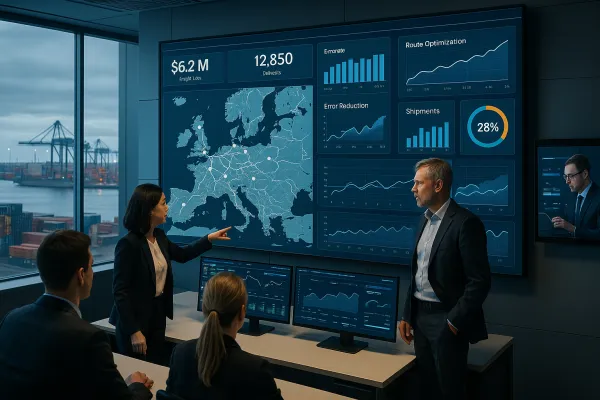
The TMS landscape shifted dramatically in 2025 as vendors integrated AI capabilities that transform freight audit from cost recovery to strategic optimization. As part of project44's Decision Intelligence Platform, Movement, the Intelligent TMS marks a significant evolution in how global companies optimize their supply chains by enabling smarter, faster, and more data-driven transportation management.
Here's what separates AI-powered TMS freight audit analytics from traditional approaches: Conversational analytics enable users to interact naturally with their freight spend data to uncover insights. AI-powered pattern recognition automatically identifies duplicate invoices and validates rate accuracy. You can literally ask your system "Which lanes offer the best carbon ROI for modal shift to rail?" and get actionable answers.
By implementing and integrating Blue Yonder's Microsoft Azure-based TMS and WMS, GEFCO will be able to transform its transportation operations by managing quickly and efficiently end-to-end business processes from modeling to planning and execution. With TMS, GEFCO will unlock visibility into inbound and outbound transportation operations along with supplier and carrier collaboration tools. The GEFCO implementation shows how major logistics providers are moving beyond basic audit functions to comprehensive transport optimization.
Real-Time Carbon Cost Tracking and Analysis
The integration difference matters for carbon optimization. The industry-standard 30-60 day delays in accrual reporting severely impact financial planning and budgeting accuracy. Service providers typically lack real-time spend analytics capabilities, hindering strategic decision-making. Integrated TMS with freight audit consistently saves 8-12% over freight audit alone by providing real-time control versus historical reporting.
Modern platforms like Cargoson, alongside project44's Intelligent TMS and Pando's AI-first platform, deliver this integration through conversational analytics interfaces. AI agents analyze historical data to deliver prescriptive analytics for cost optimization and provide strategic insights for carrier negotiations. The system automatically flags when carbon costs push specific lanes toward modal shift viability.
Consider how this works in practice: when ETS allowance prices jumped from €75 to €95 per ton in early 2025, AI analytics immediately identified 23 lanes where rail became cost-competitive after factoring in total carbon costs. Traditional audit would have missed this optimization window entirely.
Building the Modal Shift Business Case with Data
The modal shift challenge isn't just about good intentions. These are the only European countries where the modal share of rail freight has increased between 2005 and 2023, according to data from Eurostat. For the whole Union, it went from 18.5% to 16.9%, showing how the EU's modal shift policies are failing. Only the Netherlands, Germany, Switzerland, Italy, Croatia and Portugal managed to increase rail freight modal share over 18 years.
Despite policy failures, the economics are shifting. Despite the discussed decrease in modal share, the MIX-FF55 scenario estimates a significant increase in freight rail transport this decade. The estimation is that 476 billion tonne-km and 600 billion tonne-km will be travelled in 2025 and 2030 respectively, corresponding to an increase of 20.1% in 2025 and 51.4% in 2030 compared to 2015.
TMS freight audit analytics enables data-driven modal shift evaluation by analyzing lane-specific cost structures including carbon pricing. Platforms like Descartes, MercuryGate, and Cargoson now provide modal shift scenario modeling that factors in ETS costs, transit time premiums, and reliability metrics.
Carbon ROI Calculations and Scenario Planning
The carbon reduction potential creates compelling business cases when properly analyzed. Rail transport could save up to 79% GHG emissions compared to road transport, but Every percent modal share increase has strong positive impact on environment/society requires understanding the true cost dynamics.
AI-powered TMS freight audit data enables sophisticated carbon ROI modeling. You can calculate carbon payback periods for infrastructure investments, model emissions reduction scenarios against carbon tax projections, and identify which lanes offer the fastest path to carbon neutrality goals.
A German automotive supplier used this approach to identify that shifting 35% of their Poland-Germany volume to rail would achieve carbon cost neutrality within 14 months, even accounting for increased transit times and modal shift infrastructure investments. The analysis was only possible through integrated TMS freight audit data that captured true end-to-end costs including carbon pricing.
Implementation Strategy for European Shippers
Rolling out carbon-optimized TMS freight audit analytics requires a structured approach that acknowledges current system constraints while building toward AI-driven optimization. Start with data integration priorities that provide immediate carbon visibility.
Phase 1 focuses on consolidating freight audit data within your TMS platform. Whether you're using SAP TM, Oracle TM, Manhattan Active, nShift, or Cargoson, ensure carbon cost components are properly captured and categorized. The platform integrates directly with Enterprise Resource Planning (ERP) systems and Transportation Management Systems (TMS) to ensure consistent data across operations.
Phase 2 involves implementing AI-powered pattern recognition for carbon optimization opportunities. Early adopters are already seeing transformative results, including 4.1% reduction in transportation costs, 17% increase in on-time performance, over 60% time saved on quoting carriers, and a 22% increase in billing and documentation accuracy. These metrics reflect integrated TMS freight audit approaches rather than standalone audit services.
Your change management strategy should focus on logistics teams understanding the shift from cost recovery to strategic optimization. The progression of freight audit from EDI in the 1960s to AI/ML in 2025 represents more than technological advancement—it signifies a fundamental shift in how companies view transportation spend management. What was once a backward-looking administrative function has become a forward-looking strategic capability.
Integration with ERP and Financial Systems
Carbon accounting automation requires seamless TMS-ERP integration for accurate financial impact analysis. Modern platforms handle complex GL coding based on transportation attributes while maintaining compliance checks across global operations. The technology handles complex GL code mapping based on transportation attributes and maintains compliance checks across global operations.
This integration enables automated accrual reporting for carbon liabilities, ensuring accurate month-end financials while providing strategic insights for carrier negotiations. The result is real-time carbon cost visibility that supports both financial planning and strategic modal shift decisions.
The Competitive Advantage of Carbon-Smart Analytics
2025 represents the strategic window where regulatory challenges become competitive advantages through technology adoption. According to IEEP's analysis, the proposals mean that carbon pricing revenues in the EU could total over €100bn per year by 2030, compared to €14bn in 2019. The estimated revenues from the extension of carbon pricing are based on an assumed ETS price range of 50-100 Euros/tonne by 2030, yielding revenues of €71-142bn per year by that time.
Companies that implement AI-powered TMS freight audit analytics now will establish sustainable competitive advantages as carbon costs escalate. The combination of real-time carbon cost visibility, modal shift optimization capabilities, and predictive analytics for carrier negotiations creates operational efficiencies that compound over time.
Your assessment framework should evaluate current freight audit capabilities against carbon optimization needs. Can your system identify modal shift opportunities in real-time? Does it provide carbon ROI calculations for infrastructure investments? Can it automatically adjust carrier selection based on carbon pricing fluctuations?
The shippers who answer "yes" to these questions will thrive as Carbon pricing measures, such as the 'cap and trade' system of the EU Emissions Trading System (ETS) or the Energy Taxation Directive (ETD), put a price on greenhouse gas emissions continues reshaping freight economics across Europe. The technology exists. The regulatory pressure is here. The competitive advantage belongs to those who act now.