The Enterprise Shipper's Guide to TMS Marketplace Integration: How to Evaluate Built-In Freight Connectivity Features That Expand Your Carrier Network Beyond Traditional Contracts


Your enterprise transport procurement window is closing fast. The procurement window for securing optimal TMS platforms before vendor consolidation eliminates choices and capacity shortages worsen cost structures runs through Q1 2026, while Europe could lack over two million drivers by 2026, impacting half of all freight movements. Against this backdrop, TMS marketplace integration has evolved from nice-to-have to business necessity for European shippers managing €10M+ transport spend.
The challenge? Most companies struggle to distinguish between genuine marketplace connectivity and basic portal access packaged as innovation. This guide shows you how to evaluate enterprise TMS marketplace integration capabilities that will actually expand your carrier network and reduce procurement time.
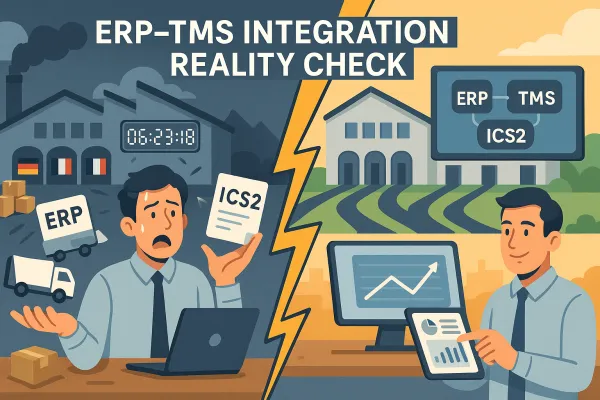
The Enterprise TMS Marketplace Integration Reality Check
Let's address the elephant in the procurement meeting: not all TMS marketplace integration is created equal. The distinction between portal access and true API integration matters more than most realize. Some vendors offer "marketplace access" through separate logins or batch rate uploads. True integration means your dispatcher sees marketplace rates alongside contracted rates in the same tendering interface.
The integration uses a direct API connection to pull real-time rates, automate booking, and sync tracking updates between Shipwell's TMS and Amazon Freight's carrier network. Once activated in the Integration Marketplace, Amazon Freight appears as a carrier option during load planning, allowing you to compare rates and book shipments without leaving the platform. This represents the technical standard you should demand from any vendor.
Compare this to the basic approach where you receive marketplace rates via email or CSV upload. The workflow difference translates to measurable time savings. One logistics director at a German automotive supplier told me they reduced tender cycle time from 72 hours to 8 hours by implementing marketplace connectivity for their spot freight - roughly 89% time reduction. The automated rate comparison alone saved 15 hours per week across their transport team.
Advanced transportation management software provider Alvys announced the launch of its integrated marketplace, which consolidates multiple load boards directly within its TMS platform, while platforms like Cargoson, nShift, Transporeon, and FreightPOP demonstrate actual API connectivity rather than marketing promises.
Why Enterprise Shippers Need Different Marketplace Features Than Brokers
Your requirements differ fundamentally from freight brokers who use marketplaces for primary capacity sourcing. Enterprise shippers need marketplace integration for capacity backup during peak seasons, spot quote validation, and carrier network expansion beyond contracted lanes.
Most European mid-market shippers work with 15-50 regular carriers across their primary lanes. Marketplace integration theoretically provides access to hundreds more. The scale difference matters: Shipwell's Amazon Freight integration provides access to 70,000+ trailers and real-time truckload rates, while Alvys Marketplace allows carriers to find and book freight from multiple load boards—representing over a trillion dollars' worth of freight—directly within their TMS.
However, enterprise requirements focus on quality over quantity. You need carrier vetting standards that match your compliance requirements, automated documentation workflows for cross-border shipments, and integration with existing contract management processes. Volume commitments and service level agreements remain with your contracted carriers - the marketplace provides tactical capacity when these arrangements fall short.
The Technical Architecture That Actually Matters
The technical architecture determines operational impact. API integration means marketplace rates appear automatically in your existing tendering screens with one-click booking that updates both systems simultaneously. The workflow difference translates to measurable time savings and reduced data entry errors.
Look for Real integration means your TMS automatically posts loads to multiple marketplaces, compares responses in standardized formats, and books selected carriers without platform switching. Total procurement time: 45 minutes for standard lanes becomes achievable only through genuine technical integration.
RESTful APIs represent the technical standard, enabling real-time rate comparison and automated booking workflows. Established enterprise vendors like Oracle, SAP TM, and MercuryGate increasingly offer marketplace connectivity, while Cargoson provides European-focused integration capabilities specifically designed for shipper workflows rather than broker operations.
Evaluating TMS Vendors for Marketplace Capabilities
Your evaluation framework should prioritize carrier network quality over size. The system is built on a multi-enterprise network that connects shippers to more than 400,000 logistics partners and carriers, but access numbers mean little without European compliance and documentation capabilities.
Key assessment criteria include:
- European carrier coverage: Does the marketplace include vetted European carriers with proper licensing and insurance documentation?
- Cross-border capabilities: Can the system handle CMR documentation, customs declarations, and country-specific requirements automatically?
- Data security compliance: GDPR compliance and data residency requirements for European operations
- Integration depth: API-first architecture vs. bolt-on portal access
Getting a TMS to talk cleanly to your ERP, your WMS, your carrier base, and your visibility tools is still harder than it should be, especially for mid-market shippers who do not have a dedicated IT team to manage EDI connections and API configurations. If onboarding takes six months and requires custom development before you can tender your first load, that is a problem.
European-Specific Marketplace Integration Requirements
Cross-border complexity demands more than basic rate comparison. Your TMS marketplace integration must handle country-specific carrier protocols, documentation requirements, and regulatory variations across EU member states.
From July 1, 2026, vans weighing 2.5-3.5 tons performing international transport of goods will be subject to the obligation to use second-generation smart tachographs (G2V2). Simultaneously, as of 1 January 2026, the transitional phase of the Carbon Border Adjustment Mechanism (CBAM) has ended and the definitive phase has begun with importers now subject to full financial obligations under the scheme.
Vendors demonstrating integrated CBAM compliance and eFTI readiness reveal their commitment to European markets. Solutions from Cargoson, SAP, and Oracle that address these requirements comprehensively indicate vendor stability during the regulatory transition ahead.
European-native solutions often provide better local carrier relationships and regulatory compliance support compared to global platforms adapted for European markets. The choice depends on organizational priorities between regional optimization and global standardization.
Implementation Strategy for Enterprise Marketplace Integration
Phased deployment minimizes operational risk while building internal confidence in marketplace connectivity. Start with non-critical lanes or spot freight before expanding to core transportation volumes.
Phase 1 focuses on establishing technical connectivity and testing rate accuracy against contracted benchmarks. Your transport team needs time to adapt workflows and build confidence in marketplace carrier selection processes.
Marketplace integration changes procurement workflows, so invest in change management alongside technical implementation. Set realistic expectations: 60% time savings occur after teams adapt to new workflows, not on day one.
Carrier onboarding processes require particular attention during European implementation. Marketplace carriers must meet your insurance requirements, provide proper licensing documentation, and demonstrate compliance with relevant transport regulations. Automated vetting workflows help scale this process without overwhelming your procurement team.
Modern mid-market TMS: 4-8 weeks - Traditional mid-market TMS: 8-16 weeks - Enterprise TMS: 6-24 months Implementation speed depends on data complexity, integrations, and customization needs. Yes. Many companies successfully switch TMS platforms. Key success factors include proper data migration planning, realistic timelines, and choosing a vendor with migration experience.
Measuring ROI and Performance from Marketplace Integration
Traditional procurement KPIs require adjustment for marketplace-connected workflows. Focus on procurement time reduction, carrier response rates, and capacity fill rates during peak demand periods rather than just cost per shipment.
The traditional European freight procurement process consuming 18-28 hours per tender can now be compressed to 45 minutes through marketplace-connected TMS automation. This represents the benchmark for time savings measurement.
Key metrics include:
- Tender cycle time: From load posting to carrier confirmation
- Carrier response rate: Percentage of marketplace tenders receiving responses
- Capacity fill rate: Success rate during peak demand periods
- Rate accuracy: Variance between quoted and invoiced amounts
The German automotive supplier case study provides a realistic ROI framework: 89% time reduction in tender cycles, 15 hours weekly savings in manual processes, and maintained service levels during capacity constraints. Your results will vary based on current process maturity and marketplace carrier quality in your operating regions.
Success requires treating marketplace integration as a strategic capacity management tool rather than a cost reduction initiative. The value lies in maintaining operational continuity when contracted capacity falls short, not necessarily in achieving lower transportation costs.
This gives you approximately 3-4 months of leverage before capacity tightens again. Act quickly to secure favorable implementation terms and ensure your marketplace integration project launches before vendor consolidation further limits your options.