The €2.5 Billion Automation Paradox: How European Shippers Can Close the TMS Automation Gap Before AI-Powered Competitors Leave Manual Operations Behind

European shippers are about to face a massive decision. Only 17% of companies report being fully automated, while over one-third still rely heavily on manual processes according to Descartes' 9th Annual Global Transportation Management Benchmark Survey of more than 600 companies. Meanwhile, their AI-powered competitors are pulling ahead at an alarming rate.
The numbers tell a stark story. 81% of shippers and logistics services providers view transportation management as a differentiator or competitive weapon - the highest percentage in nine years of tracking. Yet companies with industry-leading financial performance report 51% fully automated processes compared to just 5% among those with below-average performance. The gap isn't just operational - it's directly tied to financial success.
What makes this particularly urgent is the speed at which AI adoption is accelerating. Generative AI adoption was widespread, with 96% of respondents integrating it into operations, with the top applications being data entry (41%), route and load optimization (39%), and freight forecasting (35%).
The AI Revolution Your Competitors Are Already Using
The transformation happening in TMS technology goes far beyond simple digitization. Uber Freight launched more than 30 AI agents automating execution across the shipment lifecycle, while its generative AI tool delivers always-on recommendations to help shippers navigate disruption, reduce cost, and improve service.
Leading vendors aren't holding back on AI investments. McLeod Software is preparing to roll out its first AI-driven application, MPact.RespondAI, which reads, classifies and prioritizes communications from email inboxes and telematics systems. The application addresses a real pain point - average response time for an open-ended question to operations teams was taking over 40 minutes.
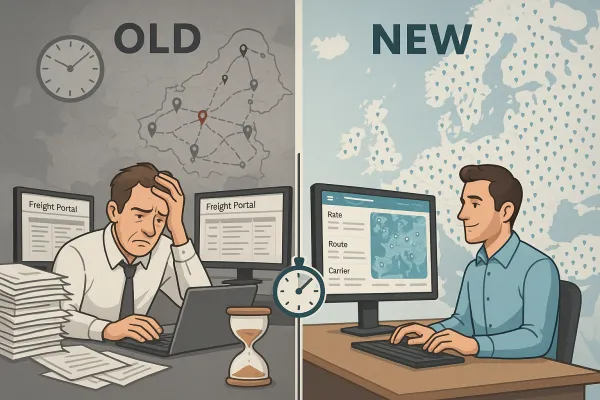
The shift extends beyond individual features to complete operational philosophy. The new generation of AI-driven TMS platforms brings machine learning, intelligent dispatching, and end-to-end process automation into daily operations. What used to require hours of manual work now happens in minutes through intelligent automation.
Consider the scope of AI integration happening right now. Uber Freight launched an AI logistics network comprising 30 autonomous agents, processing $1.6 billion in freight for clients including Colgate-Palmolive. These aren't experimental pilot programs - they're handling massive commercial volumes.
The €2.5 Billion Market Reality Check
The European TMS market tells a compelling growth story. Growing at a compound annual growth rate (CAGR) of 12.2 percent, the market value of transport management systems in Europe is forecasted to reach €2.5 billion in 2029, up from around €1.4 billion in 2024.
For context on global growth, the transportation management system market is forecasted to reach $37.04 billion by 2030, up from $18.50 billion in 2025, with a CAGR of 14.9%. This isn't just steady growth - it represents fundamental market transformation driven by digital adoption.
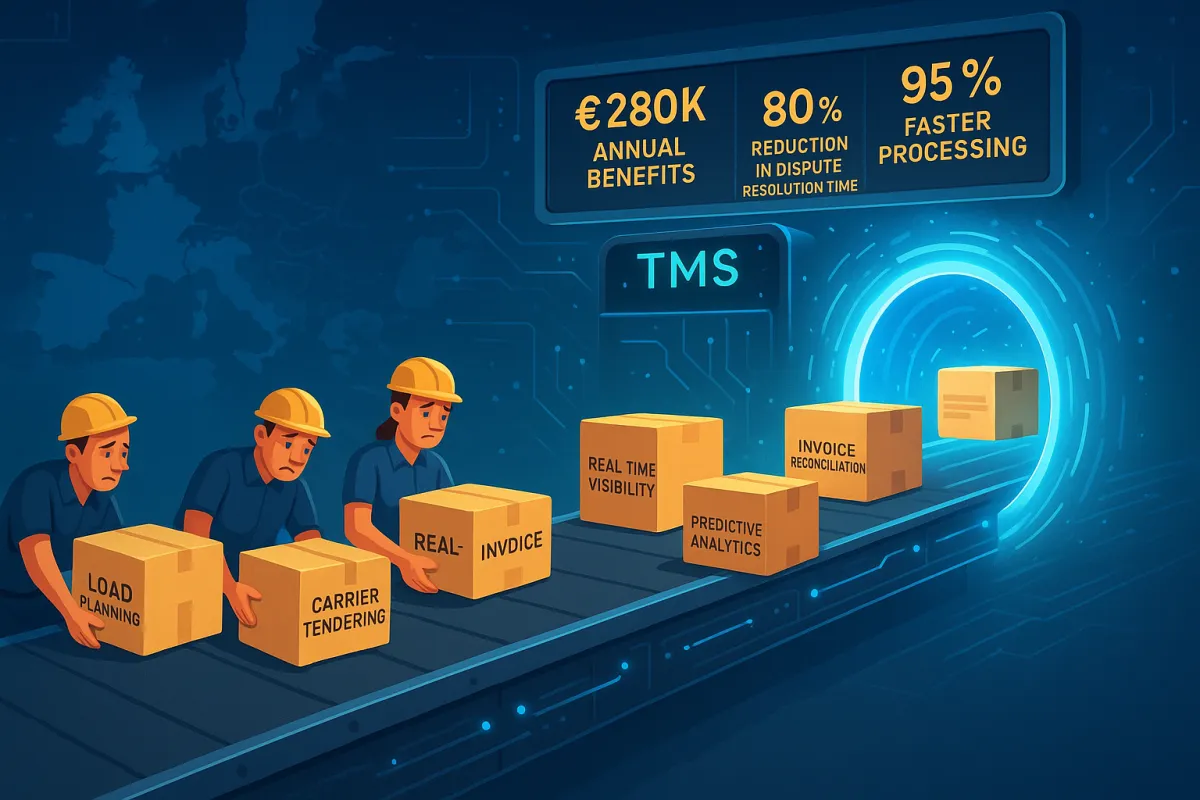
The financial implications of staying manual become clearer when you examine ROI data. A European manufacturer with €2M annual transport spend who invests €200K in a TMS implementation can expect €85K in fuel savings through route optimization, €120K in productivity gains from automated planning, €25K in dispute reduction, and €50K in additional revenue from faster deliveries - totaling €280K in annual benefits.
Five Critical Automation Areas European Shippers Must Address
Load planning represents the most immediate automation opportunity. Traditional manual planning consumes enormous resources - a typical transport tender process requires 240 hours of manual work across multiple stakeholders. AI-powered load optimization can reduce this to hours while improving consolidation rates by 15-25%.
Carrier tendering and booking automation addresses another major inefficiency. "On the data-entry side, a lot of use has been to replace manual effort for exceptions — for example, 'Where's my load?' or 'Where's my proof of delivery?' Bots can do that now" notes industry experts.
Real-time visibility and exception management benefits from AI's pattern recognition capabilities. Rather than reactive problem-solving, automated systems can predict disruptions hours before they occur. Weather delays, traffic congestion, and capacity shortages can trigger alternative routing and carrier assignments automatically.
Invoice reconciliation represents a significant cost center that AI can transform. Freight audit discrepancies that currently require manual investigation can be resolved through intelligent matching algorithms. Leading European manufacturers report 80% reduction in dispute resolution time after implementing automated audit systems.
Predictive analytics and demand forecasting complete the automation foundation. Solutions from Oracle TM, SAP TM, nShift, FreightPOP, and Cargoson now incorporate machine learning models that analyze historical patterns, seasonal variations, and market conditions to optimize capacity planning weeks in advance.
The Strategic Implementation Roadmap - From Manual to Autonomous
Successful TMS automation follows a phased approach. Phase one focuses on automating repetitive tasks like data entry and load tendering. "Artimus can take all of the information it needs about a specific load right from someone's email inbox, effectively freeing up time for employees to spend more time working directly with customers. If a load or quote request comes in from a specific customer, Artimus will process the request and build the load and quote".
Phase two introduces predictive capabilities including route optimization and capacity planning. These support specialized computing and analytics models built for specific purposes, such as developing optimization and consolidation plans, routing or ETA predictions for trucking, or cycle-time predictions for warehouses.
Phase three deploys AI agents for autonomous decision-making. Companies see "tremendous opportunity" for AI agents to improve functions such as dispatching, customer service, data entry and accounts receivable. "The opportunity for efficiency gains and for cost savings are so significant that companies who don't have an active plan to start integrating AI agents into their workflows are going to be at a competitive disadvantage".
Timeline considerations vary by organization size and complexity. Most European implementations require 6-12 months for basic automation, with advanced AI features rolling out over 12-18 months. Resource requirements include dedicated project management, integration expertise, and change management support.
Change management deserves particular attention. 76% of logistics transformations fail to achieve their performance objectives. Success depends on clear communication about AI's role in augmenting rather than replacing human expertise. Focus training on high-value activities like relationship management and strategic planning rather than data processing tasks.
Overcoming the Three Biggest Automation Barriers
Integration challenges with legacy ERP systems represent the most common implementation obstacle. Modern TMS platforms require real-time data exchange with existing financial and inventory systems. Success requires thorough API documentation, sandbox testing environments, and experienced integration partners who understand European regulatory requirements.
User resistance often stems from concerns about job security and learning new systems. Address this through transparent communication about AI's augmentation role and comprehensive training programs. It can take six months for a carrier or broker to bring a new worker on board and two or three times as long for that worker to become proficient in every activity associated with the job - automation reduces this learning curve significantly.
Budget approval requires demonstrable ROI calculations. Statistics show that most companies see ROI within 6–18 months, depending on the scale of the implementation and initial investment. Present conservative projections based on realistic benchmarks rather than maximum theoretical savings.
Cloud versus on-premise considerations affect both costs and capabilities. Cloud deployment leads with 63% revenue in 2024 and is expanding at 14.92% CAGR because it cuts capital costs and speeds implementation. European data residency requirements favor hybrid architectures that maintain sensitive data locally while leveraging cloud computing for optimization algorithms.
The 2026 Tipping Point - Why Waiting Costs More Than Acting
Market consolidation trends suggest 2026 as a critical inflection point. Companies still operating manual processes will face insurmountable competitive disadvantages as automated competitors achieve superior service levels at lower costs. Last-mile costs can reach 53% of total shipping spend, and AI-enabled optimization is cutting that burden for retailers that pivot to unified order orchestration platforms.
The competitive gap becomes more pronounced as AI systems accumulate training data. Early adopters benefit from years of machine learning optimization, creating advantages that late-moving competitors cannot quickly overcome. Pattern recognition improves exponentially with data volume - waiting means starting further behind.
Future-proofing requires immediate action on assessment and planning. Start with a clear business problem in a low-risk area (e.g., reducing phone calls to chase information). Talk to your existing vendors first. Most TMS providers already include AI capabilities that current users haven't fully activated.
The message is clear: European shippers cannot afford to wait while competitors gain insurmountable advantages through AI-powered automation. The €2.5 billion market growth represents opportunity for those who act and obsolescence for those who don't. Your transport operations will either become a competitive weapon through intelligent automation or a liability through continued manual processes. The choice is immediate, and the window for catching up is rapidly closing.