The €200M Automation Paradox: Why 83% of European Shippers Are Stuck in Manual Mode While AI-Powered Competitors Race Ahead


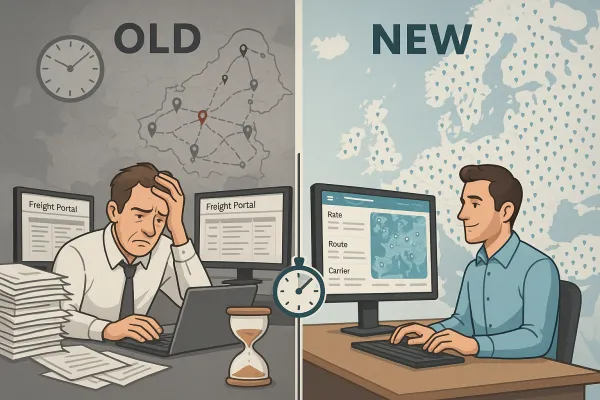
Your monthly transport coordinator spends 15 hours per week manually cross-referencing carrier rates, tracking shipments in spreadsheets, and chasing delivery confirmations. With a fully-loaded cost of €75,000 annually, that's €22,000 in opportunity cost while competitors with automated systems process the same workload in 3 hours.
Fresh research reveals the true scope of Europe's transport automation crisis. More than a third of companies remain heavily or mostly reliant on manual processes, while 96% of respondents stated they are currently using generative AI in their operations. This creates a paradox: The digital gap in automation is especially pronounced when comparing companies by financial performance.
The Financial Performance Divide That Nobody Talks About
The numbers don't lie about who's winning. Among top-performing companies, 51% achieve full automation in their transportation operations, while only 5% of poor performers reach this level. Companies with higher digital maturity and automation in transportation management are better placed for growth and improved competitiveness.
Notice the pattern? Manual processes aren't just slower, they're actively preventing companies from scaling. A German automotive parts manufacturer I consulted with discovered their procurement teams were spending 40% of their time on data reconciliation instead of strategic carrier negotiations. After TMS automation, they redirected that capacity toward identifying €2.3M in annual savings through better contract structures.
80% of respondents plan to boost their TMS IT spending, concentrating on areas such as performance management, visibility, and fleet routing. The companies planning these investments? They're the same ones showing consistent revenue growth and operational resilience.
The Real Cost of Manual Operations in 2025's Market
Your transport coordinator earning €75,000 annually represents just the visible cost. Hidden expenses compound: late delivery penalties (averaging €1,200 per incident for manufacturers), carrier disputes requiring legal intervention, and missed optimization opportunities.
More than 76% of businesses have seen supply chain disruption causing delays, with one-fifth counting more than 20 disruptive incidents over 12 months. Manual systems fail spectacularly during disruptions. While automated platforms reroute around blocked lanes within minutes, manual operations require hours of phone calls and email coordination.
Companies that implement a TMS can achieve freight cost savings of 8-10% on average. For a company spending €10M annually on transport, that's €800,000-€1M in direct savings, not counting productivity gains.
But here's what most CFOs miss: The European TMS market reached €1.4 billion in 2024 and is growing at 12.2% annually. This growth directly correlates with companies recognizing that transport automation isn't a cost center anymore - it's a profit generator.
The AI Revolution Already Reshaping European Transport
Adoption of generative AI in transportation management is accelerating, with 96% of respondents using generative AI in their operations. The applications span far beyond basic automation:
Data entry and document processing leads at 41%, followed by route optimization at 39%, and freight forecasting at 35%. A Deloitte study found 75% of companies have at least one broad or limited implementation of generative AI in their supply chain functions.
AI empowers transportation leaders with valuable, bespoke, and real-time data through predictive analytics for demand forecasting and route optimization based on historical performance. Modern platforms like Cargoson, alongside Blue Yonder, MercuryGate, and Descartes, each implement AI differently - some focusing on predictive maintenance, others on dynamic pricing optimization.
The competitive advantage becomes clear when you consider conversational AI interfaces. A customer can ask questions such as "What is my monthly spot versus contract utilization?" and receive quick answers. Compare this to manually pulling data from three different systems and building reports in Excel.
Why Investment Timing Favors Early Adopters Now
The Transport Management System market is projected to grow from USD 26,732 million in 2024 to USD 68,588.55 million by 2032, at a CAGR of 12.5%. Europe holds 28% of the global TMS market, with sustainability emphasis in Germany, France, and the UK accelerating adoption.
Market conditions favor shippers right now. Carrier capacity remains tight, but TMS platforms provide leverage through automated tendering and rate optimization. "72% of respondents expect at least 5% annual revenue growth within the next two years," according to Descartes' survey, indicating continued optimism despite operational challenges.
The regulatory environment adds urgency. EU ETS shipping coverage jumped to 70% of emissions in 2025, from 40% in 2024. eFTI compliance requires electronic freight documentation by 2026. Companies waiting until regulations force their hand will pay premium implementation costs during the rush.
Cloud-native solutions like Cargoson typically deploy in 6-12 weeks versus 6-12 months for enterprise platforms like SAP TM or Oracle Transportation Management. Early adopters secure their competitive position before capacity constraints drive up implementation costs.
From Manual to AI-Powered: The European Implementation Roadmap
Start with pilot lanes representing 20% of your transport volume. Focus on routes with consistent volumes and established carrier relationships. This approach minimizes risk while demonstrating measurable benefits to stakeholders.
Choose your automation level strategically. Only 17% of companies achieve full automation, but that doesn't mean starting there. Begin with automated rate comparisons and shipment tracking, then progress to dynamic routing and carrier selection algorithms.
Platform selection matters more than features lists. European-focused solutions like Alpega and nShift understand regional carrier integration requirements. Global platforms like Blue Yonder and MercuryGate offer advanced AI but may require more customization for European operations.
Integration planning determines success speed. Vendors usually offer a wide collection of possible integrations to connect to your WMS or ERP. Map your current data flows before vendor selection to avoid the €800,000 mistake that German manufacturer made when they discovered integration gaps six months into implementation.
Set realistic automation benchmarks. Aim for 70% process automation within 12 months, 85% within 18 months. Companies pushing too fast often create data quality issues that undermine confidence in the system.
The 2025 Competitive Reality: Automate or Fall Behind
Companies with higher digital maturity are better positioned for growth, while a substantial proportion still face challenges moving away from manual processes, impacting their ability to respond to changing market dynamics.
The automation gap isn't just about efficiency anymore. It's about market positioning. Among the small proportion not using generative AI (4%), there was a higher likelihood of viewing transportation management as a necessary evil and expecting limited growth.
European manufacturers competing globally need transport automation to match their production sophistication. Your factory runs on automated systems optimizing every process, but your transport operation still relies on spreadsheets and phone calls? That disconnect becomes a strategic vulnerability.
Mike Hane from Descartes notes the sector is "making meaningful progress elevating transportation from a cost center to a strategic driver of customer value and business growth, backed by greater investment in TMS technology".
The companies thriving in 2026 will be those that treated transport automation as infrastructure investment in 2025. Manual processes aren't just slower - they're becoming competitively obsolete. Your choice isn't whether to automate, but whether to lead the transition or scramble to catch up when market pressure forces your hand.