The €50,000 ERP-TMS Integration Reality Check: How European Manufacturers Can Build Cost-Effective ICS2 Compliance Frameworks Without Joining the 66% Project Failure Rate

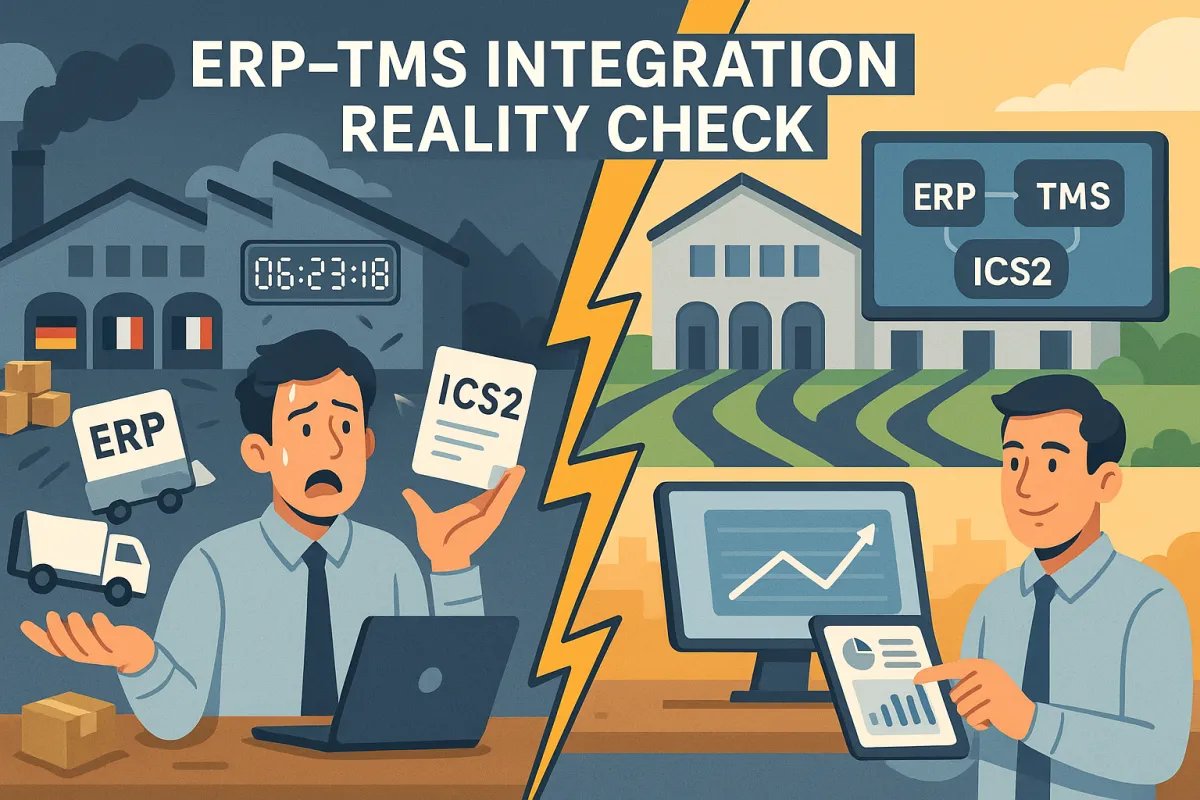
European manufacturers are staring at their Q1 2026 budgets, watching ERP-TMS integration line items spiral beyond recognition. ICS2 becomes mandatory from 1 January 2026, while basic API integrations cost €5,000-€15,000, while complex ERP connections exceed €50,000. But here's the uncomfortable truth your IT director isn't telling you: budget overruns hit 75% of European TMS implementations, and 66% of technology projects end in partial or total failure.
A German automotive parts manufacturer discovered their €800,000 TMS implementation mistake the hard way. Six months into deployment, they realized their new system couldn't handle their complex carrier network across 12 European countries. Sound familiar? You're racing to meet ICS2 compliance while vendor consolidation eliminates your procurement options and integration costs multiply faster than your CFO's patience.
This guide breaks down the real-world costs behind European ERP-TMS integration strategies, provides a bulletproof implementation framework that accounts for ICS2 compliance requirements, and reveals how to avoid joining the disaster statistics crushing manufacturers across Europe right now.
Why ICS2 Makes ERP-TMS Integration Mandatory, Not Optional
Economic Operators need to submit a complete Entry Summary Declaration (ENS) in the ICS2 system for all goods transported to or through the EU prior to their arrival. But here's what most manufacturers miss: as of January 2026, ICS2 is the default and expected filing system for road and rail transport into or through the EU.
Your standardized commercial invoices and product management tools must now centralize ICS2-required data elements including detailed description of goods per commodity, the respective six-digit Harmonized System (HS) code, and the EORI Number for consignees. This data lives in your ERP system, but ICS2 submissions happen through your transportation management platform.
The penalty structure makes compliance non-negotiable. Carriers and importers must integrate ERP and TMS systems with the ICS2 platform, with failure to report potentially resulting in a fine of up to 5,000 euros. With multiple daily shipments, non-compliance costs add up faster than implementation expenses.
The regulatory timeline gets tighter each month. Start of application of the new version (v3) of ICS2 messages on 3 February 2026, and decommissioning of older version (v2) means your integration must handle messaging format updates automatically - not through manual system adjustments.
The Real Cost Anatomy: Beyond the €50,000+ ERP Integration Price Tag
Let's dissect the numbers European procurement teams consistently underestimate. A basic domestic shipper requires 10-15 integrations minimum, potentially totaling 1,000-1,500 hours of labor. For shippers with freight spend exceeding $250M annually, implementation can cost 2-3 times the subscription fee.
The budget planning reality check: Plan for 15-20% budget increases in 2026-2027 if reactive, or 8-12% if proactive with proper contract protection. That German manufacturer's disaster wasn't an outlier - it's the predictable outcome when you evaluate complex integration requirements using simple software selection criteria.
Hidden costs multiply through regulatory requirements. These regulatory requirements multiply TMS implementation costs through mandatory integrations with government systems, telematics providers, and customs platforms. Your base integration estimate needs separate line items for ICS2 connectivity, eFTI compliance capabilities, and Smart Tachograph data processing.
Major vendors like Oracle TM and SAP TM price complex ERP connections based on data volume and customization requirements, while European specialists including nShift, Transporeon, Alpega, and Cargoson often provide more transparent pricing models built specifically for cross-border European operations.
The Integration Architecture Decision: Hub-and-Spoke vs Point-to-Point
Hub-and-spoke versus point-to-point integration strategies create fundamentally different operational outcomes. Hub-and-spoke architectures centralize data transformation and business logic, simplifying compliance management and reducing maintenance overhead. Point-to-point connections offer lower initial costs but create complex webs of dependencies that become expensive to maintain and modify.
The architectural decision affects your total cost of ownership for years. API-first integration strategies provide superior flexibility for European operations. Modern TMS platforms from providers like nShift, Transporeon, Alpega, and Cargoson prioritize RESTful APIs with standardized data formats.
Single-vendor solutions offer distinct advantages for European operations. Alvys TMS has its own native EDI engine for seamlessly integrated communication, with no need for third party EDI, costly custom integrations, or per-transaction charges. This reduces total cost of ownership and integration complexity.
Your integration strategy must account for European carrier diversity. When your TMS can't handle carrier connectivity protocols that vary dramatically by country – French carriers might use different API standards than German logistics providers, while Scandinavian forwarders often require specialized integration approaches – you're looking at costly custom development work that wasn't in your original budget.
ICS2 Data Quality Requirements and ERP Synchronization
ICS2 data standardization demands precise synchronization between your ERP master data and TMS operational systems. Customers are strongly encouraged to begin providing six-digit HS codes for their shipments as soon as possible to facilitate data reporting already required under ICS2. Six-digit Harmonized System (HS) codes along with net weight of each where there is more than a single HS code involved must flow automatically from product management to shipment documentation.
EORI number validation creates another integration requirement. An Economic Operator Registration and Identification (EORI) number is mandatory to connect to ICS2. Without an EORI, you cannot submit ENS data. Your ERP-TMS integration must validate EORI numbers in real-time and flag missing or incorrect registrations before shipment processing.
Data quality issues between your TMS and existing systems can undermine the entire process. Test integrations thoroughly with actual historical data before full deployment. Use your 2025 shipment data to validate integration accuracy before ICS2 enforcement intensifies.
The July 2027 deadline adds another complexity layer. QR code generation and machine-readable format requirements become mandatory by July 2027. Your TMS must generate these automatically for every shipment across all transport modes. Plan your integration architecture to handle these automated document generation requirements.
Risk Mitigation: Learning from the €800,000 Implementation Disasters
What made that German automotive manufacturer's failure predictable? They evaluated their TMS like a standalone software purchase instead of a strategic transformation that affects every carrier relationship, integration requirement, and operational workflow across their European network.
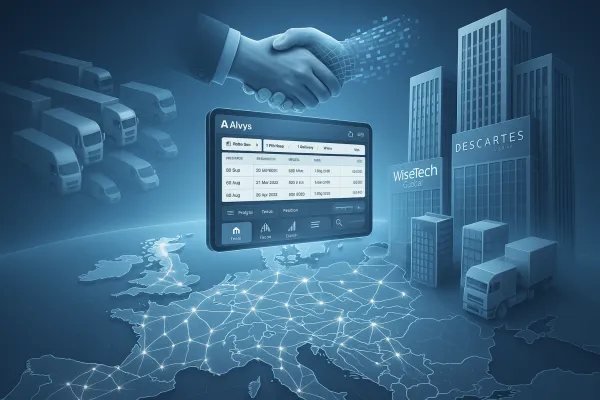
The vendor consolidation wave amplifies implementation risks. WiseTech Global's $2.1 billion acquisition of E2open, expected to complete in 1H26, alongside Descartes Systems Group's $115 million acquisition of 3GTMS in March 2025, represents the most significant TMS vendor consolidation wave in over a decade.
Companies undergoing integration often experience 12-18 months of reduced innovation while they harmonize platforms and teams. When vendor acquisitions happen mid-implementation, your project timeline extends while support resources get redistributed.
The vendor evaluation criteria must account for European regulatory expertise. Platforms like Cargoson, Manhattan Active, MercuryGate, and Descartes each bring different approaches to ICS2 compliance, but European-native solutions often provide better understanding of cross-border complexity and multi-country regulatory variations.
Build phased implementation strategies that validate core functionality before adding complex integrations. Start with core functionality in Q2-Q3 2025, activate AI features in Q4 2025, and ensure eFTI compliance by Q1 2026.
Implementation Framework and ROI Measurement
Performance monitoring must track both technical metrics and business outcomes. Monitor API response times, data synchronization success rates, and error frequencies alongside operational measures like carrier onboarding speed, compliance reporting accuracy, and cost savings achievement.
European operations typically achieve measurable efficiency gains once integrations stabilize. European operations often see 15-25% improvements in transport administrative efficiency within the first year of successful TMS data integration. These improvements come from reduced manual data entry, automated compliance reporting, and enhanced visibility across transport networks.
Use the January 2026 eFTI voluntary period strategically. Member States authorities may start accepting data stored on certified eFTI platforms for inspection from January 2026. Use this voluntary period for real-world testing and staff training.
ROI measurement frameworks must extend beyond simple cost calculations. Track operational improvements like reduced manual data entry, faster carrier onboarding, improved compliance reporting accuracy, and enhanced visibility across your transport network.
Regular audit cycles become mandatory as European transport regulations continue evolving rapidly. Your implementation framework must account for ongoing regulatory changes, not just current compliance requirements. The telematics data explosion - The Europe Telematics Market size is estimated at 24.49 million units in 2025, and is expected to reach 49.77 million units by 2030 - requires platforms designed for automated processing rather than manual analysis.
Your ERP-TMS integration strategy determines whether you capture competitive advantage from regulatory complexity or get crushed by implementation costs. The €50,000+ budget overruns hitting most European manufacturers aren't inevitable - they're the predictable result of treating complex cross-border integration requirements like simple software purchases. Build your implementation framework around ICS2 compliance requirements, vendor consolidation realities, and measurable ROI criteria that account for the operational transformation actually happening in your transport operations.