The European Shipper's 2025 TMS Procurement Shift: How to Evaluate Vendors for Capacity Crisis Management When Freight Demand Outpaces Available Carriers

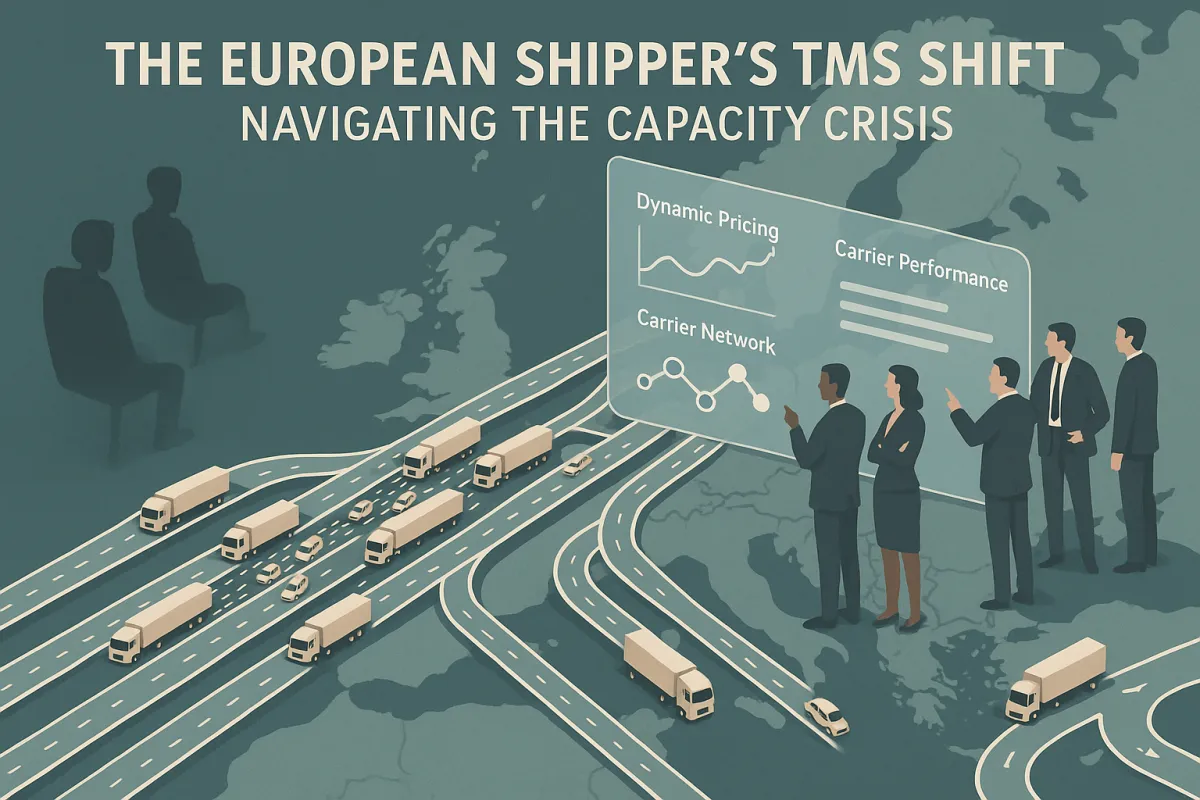
January 2025 saw a spike in freight offers on the Trans.eu platform, with volume increasing on 14 of 16 key lanes. On some routes, the month-over-month growth exceeded 100%. But here's what caught many European procurement teams off-guard: carrier activity moved in the opposite direction – dropping both month-over-month and year-over-year. Many carriers are scaling down operations, exiting less profitable routes, or suspending business entirely.
This isn't just another freight market cycle. According to IRU's 2024 driver shortage survey, there are 426,000 unfilled truck driver positions across Europe. Driver shortages persist, with 426,000 unfilled positions in 2024, and carriers can't expand capacity fast enough to meet demand. The result? Your traditional TMS procurement criteria now miss the most important factor: can this system help secure capacity when most of the market can't deliver?
Most European TMS procurement still follows the same playbook from 2019. Rate optimization features, carrier connectivity counts, and basic automation capabilities dominate evaluation frameworks. Yet when European TMS procurement requires a fundamentally different approach in 2025. The traditional RFP process that worked when the market had dozens of independent vendors no longer adequately addresses consolidation risks, vendor viability concerns, or European-specific regulatory requirements.
The vendor landscape itself changed dramatically. WiseTech Global's $2.1 billion acquisition of E2open has sent shockwaves through the European transportation management systems market, marking the most significant consolidation move in recent TMS history. Descartes Systems Group bought 3GTMS for USD 115 million in March 2025 and Sellercloud in October 2024, adding domestic planning and omnichannel order-management modules that round out end-to-end visibility. This consolidation means fewer independent options and more pressure to evaluate vendors on capacity management rather than just feature breadth.
Critical TMS Capacity Management Features for 2025's Market
Your TMS evaluation framework needs new priorities. Start with real-time carrier network monitoring and availability tracking. When 426,000 driver positions remain vacant, you need systems that track which carriers actually have capacity, not just which ones offer competitive rates. Ask vendors how their platform identifies when a carrier stops accepting loads on specific lanes before your shipments get rejected.
Multi-carrier integration capabilities become your insurance policy. Instead of managing relationships with 12-15 core carriers manually, modern platforms should automatically onboard backup carriers when primary relationships hit capacity constraints. Look for systems that maintain pre-qualified carrier pools segmented by lane, equipment type, and service requirements.
Dynamic pricing and capacity allocation tools matter more than static rate optimization. Spot rates have increased year-over-year – by double digits on some lanes – but still don't keep pace with the operational cost surge. On many key routes, rate increases remained under 8%. On one lane (Italy–Poland), it was just 5%. Your TMS needs algorithms that balance cost with capacity availability in real-time, not just select the cheapest option that might not have trucks available.
Carrier performance scoring must evolve beyond cost metrics. Traditional scorecards focus on on-time delivery and damage rates. Now you need metrics for capacity acceptance rates, advance booking requirements, and reliability during peak seasons. When carriers become more selective about which loads they accept, you need data on which carriers consistently deliver capacity when promised.
Predictive capacity shortage alerts prevent crisis management. Advanced platforms analyze historical patterns, seasonal variations, and market conditions to identify potential capacity shortages 2-4 weeks ahead. This gives procurement teams time to secure alternative carriers before shipments are at risk.
Integration with freight exchanges and spot market platforms provides overflow capacity. Platforms like Cargoson, Blue Yonder, and Manhattan Active now offer direct connections to Trans.eu, Timocom, and other European freight exchanges. When contract carriers reach capacity, your TMS should automatically query spot markets for available alternatives.
Advanced Carrier Relationship Management in Modern TMS
Automated carrier onboarding becomes a competitive advantage when you need to expand your network quickly. Traditional manual onboarding processes take 4-8 weeks to verify insurance, complete documentation, and establish EDI connections. Modern systems compress this to 5-10 business days through automated document verification, API-based insurance validation, and digital contract execution.
Contract versus spot rate optimization takes on new complexity during capacity crunches. Your TMS should dynamically balance contracted volumes with spot market opportunities based on real-time capacity availability. When contract carriers can't deliver, the system needs immediate access to spot rates without manual intervention.
Carrier diversification scoring helps quantify risk concentration. Calculate what percentage of your volume flows through your top 5 carriers versus your total network. Platforms should flag when lane concentration creates capacity vulnerability and recommend diversification strategies before problems occur.
Vendor Evaluation Framework for Capacity-Constrained Markets
Start with financial stability assessment. Look beyond current revenue figures to understand how recent acquisitions impact the vendor's cash flow, development priorities, and customer service capacity. Companies undergoing integration often experience 12-18 months of reduced innovation while they harmonize platforms and teams.
European market-specific capabilities require deeper evaluation. Generic TMS platforms designed for North American markets often struggle with European carrier fragmentation, cross-border documentation, and multi-lingual requirements. Evaluate European market commitment specifically. Geopolitical changes (Brexit), the scarcity of drivers and the need to retain logistics talent are some of the challenges faced by supply chain leaders in the European region.
Scalability for rapid carrier network expansion becomes essential. When market conditions force you to double your carrier base within 6 months, can your TMS handle the load? Evaluate vendor performance with similar rapid scaling scenarios. Ask for reference customers who've added 50+ new carriers during capacity crunches.
Integration capabilities with existing ERP and carrier systems need stress testing. API-first architecture requirements protect against platform changes by ensuring your integrations don't depend on proprietary connections that may be deprecated during vendor consolidations. Specify open API standards and require documentation that enables third-party integration development.
When comparing vendors, position established players like Oracle TMS, SAP TM, and Manhattan alongside emerging European-focused solutions like Cargoson, Descartes, and newly merged entities like E2open/CargoWise. Position established vendors (Manhattan, SAP) alongside emerging European solutions (Cargoson, nShift) in your evaluation. Each category offers different trade-offs between feature breadth and European market specialization.
Due Diligence Questions That Matter in 2025
Ask specific questions about carrier network size and quality in your regions. Don't just count total carrier connections; understand how many actively accept loads on your primary lanes. Request data on carrier response rates, capacity acceptance rates, and average booking lead times by geographic corridor.
Capacity shortage response mechanisms reveal platform sophistication. How quickly can the system identify capacity shortages? What automated responses trigger when primary carriers decline loads? Can the platform maintain service levels during carrier network disruptions?
Average carrier onboarding timelines during crisis periods differ significantly from standard onboarding. When you need new capacity urgently, can vendors compress their typical 4-week onboarding to 5-7 business days? What documentation and verification steps can be streamlined without compromising compliance?
Real customer case studies of capacity crisis management provide the clearest evaluation criteria. Insist on customer references in similar industries with comparable shipment volumes and carrier complexity. Verify claimed automation rates, implementation timelines, and ongoing support satisfaction through direct customer conversations. Ask how those customers maintained service levels during the 2023 trucking capacity shortage or recent peak season challenges.
Implementation Strategy for Capacity-Focused TMS Deployment
Phased rollout prioritizing high-risk lanes first allows you to test capacity management capabilities where they matter most. Identify your top 5 lanes by volume and carrier dependency. Deploy TMS capacity monitoring features on these routes before expanding to your full network. This approach validates the platform's performance under actual capacity pressure.
Change management for procurement teams requires mindset shifts from pure cost optimization to cost-capacity balance. Train your team to evaluate total cost of shipping delays, not just freight rates. Benchmark targets include 50-70% automation rates for high-volume operations and sub-hour reporting latency for critical shipments. Modern platforms can reduce procurement cycle times by 60% while delivering measurable cost savings.
Integration timeline with existing transport operations needs careful coordination. TMS implementation costs range from €30,000 to €900,000, depending on complexity and vendor approach. But here's what catches European shippers off-guard: recurring costs spread over 10+ years typically link directly to shipment volumes, while one-time implementation expenses hit immediately. Plan for capacity management features to become operational within 90 days, not at the end of a full implementation.
Training teams on capacity optimization versus pure cost optimization requires new KPIs. Measure capacity secured as a percentage of requested volumes, not just cost per kilometer. Track carrier diversification improvements and capacity shortage resolution times alongside traditional cost metrics.
Measuring ROI beyond transport cost savings captures the full value of capacity management. Calculate the cost of delayed shipments, emergency freight purchases, and customer service disruptions when capacity isn't available. ARC's survey-based research found that respondents indicated freight savings of approximately 8 percent with the use of a TMS application. Of these savings, nearly 60 percent of users indicated that less than 10 percent of the net savings were absorbed by the TMS. These freight savings can be attributed to network design, load consolidation, multi-stop route optimization improved data for procurement, and freight audit.
Building Resilient Carrier Networks Through TMS Technology
Supplier diversification strategies enabled by modern TMS go beyond adding more carriers. Focus on geographic distribution, equipment type coverage, and service level variety. Use your TMS to identify gaps where single carriers handle disproportionate volumes on critical lanes.
Balancing contract carriers with spot market access requires sophisticated algorithms. AI-driven procurement capabilities are emerging across major platforms. These features analyze historical performance, predict market trends, and recommend optimal tender timing. Early adopters report 10-15% additional savings beyond basic automation benefits. Contract with 70-80% of your capacity needs through traditional agreements, but maintain automated access to spot markets for the remaining 20-30%.
Geographic risk distribution and backup capacity planning prevent single-point failures. When your primary carrier on the Germany-Italy corridor suddenly exits the market, your TMS should immediately identify alternative carriers already onboarded and pre-qualified for that route. Build redundancy into your most critical lanes before you need it.
Future-Proofing Your TMS Investment Against Market Volatility
Vendor consolidation trends continue reshaping the competitive landscape. Körber Supply Chain Software acquired MercuryGate International Inc., a Transportation Management System provider, to expand its supply chain execution portfolio, creating what is now known as Infios. This wasn't just a typical software acquisition; it represented a strategic move to integrate OMS, WMS, and TMS functionalities into a comprehensive supply chain platform. Choose vendors with clear post-acquisition integration roadmaps and stable development resources.
Regulatory compliance requirements like eFTI (Electronic Freight Transport Information) and EU ETS (Emissions Trading System) add complexity to vendor selection. European transport regulations evolve rapidly, and your TMS needs native compliance support rather than bolt-on modules that lag regulatory changes.
AI and automation capabilities for capacity prediction will become table stakes. Synergistic technologies like predictive analytics, automation, real-time tracking, machine learning, AI, and blockchain will continue to evolve for greater flexibility, improved customer support, and enhanced forecasting capabilities. A growing list of cloud-based software vendors is offering Artificial Intelligence (AI) and advanced analytics capabilities. These solutions can reliably interpret data from many complex indicators and execute more insightful and connected strategies.
Sustainability considerations increasingly influence carrier selection criteria. European regulations around emissions reporting and carbon footprints require more sophisticated evaluation methods. Platforms like Cargoson and established providers are adding carbon calculation and reporting capabilities. Your TMS should support modal shift decisions and carbon footprint optimization alongside capacity management.
Exit strategy and data portability considerations protect against vendor lock-in during market consolidation. Multi-vendor strategies can provide insurance against individual vendor risks, though they require more complex integration management. Consider core TMS functionality from your primary vendor with specialized modules (carbon tracking, customs management, carrier connectivity) from best-of-breed providers that integrate via APIs. Ensure your contract includes data export rights and API access for migration scenarios.
The capacity crisis reshaping European freight markets in 2025 demands fundamental changes to TMS procurement strategy. The European TMS vendor consolidation of 2025 represents both challenge and opportunity. Companies that understand the new landscape, evaluate vendors based on post-consolidation criteria, and implement with appropriate risk mitigation will emerge with competitive advantages. Choose carefully, but don't delay. The vendor landscape will look dramatically different by 2026.
Your TMS selection in 2025 isn't just about managing transport operations – you're building the foundation for securing capacity in an increasingly constrained market. Procurement teams that adapt their evaluation criteria to prioritize capacity management capabilities will maintain service levels while competitors struggle to secure trucks. The question isn't whether you can afford to upgrade your TMS; you can't afford to maintain manual, reactive processes when capacity becomes the constraining factor in European logistics.