The European Shipper's Acquisition-Resistant TMS Procurement Strategy: How to Navigate 2026's Vendor Consolidation Wave While Meeting Compliance Deadlines Before Integration Risks Eliminate Your Options

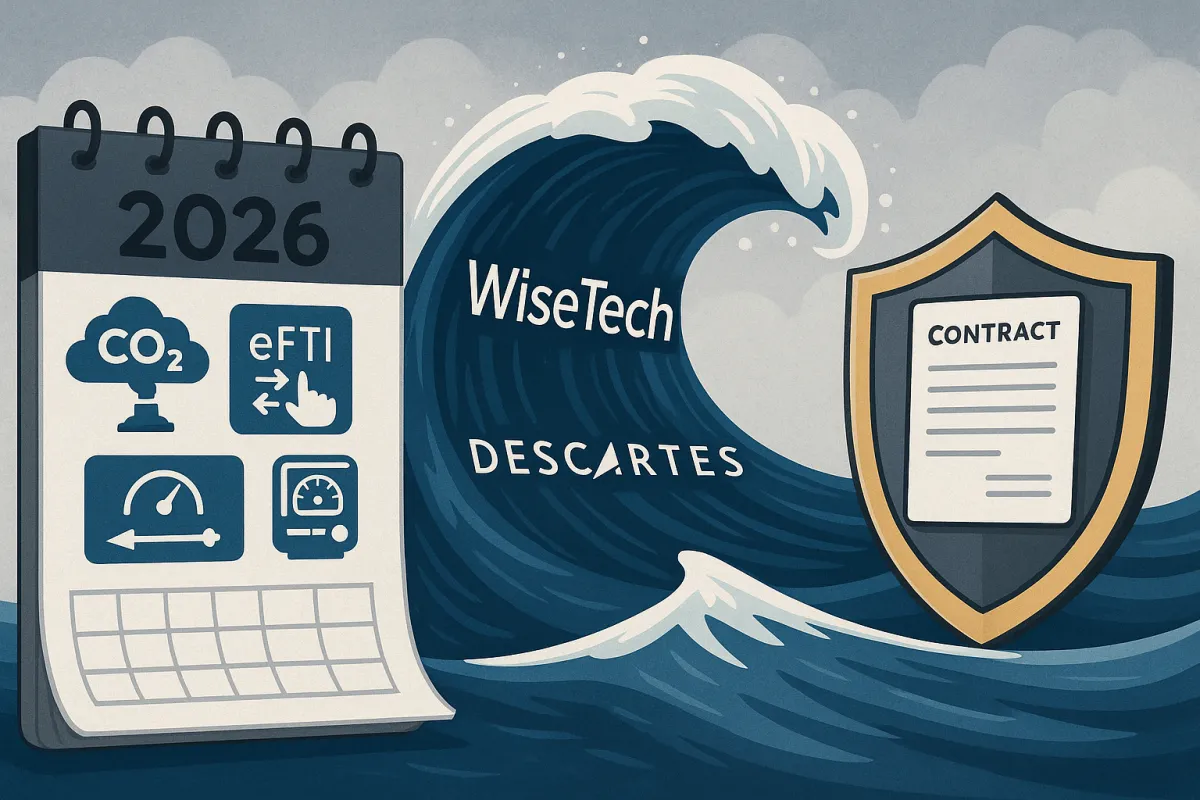
European shippers find themselves navigating a particularly volatile moment in transportation management system procurement. As of January 2026, eFTI platforms and service providers can start preparing for operations while Member States authorities may start accepting data stored on certified eFTI platforms for inspection, creating urgent compliance deadlines that coincide with unprecedented vendor consolidation activity transforming the TMS landscape.
The 2026 Perfect Storm: When Regulatory Deadlines Meet Vendor Consolidation
The confluence of regulatory changes and market consolidation in 2026 represents a fundamental shift that requires strategic response from European transport departments. WiseTech's acquisition of e2open for $3.30 per share in cash equating to an enterprise value of $2.1 billion marks the largest TMS industry acquisition to date, while Descartes Systems Group has acquired Columbus, Ohio-based 3Gtms for $115 million USD in cash, reshaping vendor options for European buyers.
These acquisition waves occur precisely as European transport faces multiple 2026 regulatory milestones. From July 1, 2026, vans weighing 2.5-3.5 tons performing international transport of goods will be subject to the obligation to use second-generation smart tachographs (G2V2). Simultaneously, as of 1 January 2026, the transitional phase of the Carbon Border Adjustment Mechanism (CBAM) has ended and the definitive phase has begun with importers now subject to full financial obligations under the scheme.
European shippers evaluating TMS options face reduced vendor choice at the precise moment when compliance requirements demand sophisticated platform capabilities. Europe transportation management system market generated revenue of USD 4 billion in 2025, with Europe leading in sustainability-driven TMS adoption due to strict emissions regulations, carbon reporting mandates, and low-emission zone compliance.
The Hidden Costs of Vendor Acquisition Integration Failures
Technology project failure rates create substantial risk when vendor acquisitions disrupt established TMS implementations. Implementation complexity scales exponentially with platform size, with Cloud TMS implementations often concluding within eight weeks, compared to 6-18 months for traditional systems. Acquisition-driven changes typically extend these timelines and increase complexity significantly.
The financial impact of integration disruptions often exceeds initial procurement budgets. Licensed TMS software runs $50,000-$400,000+ with annual maintenance charges ranging from 15-20% of license costs, with a 100-truck operation's initial $100,000 investment becoming $200,000+ in the first year when factoring in implementation, training, and infrastructure requirements. Vendor acquisitions compound these costs through forced migrations, system re-integrations, and compliance timeline pressures.
European manufacturers face particular challenges when acquisitions shift vendor focus away from regional requirements. The deal marks WiseTech's expansion beyond their traditional 3PL and freight forwarder customer base into the broader shipper brand owner and producer shipper market that e2open serves, while WiseTech has focused on logistics service providers. This geographic and market focus shift creates uncertainty about European feature development priorities and local market support commitments.
Building Acquisition-Resistant Contract Frameworks
Standard TMS procurement contracts don't address vendor acquisition scenarios, leaving European shippers vulnerable to post-acquisition changes without recourse. Acquisition-resistant contracts require specific protections including 12-18 months advance notice for ownership changes, guaranteed functionality preservation for minimum periods, and migration assistance rights.
Price protection mechanisms become essential when vendor acquisitions typically result in pricing model changes. Contract language should specify that pricing structures, discount schedules, and support level commitments remain unchanged through ownership transitions, with automatic renewal options at existing terms if vendors cannot meet transition commitments.
Feature deprecation rights protect against post-acquisition platform consolidation that eliminates capabilities European operations require. Include contractual guarantees for feature availability, performance benchmarks, and alternative solution provision if acquired vendors discontinue functionality critical to European regulatory compliance or operational requirements.
The 2026 Regulatory Compliance Readiness Matrix
As of January 2026, eFTI platforms and service providers can start preparing for operations while Member States authorities may start accepting data stored on certified eFTI platforms for inspection, creating the first practical deadline for TMS platforms to demonstrate compliance capabilities. By July 2027, all Member States will be required to accept electronic transport data via eFTI-certified platforms, making 2026 the critical preparation year.
Beyond eFTI implementation, 2026 introduces multiple overlapping regulatory requirements that TMS platforms must support simultaneously. In 2026, the AES/ECS2 PLUS system has become operational across the EU, replacing existing simplified export procedures with export declarations that must now be submitted exclusively in electronic form. European operations require TMS platforms capable of managing these parallel compliance streams without manual intervention.
Smart tachograph obligations create additional integration requirements for TMS platforms. The purchase and installation of a tachograph costs about 1,000 euros without installation, while companies need to issue driver cards and company cards, train staff, and update internal procedures and data reading software. TMS platforms must integrate with these systems for automated compliance monitoring and reporting.
Platform Evaluation Criteria for Multi-Regulation Support
European TMS platforms require broader regulatory support beyond basic eFTI integration. From January 2026, methane (CH₄) and nitrous oxide (N₂O) emissions from maritime transport will also fall under the EU ETS, with EU ETS revenues remaining a major source of funding for Europe's clean transition. Transport management systems must track and report these expanded emissions categories for compliance and carbon cost management.
Customs integration capabilities become mandatory rather than optional features as regulatory requirements expand. Carriers and importers must integrate ERP and TMS systems with the ICS2 platform, with failure to report potentially resulting in a fine of up to 5,000 euros, especially with a large volume of shipments.
Technical requirements for certified platform integration include unique access links, machine-readable QR codes, and real-time data sharing capabilities that many legacy TMS platforms cannot support without significant development investment. European shippers should evaluate vendor roadmaps for these capabilities alongside their acquisition-resistance and market stability.
Strategic Vendor Due Diligence in a Consolidating Market
Vendor stability assessment requires as much rigor as functional evaluation when additional acquisitions are likely as private equity firms and strategic acquirers seek to capture market share in the growing European TMS market, requiring procurement strategies that account for ongoing vendor landscape changes.
Financial health indicators become critical evaluation criteria in a consolidating market. While WiseTech has demonstrated consistent profitability and growth, e2open has struggled with financial performance in recent years, reporting declining revenue and net losses in recent fiscal years. European buyers should evaluate vendor acquisition likelihood based on financial performance, market position, and strategic value to potential acquirers.
Geographic focus assessment helps predict post-acquisition prioritization. WiseTech, founded in 1994 by Richard White, has built an empire serving the freight forwarding and third-party logistics (3PL) industries with numbers telling a compelling story, but their traditional focus on logistics service providers rather than shippers creates uncertainty about European manufacturer priority in integration planning.
Regional vs. Global Platform Trade-offs
European TMS vendors like Alpega and Cargoson offer regional focus advantages including dedicated European development teams, local regulatory expertise, and market-specific feature development priorities. These vendors typically provide faster eFTI implementation, better cross-border carrier connectivity, and deeper understanding of European compliance requirements.
The fragmented nature of Europe has led to increased requests for TMS due to the ability to move freight between different modes, with the complexity of customs regulations after Brexit for freight moving within Europe, the need to create pan-European transport corridors, and an increase in the use of intermodal freight driving TMS adoption. Regional vendors typically better address these European-specific challenges.
Global platforms like Oracle TM and SAP TM provide enterprise integration advantages and broader functional scope but may deprioritize European-specific features during consolidation activities. The choice depends on organizational priorities between regional optimization and global standardization.
Implementation Timeline Strategy for Dual Pressures
The July 2027 eFTI mandatory deadline approaches while vendor landscape changes occur monthly, creating implementation timing challenges. European shippers should begin TMS evaluation and selection processes in 2025-2026 to allow sufficient time for system integration and testing before authority readiness phases begin.
Phased implementation strategies protect against vendor disruption by establishing core functionality first, then adding compliance modules and specialized features in subsequent phases. This approach allows platform changes or vendor consolidation to be addressed without complete system replacement.
Implementation milestones include January 2025 when EU Member States begin developing IT systems to support eFTI compliance, September 2025 when the European Commission finalizes technical and functional requirements, and January 2026 when eFTI platforms and service providers start preparing for operations while national authorities may begin accepting digital freight data.
Future-Proofing Your Procurement Decision
The vendor landscape will look dramatically different by 2026, requiring acquisition-resistant procurement strategies that protect against vendor disruption while ensuring regulatory compliance capabilities. European shippers should evaluate multiple vendor options, negotiate flexible contract terms, and prioritize compliance-ready platforms over pure functionality.
Multi-vendor preparedness strategies reduce single-vendor dependency through API-first architecture and standardized integration frameworks. API-first architecture requirements protect against platform changes by ensuring your integrations don't depend on proprietary connections that may be deprecated during vendor consolidations, with specifications for open API standards and documentation that enables third-party integration development.
The combination of regulatory deadlines and vendor consolidation creates both risk and opportunity for European transport departments. Organizations that act decisively in 2025-2026 can secure favorable contract terms and compliance-ready platforms before market consolidation limits options. Those that delay face reduced vendor choice, increased implementation timelines, and potential compliance gaps as 2027 deadlines approach. Success requires treating vendor stability and acquisition-resistance as core procurement criteria alongside traditional functionality and cost evaluation.