The European Shipper's CBAM-Ready TMS Implementation Guide: How to Deploy Carbon Tracking Transport Management Systems That Handle Emissions Data, Supplier Integration, and Compliance Reporting Before Manual Processes Become Competitive Disadvantages

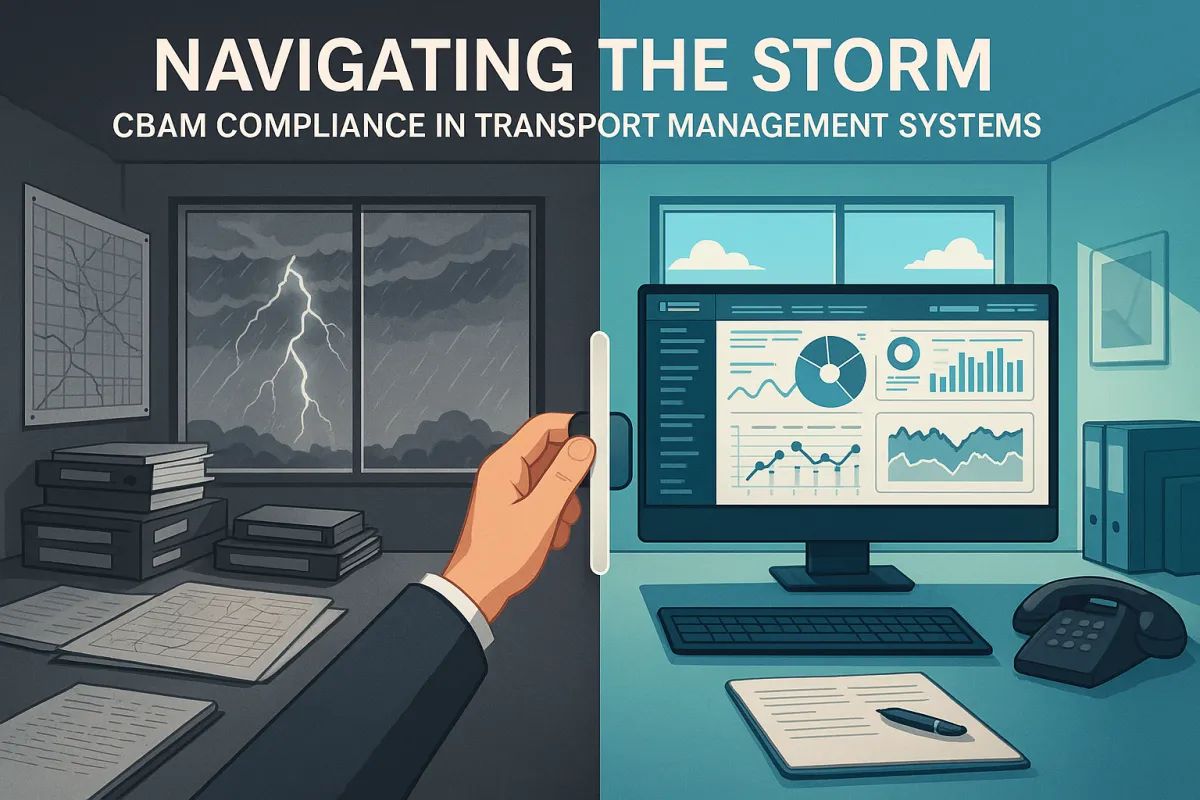
CBAM became financially binding for imports made from January 1, 2026, and companies that delay preparation risk significant operational and financial disruption. From 1 January 2026 importers must purchase and surrender certificates based on verified annual emissions, with a €100 per excess tonne penalty for non-compliance. For European transport directors managing import operations, this isn't just another regulatory hurdle - importers (authorised declarants) are legally responsible for CBAM compliance, reporting, and cost exposure, with their challenge being coordinating supplier data, managing financial liability, and meeting registry reporting requirements.
You're facing a perfect storm: the first surrender deadline will be the 30 September 2027 for imports during the year 2026, while without verified data, punitive default values apply to your imports. The window for preparation is closing rapidly, yet most transport management systems aren't equipped to handle the complexity of CBAM compliance requirements.
The CBAM Compliance Crisis Facing European Transport Directors
CBAM prices the carbon embedded in imports of cement, steel, aluminium, fertilisers, electricity and hydrogen into the EU. In case of data inconsistency, a fee of €100 per undeclared ton of CO2 will be charged, with national authorities may impose administrative fines and require a third-party audit at the importer's expense.
The financial implications are immediate and substantial. No certificates are purchased in 2026, even though imports made in 2026 generate financial liability, with the sale of CBAM certificates by Member States covering embedded emissions in goods imported during 2026 beginning on 1 February 2027. Your 2026 imports create direct cost exposure that you must manage now, not later.
Understanding CBAM's Impact on Transport Operations
CBAM will initially apply to imports of certain goods and selected precursors whose production is carbon-intensive and at most significant risk of carbon leakage: cement, iron and steel, aluminium, fertilisers, electricity and hydrogen. The deadline for submitting annual CBAM declaration and for surrendering CBAM certificates during the definitive period has been extended to 30 September of the year following the import of CBAM goods.
A legally binding exemption now applies: importers with total annual net imports below 50 tons of CBAM-relevant goods are fully excluded from CBAM obligations, including reporting, authorization, and certificate purchases. However, if you exceed this threshold, EU importers or their indirect customs representatives importing more than the single mass-based threshold of 50 tonnes of CBAM goods into the EU will have to apply for the authorised CBAM declarant status.
Why Traditional TMS Platforms Fall Short of CBAM Requirements
Most transport management systems weren't designed for carbon compliance beyond basic reporting. TMS vendors are systematically charging premiums for sustainability modules that procurement teams increasingly view as standard functionality, with basic carbon tracking add-ons typically increasing total system costs by 15-30%.
The technical gap is wider than vendors acknowledge. Contact all relevant suppliers and request installation-specific, CBAM-compliant emissions data - this requires sophisticated supplier integration capabilities that most legacy systems lack. You need platforms that can automate data collection while maintaining the audit trails required for third-party verification that becomes mandatory from 2026.
Default values are intentionally conservative and penalizing, often resulting in materially higher CBAM costs than verified supplier data. Your TMS needs to actively manage supplier relationships to avoid these punitive defaults, not just calculate emissions after the fact.
Essential CBAM Features for Modern Transport Management Systems
The minimum technical requirements for CBAM-capable transport management systems extend far beyond standard carbon calculators. Advanced transport management systems can automate CBAM data collection while simultaneously optimizing transport decisions for both cost and carbon performance.
Modern TMS platforms like Cargoson, MercuryGate, and Descartes now offer built-in carbon calculators that provide pre-calculated CO2 emission estimation before making transport booking. However, CBAM compliance requires more granular capabilities. You need systems that track Scope 3 emissions at shipment, route, and carrier levels while generating reports formatted for CSRD, CBAM, and ESG requirements.
Supplier Data Integration and Management
A new portal section of the CBAM Registry allows installation operators outside the EU to upload and share their installations and emissions data with reporting declarants in a streamlined manner, with advanced TMS platforms integrating with this registry through APIs, automatically pulling verified emissions data from suppliers and embedding it into transport planning workflows.
Your platform must automate supplier onboarding while maintaining data quality controls. Help suppliers calculate cradle-to-gate emissions using a built-in, step-by-step PCF interface—no prior experience needed, with suppliers inputting primary data like raw materials, energy usage, and transport, while the system fills in gaps with trusted emissions factors to ensure consistency and quality.
Real-time validation becomes critical when verifiers must perform on-site inspections in the first year of reporting, i.e. 2026, with limited flexibility for virtual visits thereafter, following a risk-based approach.
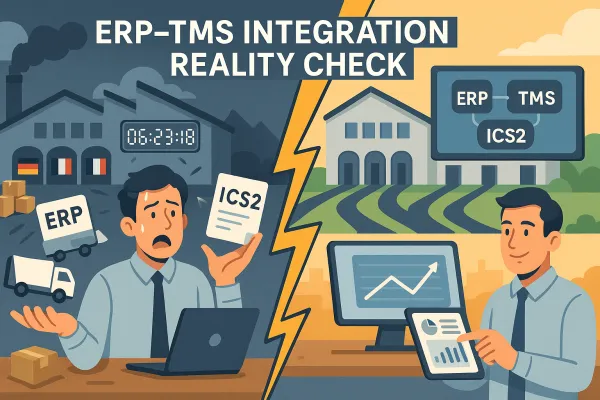
TMS-ERP Integration Strategies for CBAM Data Flow
Seamless data exchange between your TMS and enterprise systems prevents the manual data handling that creates compliance risks. Integration costs with emissions databases create additional budget pressure, with basic API integrations typically costing between $5,000 and $15,000, while connecting with complex ERP systems might exceed $50,000.
Data residency requirements for EU compliance add complexity, with information needing to be submitted digitally and machine-readable in XBRL format, requiring specific infrastructure investments that vendors may price separately.
Your integration strategy should prioritize automated data flows that eliminate manual entry points. When submitting annual CBAM declarations through the CBAM Registry, whilst quarterly reporting ends in 2026, ongoing quarterly data preparation improves accuracy and forecasting.
Vendor Evaluation Framework for CBAM-Capable TMS Platforms
The vendor landscape is consolidating precisely when you need the most sophisticated capabilities. Evaluate platforms including Cargoson, Oracle Transportation Management, SAP Transportation Management, and specialized solutions like IntegrityNext that focus specifically on CBAM compliance.
Solutions like Cargoson, Alpega, and nShift offer transparent carbon pricing integrated into their core platforms, avoiding the sustainability markup that affects other vendors. By 2026, Uber Freight's TMS merges Transplace's institutional logistics power with Uber's high-speed AI DNA, standing out because the system self-manages tendering, scheduling and carbon tracking, reducing manual overhead through the use of 30 embedded AI agents.
Look for vendors that offer automated supplier integration, real-time emissions calculation, and API connectivity with the CBAM Registry. Designed to reduce complexity and ensure compliance, CBAM solutions should be fully aligned with EU regulatory requirements and verified by legal opinion.
Cost-Benefit Analysis and ROI Considerations
Automation of data management and calculations reduce mistakes and improve efficiency overall, with significant time savings as suppliers can upload their data directly into the platform, and Dubrink emerging as the overall best option at €1,990/year for importers handling up to 15,000 tonnes, combining automated data exchange, PDF/XML reporting, forecasting tools, and a strong audit trail.
The compliance vs. penalty calculation is straightforward. While competitors pay CBAM penalties and compliance costs, early adopters optimize both transport spend and carbon performance, often reducing total costs despite sustainability investments.
Consider the operational efficiency gains beyond compliance. By collecting and analyzing data based on transportation factors, a TMS can provide an accurate estimate of an organization's carbon emissions from their transportation activities, with this information used for mandatory reporting in the EU from 1 Jan 2024 for medium/large sized companies.
Implementation Roadmap and Timeline Management
From early 2025, CBAM declarants can apply for the 'authorised CBAM declarant' status via the CBAM Registry, processed by the National Competent Authority of the EU Member State where they are established, with your TMS needing to be operational before you submit this application.
Your implementation phases should align with CBAM deadlines. Y238 means that the application for recognition as a CBAM declarant was submitted before March 31, 2026, giving you a clear target for system readiness.
Your TMS should automatically generate audit-ready documentation, not require manual compilation for verification. This means implementing data validation workflows during the setup phase, not as an afterthought.
Risk Mitigation and Contingency Planning
Even though CBAM reporting becomes annual, many companies still want to manage and revise data quarterly to stay on top of tracking and certificate planning, with the product roadmap reflecting this so you can view and manage data both yearly and by quarter.
Build redundancy into your supplier data collection processes. For non-electricity goods, default values include mark-ups to reflect potential underestimation of emissions, with these mark-ups phased in with highest values of +30% for most CBAM products from 2028 onwards. Your backup plans need to account for these increasing penalties.
The question isn't whether CBAM will impact your transport operations - it's whether you'll use this disruption to gain competitive advantage or just scramble to comply. The TMS platform you choose today determines which category you'll be in when CBAM enforcement begins.
Start your TMS evaluation now. Companies implementing TMS-powered sustainability strategies before CBAM enforcement gain multiple advantages: they develop carbon-optimized supplier relationships while competitors are still figuring out reporting requirements, and establish market position as sustainability leaders before this becomes table stakes. The integrated platforms available today provide the foundation for compliance that becomes mandatory tomorrow.