The European Shipper's Guide to TMS-Marketplace Integration: How Built-In Freight Connectivity Can Cut Procurement Time by 60% While Expanding Your Carrier Network to 300+ Verified Providers

European manufacturers with €50 million+ annual transport spend are watching a significant shift unfold. The growing chasm between retiring and new drivers is set to triple the rate of unfilled truck driver positions, to over 60% by 2026, while unfilled driver positions for heavy goods vehicles (HGVs) in Europe have surged to 426,000 in 2024, a significant increase from 233,000 in 2023. TMS marketplace integration offers a direct response to these capacity constraints by connecting your existing transport management system to networks of 300+ verified carriers through automated APIs that handle everything from rate comparison to booking execution.
Why 2026 Is the Year European Shippers Must Consider Marketplace-Connected TMS
The numbers paint a stark picture of European transport capacity. Without action to make the driver profession more accessible and attractive, Europe could lack over two million drivers by 2026, impacting half of all freight movements and millions of passenger journeys. This isn't just about higher rates - it's about securing capacity at all.
Trucks transport 75% of Europe's freight by volume, and 85% of its perishable, high value and medical goods, such as vaccines and food. When your quarterly procurement rounds yield fewer carrier responses or spot market rates spike 40% overnight, marketplace connectivity becomes less luxury and more survival tool.
Traditional TMS vendors are responding. Major players including SAP, Oracle, MercuryGate, and Cargoson have integrated marketplace connectivity APIs that pipe real-time spot rates directly into traditional tendering workflows. This integration has now gone live for AscendTMS customers, making it possible to digitally match loads and carriers, negotiate pricing and execute the full freight transaction within the TMS environment.
What TMS-Marketplace Integration Actually Means for European Operations
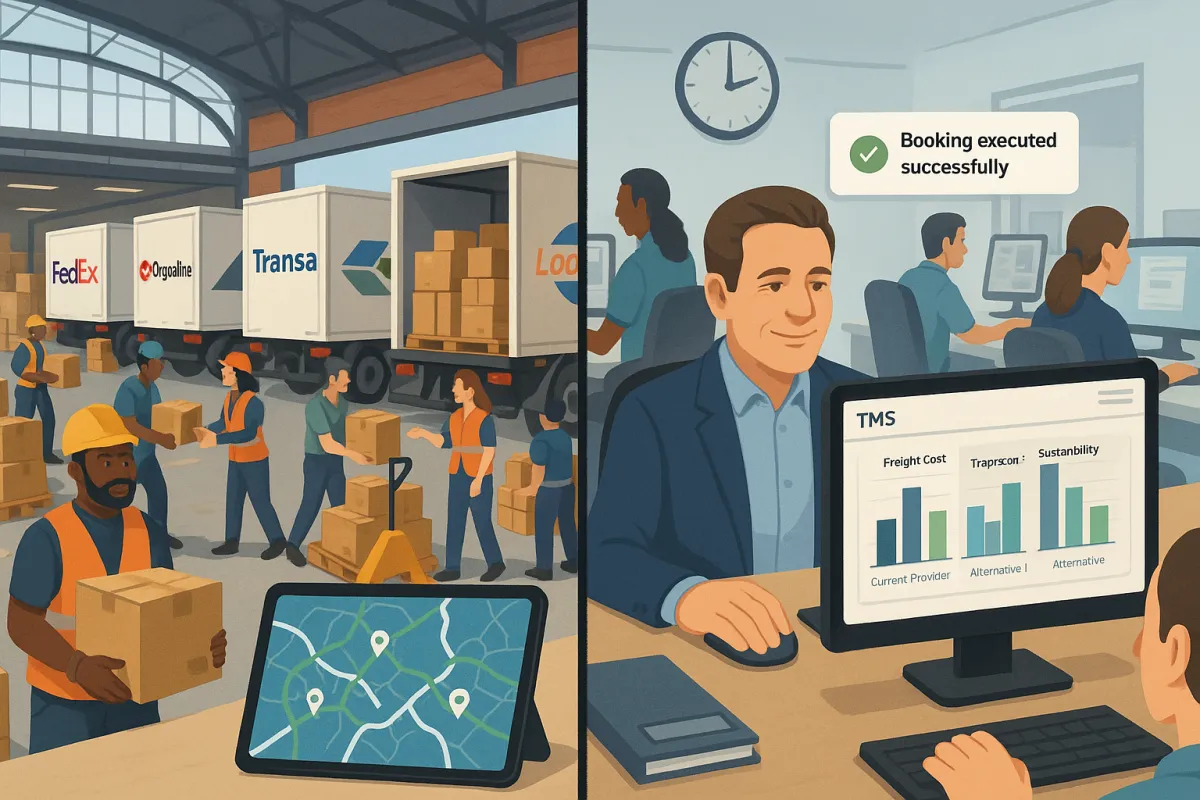
Real marketplace connectivity goes beyond portal access or manual uploads. Digital freight-matching APIs pipe live spot rates into TMS tendering screens, letting users auto-award loads to best-fit carriers based on cost, on-time metrics, and sustainability performance. As platform interoperability improves, shippers push more of their freight spend through marketplace-connected TMS workflows, driving real-time procurement efficiencies and elevating service resilience in volatile capacity cycles.
The distinction matters. Some vendors offer "marketplace access" through separate logins or batch rate uploads. True integration means your dispatcher sees marketplace rates alongside contracted rates in the same tendering interface, with automatic booking and tracking updates flowing back to your primary TMS dashboard.
The system offers both shipper-negotiated rates and marketplace rates - platforms like FreightPOP demonstrate this hybrid approach. Shipwell and Uber Freight have built their TMS offerings around marketplace-first architectures, while Cargoson focuses specifically on European compliance requirements and GDPR-compliant carrier verification.
API vs. Portal Integration: Understanding the Difference
Portal integration requires users to switch between systems, manually comparing rates and copying booking details. API integration means marketplace rates appear automatically in your existing tendering screens with one-click booking that updates both systems simultaneously. The workflow difference translates to measurable time savings and reduced data entry errors.
The 60% Time Reduction: How Marketplace Integration Transforms Procurement Workflows
Traditional European freight procurement follows a familiar pattern: RFQ creation (2-3 hours), carrier outreach (4-6 hours), quote compilation (2-4 hours), negotiation cycles (8-12 hours), and contract finalization (2-3 hours). Total cycle time: 18-28 hours for a single lane tender.
Marketplace-connected TMS compresses this into automated workflows. Automated invoicing and carrier bill audit cuts billing cycle time by nearly two-thirds compared to manual processes. Our platform eliminates manual intervention from quote to delivery, saving brokerages over 1.4 million hours to date, according to Tai TMS data.
Here's the math: Load posting takes 10 minutes (not 3 hours). Rate comparison happens automatically (not 4-6 hours of phone calls). Booking confirmation arrives within 15 minutes (not 8-12 hours of negotiation). Total procurement time: 45 minutes for standard lanes.
One logistics director at a German automotive supplier told me they reduced tender cycle time from 72 hours to 8 hours by implementing marketplace connectivity for their spot freight - roughly 89% time reduction. The automated rate comparison alone saved 15 hours per week across their transport team.
Automated Tendering Features
Advanced TMS systems optimize overall efficiency by consolidating loads and automatically comparing rates, capacity, emissions, and other criteria to determine the best carrier for each load. Modern platforms include carrier scoring algorithms that weigh cost against performance history, sustainability metrics, and real-time capacity availability.
From 50 to 300+ Carriers: The Network Expansion Reality Check
Most European mid-market shippers work with 15-50 regular carriers across their primary lanes. Marketplace integration theoretically provides access to hundreds more. They have over 2,000 carrier accounts (3,000 or 8,000 according to other sources), and over 300 parcel carriers integrated - these numbers reflect the scale difference.
But quantity isn't everything. Alpega promotes access to their Freight Exchange Network with 350,000+ daily freight offers across Europe. The real question: how many of those carriers meet your specific requirements for insurance, safety ratings, and route coverage?
Quality marketplace platforms implement verification standards. Keypoint automatically imports carrier information from DAT CarrierWatch, verifies insurance and safety credentials, and prevents dispatch of unqualified carriers. European-focused platforms like Cargoson build verification around EU-specific requirements: GDPR compliance, cross-border permits, and ADR certifications where relevant.
Expanding Your Verified Network
Effective marketplace connectivity adds 50-100 verified carriers to your network within 90 days - not thousands of unvetted options. Focus on platforms that pre-screen carriers for European compliance rather than raw numbers. The goal is reliable backup capacity, not procurement complexity.
The European Compliance Factor: GDPR, Data Security, and Marketplace Vetting
European freight operates under stricter data protection rules than other regions. GDPR and sector-specific rules impose strict controls, leading some EU shippers to favour private clouds or hybrid models. Multi-tenant SaaS expands the attack surface, and few organizations possess in-house cybersecurity teams versed in logistics protocols. Concerns centre on cross-border data flows, vulnerability management, and breach notification obligations, all of which can slow cloud TMS adoption in regulated segments of the transportation management system industry.
Marketplace platforms handle sensitive cargo data: shipment contents, delivery addresses, customer information. EU data residency requirements mean this information must remain within European data centers. Some US-based platforms struggle with these requirements.
Carrier verification in marketplace environments requires additional layers. Beyond standard insurance and safety checks, European platforms must verify: VAT registration numbers, cross-border transport licenses, driver CPC qualifications, and tachograph compliance. Descartes and SAP TM maintain European data centers and compliance frameworks, while Cargoson builds specifically around European regulatory requirements.
Data Flow Considerations
Marketplace integration involves bidirectional data sharing: your load details flow to carrier networks while their capacity and pricing data flows back. Understanding what data crosses borders and under which legal frameworks helps inform platform selection and contract negotiations.
Implementation Framework: Your 90-Day Marketplace-Connected TMS Deployment Plan
Phase 1: Requirements Assessment and Vendor Evaluation (Days 1-30)
Map your current carrier network and identify coverage gaps. Document annual spend by lane and freight mode. Define mandatory compliance requirements: GDPR, data residency, carrier verification standards. Evaluate 3-4 platforms against these criteria, focusing on API capabilities rather than feature breadth.
Request proof-of-concept demonstrations with real carrier data. Test integration complexity with your existing TMS. Platform Science says its Integration Manager simplifies how fleets connect their transportation management systems (TMS), visibility tools, and partner platforms - but verify this applies to your specific technical environment.
Phase 2: Integration Setup and Carrier Onboarding (Days 31-60)
Configure API connections between your TMS and selected marketplace platform. Import carrier master data and establish verification workflows. Set up automated rate comparison rules and approval thresholds. With 1,500+ integrations—ERPs, carriers, and more—it plugs into your existing systems for quick, low-friction setup according to FreightPOP, though actual integration complexity varies significantly by platform.
Pilot with 3-5 secondary lanes before expanding to primary routes. Train dispatch teams on hybrid workflows that combine contracted and marketplace rates. Establish performance monitoring dashboards.
Phase 3: Go-live and Optimization (Days 61-90)
Roll out marketplace connectivity across all applicable lanes. Monitor carrier performance and rate competitiveness. Fine-tune automated decision rules based on actual booking patterns. "You're going to see more integrated data and early learning tools that support broader decisions," says Hamilton, who also expects to see more automation tied to carrier performance and market conditions.
Document process improvements and cost savings. Plan expansion to additional freight modes or geographic regions.
Critical Success Factors
Executive buy-in matters more than technical complexity. Marketplace integration changes procurement workflows, so invest in change management alongside technical implementation. Set realistic expectations: 60% time savings occur after teams adapt to new workflows, not on day one.
ROI Measurement and Success Metrics for European Shippers
Measuring marketplace-connected TMS success requires tracking both operational and financial metrics. Organisations implementing TMS solutions achieve freight cost reductions of up to 15% in the first year through optimised carrier selection, improved route planning, and enhanced load consolidation.
Primary KPIs:
- Procurement cycle time (target: 60% reduction)
- Carrier network size (active carriers used monthly)
- Rate competitiveness (average savings vs. contracted rates)
- Booking success rate (tenders accepted within target timeframe)
- Manual touches per shipment (data entry, phone calls, email exchanges)
Financial Metrics:
- Cost per shipment (including platform fees)
- Emergency freight reduction (spot market usage)
- Procurement team productivity (shipments handled per FTE)
- Carrier invoice accuracy (reduced audit exceptions)
Benchmark against European market standards rather than global averages. A 15% cost reduction in Germany's highly regulated transport market represents greater achievement than similar savings in less regulated regions. Document both hard savings (reduced rates) and soft savings (time efficiency, reduced emergency freight).
Long-term Value Calculation
Calculate ROI over 24-36 months, not annual cycles. Platform licensing costs are offset by procurement efficiency gains and improved carrier access during capacity crunches. Factor in reduced dependency on spot market rates during peak seasons - marketplace connectivity provides rate stability through diversified carrier access.
The most successful implementations I've observed combine marketplace connectivity with AI-powered decision tools. Blue Yonder, Oracle TM, and Cargoson each offer different approaches to automating carrier selection based on historical performance data, real-time capacity, and cost optimization.
Ready to evaluate marketplace-connected TMS for your European operations? Start with a clear understanding of your current procurement pain points and specific compliance requirements. The platforms exist - the question is finding the right fit for your organization's size, complexity, and risk tolerance.