The European Shipper's Guide to TMS Services Strategy: How the Fastest-Growing Market Segment Can Transform Your Implementation Success Rate From 24% to 85% Before Vendor Consolidation Changes Everything


The services segment is projected to expand at a fastest CAGR of 11.4% from 2026 to 2034 owing to the increasing complexity of TMS deployments, the need for continuous system customization, and the rising demand for managed services among European shippers who can no longer afford the 66% of technology projects ending in partial or total failure, while a staggering 76% of logistics transformations never meet their budget, timeline, or performance targets.
Your procurement window is shrinking faster than available capacity. WiseTech's acquisition of E2open in 2025, Descartes' purchase of 3GTMS for $115 million in March 2025, and Körber's transformation of MercuryGate into Infios following their 2024 acquisition represent just the beginning of a fundamental market restructuring that's forcing European shippers to reconsider their entire TMS procurement strategy, while the window for optimal TMS contract negotiations closes rapidly as vendor options diminish and regulatory requirements become mandatory. European shippers who act decisively in 2026 secure favorable contract terms and compliance-ready platforms before market consolidation eliminates choice.
The Hidden Complexity Behind TMS Implementation Failures
European manufacturers are discovering that a basic domestic shipper requires 10-15 integrations minimum, potentially totaling 1,000-1,500 hours of labor. For shippers with freight spend exceeding $250M annually, implementation can cost 2-3 times the subscription fee. This complexity multiplies when you consider carriers are often unwilling or unable to create connections themselves, and even when they can, they typically charge integration costs back to the shipper. Basic API integrations cost €5,000-€15,000, while complex ERP connections exceed €50,000.
The vendor consolidation wave amplifies these risks. Companies undergoing integration often experience 12-18 months of reduced innovation while they harmonize platforms and teams. When your TMS vendor becomes an acquisition target, you inherit integration complexity without controlling the timeline.
Consider the hard lessons from a German automotive parts manufacturer who discovered their €800,000 TMS implementation mistake the hard way. Six months into deployment, they found their European carriers couldn't integrate without costly custom development work - turning their "smart procurement decision" into a complete platform re-implementation.
Multi-country deployments create exponential complexity. Implementing in Germany versus Germany, France, Poland, and the Netherlands simultaneously introduces carrier integration challenges, regulatory variations, and language requirements that North American-focused platforms often handle poorly. Europe's fragmented carrier landscape demands specialized integrations that global TMS platforms often handle poorly. Cross-border operations require support for multiple tachograph systems, customs documentation formats, and national reporting requirements.
Cloud Migration Reality: 8 Weeks vs. 18 Months Implementation Timeline
Many cloud TMS rollouts can be implemented and integrated within eight weeks, depending on data migration, integrations, and workflow complexity, dramatically faster than traditional systems requiring 6-18 months. When European manufacturers launched their cloud TMS migrations this year, 63% chose cloud deployment over on-premise solutions for the first time, driven by cloud TMS pricing ranges from $1.00 to $4.00 per freight load booked in the system, while licensed options demand significant upfront investment plus ongoing maintenance fees. Cloud TMS implementations often conclude within eight weeks, compared to 6-18 months for traditional systems.
But speed creates new challenges. Baseline functionality in 6-8 weeks is realistic. Full value realization (integrations, training, adoption, process change) takes 4-6 months minimum. European shippers rushing to meet regulatory deadlines risk joining the three-quarters of these digital transformation projects [that] fail to meet their objectives.
GDPR and data residency requirements favor EU private clouds over global platforms. Maritime operators will surrender allowances under the EU ETS for the first time in 2025, and the three-year phase-in period increases scope from 40% of emissions in 2024 to 70% in 2025 and 100% in 2026. Cloud TMS platforms built for European markets increasingly include integrated carbon calculation engines that automatically track emissions by route, mode, and carrier.
When evaluating cloud options, compare Transporeon's European carrier network against nShift's e-commerce focus, while platforms like Cargoson deliver purpose-built European cross-border functionality that often requires months of customization in global systems.
The Services Revolution: From Software Sales to Outcome Delivery
The services segment is projected to expand at a fastest CAGR of 11.4% from 2026 to 2034 owing to the increasing complexity of TMS deployments, the need for continuous system customization, and the rising demand for managed services, representing a fundamental shift from one-time software purchases to recurring outcome delivery. This growth reflects Europe's ICT professional deficit exceeding one million workers, forcing shippers to rely on external expertise rather than internal development.
Technology evolution requires frequent upgrades and ERP system reconfigurations that internal teams cannot handle. The regulatory timeline gets tighter each month. Start of application of the new version (v3) of ICS2 messages on 3 February 2026, and decommissioning of older version (v2) means your integration must handle messaging format updates automatically - not through manual system adjustments.
Carriers unwilling to create connections themselves charge costs back to shippers, making vendor-managed connectivity a necessity rather than luxury. While many TMS solutions offer published APIs, carriers are often unwilling or unable to create connections themselves, and even when they can, they typically charge integration costs back to the shipper. Basic API integrations cost €5,000-€15,000, while complex ERP connections exceed €50,000.
Successful services models focus on outcome delivery rather than feature deployment. Instead of managing software, European shippers gain access to operational expertise, regulatory compliance automation, and continuous optimization that adapts to changing market conditions. European specialists including Cargoson, Alpega, and established providers like Descartes offer different approaches to services delivery, with regional vendors often providing more responsive support during regulatory transitions.
European Regulatory Complexity Driving Services Demand
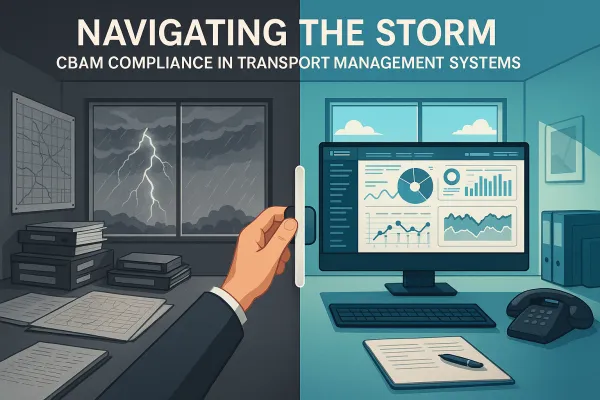
The regulatory convergence of 2026 creates unprecedented complexity. From July 1, 2026, vans weighing 2.5-3.5 tons performing international transport of goods will be subject to the obligation to use second-generation smart tachographs (G2V2). Simultaneously, as of 1 January 2026, the transitional phase of the Carbon Border Adjustment Mechanism (CBAM) has ended and the definitive phase has begun with importers now subject to full financial obligations under the scheme.
9 July 2027 · The eFTI Regulation will apply in full. Member State authorities must accept information shared electronically by operators via certified eFTI platforms. As of January 2026 · eFTI platforms and service providers can start preparing for operations. Member States authorities may start accepting data stored on certified eFTI platforms for inspection. This creates a narrow window for platform testing and staff training before mandatory compliance.
The complexity extends beyond single regulations. European transport faces 27 different VAT rates, multiple languages, and varying carrier protocols across borders. Regular audit cycles become mandatory as European transport regulations continue evolving rapidly. Your implementation framework must account for ongoing regulatory changes, not just current compliance requirements. The telematics data explosion - The Europe Telematics Market size is estimated at 24.49 million units in 2025, and is expected to reach 49.77 million units by 2030 - requires platforms designed for automated processing rather than manual analysis.
Regulatory compliance automation becomes competitive necessity when manual management cannot scale. Vendors demonstrating integrated CBAM compliance, eFTI readiness, and Smart Tachograph data processing reveal their commitment to European market requirements. Solutions from SAP TM and Oracle TM handle enterprise complexity but often require extensive customization for European-specific regulations, while Cargoson and Alpega offer platforms built specifically for European regulatory environments.
Vendor Consolidation Impact on Services Strategy
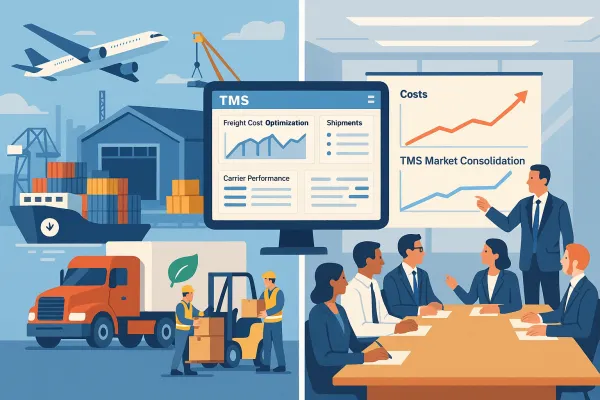
WiseTech Global's $2.1 billion acquisition of E2open is more than a headline—it's a directional shift for one of the industry's biggest technology players. With the addition of E2open's 500,000+ connected enterprises and its legacy platforms like INTTRA—responsible for around 25% of global ocean bookings, while Descartes Systems Group has acquired the transportation management solutions (TMS) software vendor 3GTMS for $115 million. The deal marks Descartes' 32nd acquisition since 2016.
This consolidation creates both risks and opportunities for services procurement. Companies undergoing integration often experience 12-18 months of reduced innovation while they harmonize platforms and teams, directly impacting service delivery quality during critical regulatory implementation periods.
Acquisition-resistant contracts require specific protections. Acquisition-resistant contracts require specific protections including 12-18 months advance notice for ownership changes, guaranteed functionality preservation for minimum periods, and migration assistance rights. Standard TMS contracts rarely address vendor acquisition scenarios, leaving European shippers vulnerable to post-acquisition service degradation.
The procurement window is narrowing because regulatory pressure is forcing vendor priorities. Companies that haven't initiated TMS selection processes by mid-2026 will find significantly fewer viable options as vendors focus resources on existing customer compliance rather than new client acquisition.
The post-consolidation landscape reveals three distinct categories: global mega-vendors (Oracle TM, SAP TM, E2open/WiseTech, Descartes), European specialists (Alpega, nShift, Transporeon), and emerging European-native solutions like Cargoson that maintain development focus specifically on European regulatory requirements.
Implementation Success Framework for European Shippers
Change management investment alongside technical implementation determines success rates. The prevailing urgency approach, characterized by directive leadership, limited stakeholder engagement, and a "get with the program" mindset, leading to a 47% decrease in the odds of transformation success. Organizations achieving measurable efficiency gains invest in workflow adaptation rather than rushing technology deployment.
Budget planning must account for regulatory complexity. Plan for 15-20% budget increases in 2026-2027 if reactive, or 8-12% if proactive with proper contract protection. These increases reflect mandatory eFTI integration, G2V2 tachograph connectivity, and enhanced customs documentation requirements.
Implementation timelines extend beyond vendor promises. Plan for 8–12 months to implement properly—not the "weeks" you'll hear in sales calls. European operations typically require additional time for cross-border complexity, carrier integrations, and regulatory testing.
Success metrics must track both technical and business outcomes. Monitor API response times, data synchronization success rates, and error frequencies alongside operational measures like carrier onboarding speed, compliance reporting accuracy, and cost savings achievement. European operations often see 15-25% improvements in transport administrative efficiency within the first year of successful TMS data integration. These improvements come from reduced manual data entry, automated compliance reporting, and enhanced visibility across transport networks.
The implementation framework must balance urgency with thoroughness. European shippers implementing strategic TMS platforms during the 2026 regulatory convergence position themselves for sustainable competitive advantages. Phase your implementation to balance risk with operational requirements. Start with core functionality in Q2-Q3 2025, activate AI features in Q4 2025, and ensure eFTI compliance by Q1 2026.
Vendor selection requires evaluating both capabilities and European market commitment. Platforms demonstrating native eFTI integration, automated tachograph data processing, and integrated CBAM compliance show commitment to European operations. Consider European specialists like Cargoson alongside global solutions, evaluating implementation methodology, regulatory expertise, and acquisition resistance as core procurement criteria.