The European Shipper's Guide to TMS Vendor Consolidation: How to Future-Proof Your Transport Technology Investment Before the Next Wave of Acquisitions

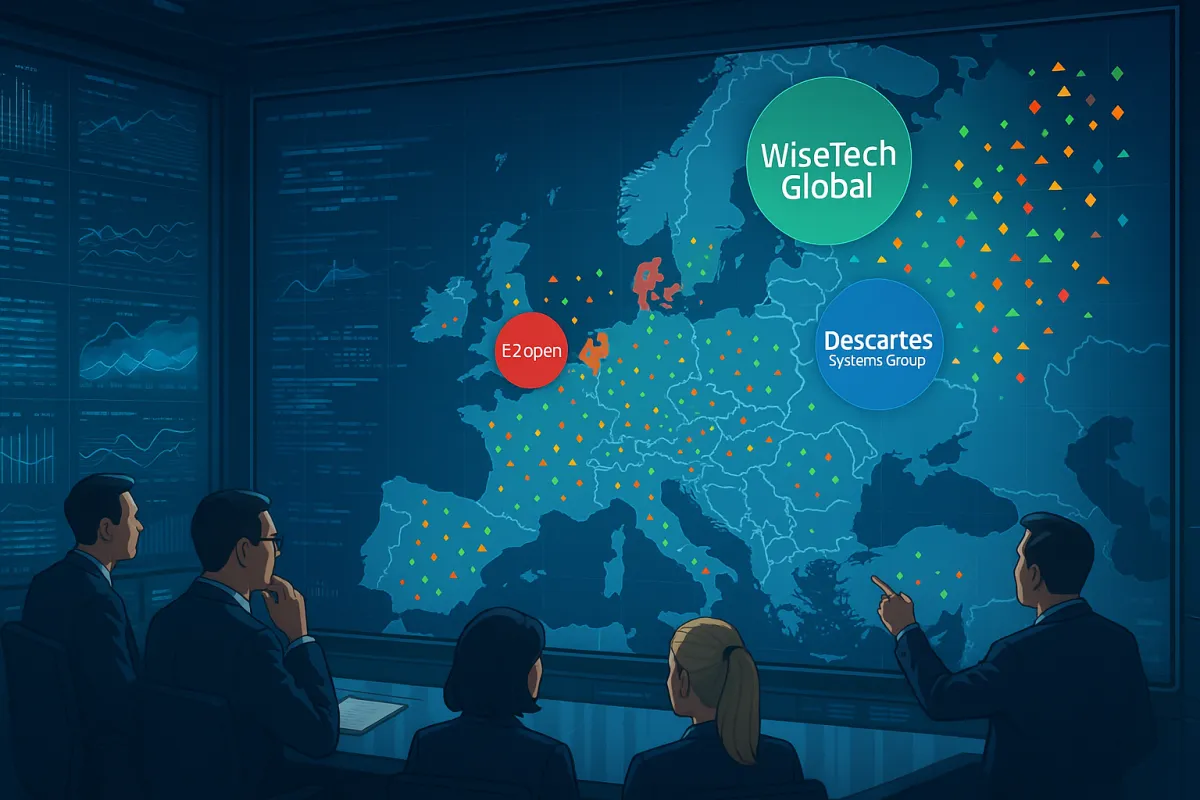
WiseTech Global's $2.1 billion acquisition of E2open has sent shockwaves through the European transportation management systems market, marking the most significant consolidation move in recent TMS history. Descartes Systems Group's $115 million purchase of 3GTMS in March 2025 adds another major player to the rapidly consolidating landscape. For European manufacturers and logistics managers already grappling with supply chain complexity, these mega-deals signal a fundamental shift in how TMS vendor consolidation will reshape their technology decisions.
The European TMS market is projected to reach $8.9 billion by 2030, growing at a robust 14.6% CAGR from 2025 to 2030, yet paradoxically, your vendor choices are shrinking as consolidation accelerates. France leads this regional expansion, but growth means little if your current TMS provider vanishes into a larger platform that doesn't prioritize your specific needs.
The Consolidation Wave Hitting European Markets
Major supply chain providers including Blue Yonder, Manhattan, E2open (acquired by WiseTech in 2025), Descartes (including 3GTMS acquired in 2025), and Kinaxis are all competing in the TMS space. Notice the pattern? Two major acquisitions completed in a single year, with more likely coming.
The European and North American TMS market value is forecast to grow at 11.6% CAGR from €3.1 billion in 2024 to €5.4 billion in 2029. But here's what the growth projections don't tell you: E2open itself consumed Logistyx Technologies in 2022, BluJay Solutions in 2021, Amber Road in 2019, INTTRA and Cloud Logistics in 2018, Zyme and Steelwedge in 2017, and Terra Technology in 2016.
This marks Descartes' 32nd acquisition since 2016. That's roughly two acquisitions per year, systematically absorbing competitors and specialized solutions.
The European market differs from North America in one crucial way: regulatory complexity across borders makes vendor lock-in more problematic. When your TMS handles customs documentation for 27 EU countries plus UK and Swiss requirements, switching costs multiply exponentially compared to domestic U.S. operations.
Why This Consolidation Matters for Your Business
E2open's integration into the WiseTech Global ecosystem raises questions about its long-term neutrality, with some viewing the acquisition as a potential limitation rather than synergy. This mirrors what happens when any independent TMS provider gets absorbed: priorities shift from serving diverse customers to integrating with the parent company's broader platform strategy.
Consider the immediate impacts on your operations:
Pricing leverage disappears when fewer vendors compete for your business. Post-acquisition, you're not just negotiating with your TMS provider anymore - you're negotiating with a supply chain conglomerate that may prioritize different market segments.
In 2024, freight and order management represented the largest TMS revenue segment, while reporting and analytics showed the fastest growth. Consolidated vendors often eliminate redundant features across their portfolio, potentially discontinuing specialized European compliance tools that don't scale globally.
Your current support team? They might be reassigned to higher-value enterprise clients after acquisition. E2open experienced operating losses of around $24 million in 2024, caused by goodwill write-downs on acquisitions, with integration problems between products for freight forwarders like BluJay and beneficial cargo owners creating pressure.
Warning Signs Your TMS Provider Might Be Next
Look for declining profitability, layoffs, legal disputes, or changes in leadership. Frequent mergers or acquisitions may also indicate instability. Entrusting your transportation management to a financially unstable provider could pose significant risks to your operations in the long run.
Watch for these specific indicators:
Fractious vendor relations and a feeling of always fighting fires as exceptions are not handled in a timely manner, adding stress to the transportation department. When your vendor's attention shifts to integration challenges or acquisition negotiations, support quality degrades first.
Product development slowdowns become evident when releases focus on API compatibility rather than new functionality. Your feature requests get deprioritized while the vendor focuses on making their platform "acquisition-ready."
Additional consideration should be given to a vendor's financial stability, ownership structure, and investment in ongoing development. Private equity ownership often signals preparation for sale within 3-5 years.
Due Diligence Framework for TMS Vendor Stability
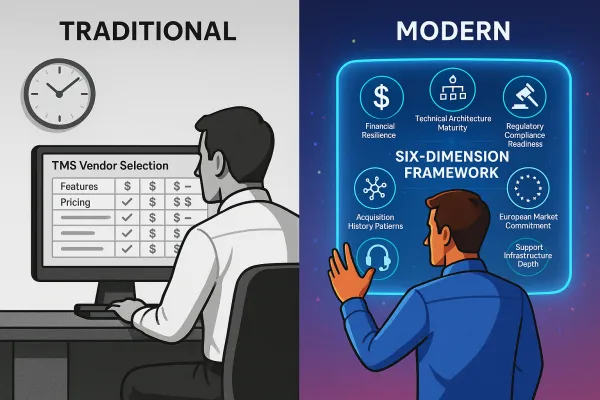
European shippers need a systematic approach to evaluate vendor stability beyond standard RFP criteria. The TMS market shows that greater breadth and depth of functionality doesn't always lead to better ROI, while suppliers have specific domain expertise, geographical presence, and complementary product suites that must all be evaluated.
Start with financial health assessment. A vendor's financial condition is a strong predictor of future reliability. Use credit checks, financial monitoring tools, and public records to evaluate vendor health over time. For European operations, this becomes more complex with vendors operating across multiple legal jurisdictions.
Evaluate product roadmap transparency. Stable vendors publish detailed roadmaps with specific European compliance updates. Acquisition targets often go silent on future development while "strategic reviews" occur.
Customer base analysis reveals vulnerability patterns. WiseTech's CargoWise maintains annual retention rates over 99% since 2013, with half the world's top 25 freight forwarders signed up, yet less than 10% of international freight forwarding volumes go through the platform. Vendors overly dependent on a few large customers face higher acquisition risk.
Technology architecture assessment matters more in consolidating markets. Cloud-native platforms with API-first design survive acquisitions better than legacy systems requiring expensive integration work. European data residency requirements add another complexity layer that acquirers often underestimate.
Contract Protection Strategies
Your TMS contract should include specific acquisition protection clauses. Demand migration assistance guarantees with defined timelines and cost caps. Data portability rights become essential when your provider gets absorbed into a competing platform.
Service level agreement protections should include compensation for degraded performance during integration periods. Most acquisitions result in temporary service disruptions lasting 3-6 months as systems integrate.
Consider including "change of control" clauses that allow contract termination without penalty when ownership changes. This provides negotiating leverage and exit options if the new parent company doesn't align with your needs.
Alternative TMS Procurement Strategies in a Consolidating Market
The traditional single-vendor approach becomes riskier as consolidation reduces options. Consider multi-vendor strategies that distribute risk while maintaining integration benefits.
Cloud platforms commanded 71.67% of shipping software market share in 2024, using continuous delivery pipelines to push weekly upgrades with new carrier APIs and workflow widgets. This architecture enables easier vendor switching compared to on-premise solutions.
Evaluate independent European vendors alongside global players. Solutions like Cargoson, Transporeon, and nShift offer specialized European functionality without the acquisition uncertainty of larger consolidating platforms. These vendors often provide more responsive service and competitive pricing during consolidation waves.
Best-of-breed versus integrated suite considerations shift in consolidating markets. While integrated suites promise simplicity, they create vendor lock-in that becomes problematic when ownership changes. Best-of-breed approaches using standardized APIs provide more flexibility but require stronger internal integration capabilities.
The Independent Vendor Advantage
Independent TMS providers often accelerate innovation during consolidation periods, knowing agility represents their key competitive advantage against newly merged giants struggling with integration complexity.
Pricing stability benefits emerge as independent vendors avoid the pressure to recoup acquisition premiums through customer price increases. Avoid TMS providers requiring large upfront payments, as choosing a TMS should not be a financial burden, with today's subscription-world approach being standard.
Customer focus intensifies among independent providers who can't rely on cross-selling opportunities from broader product portfolios. Your European-specific requirements receive priority attention rather than being subordinated to global platform strategies.
Building a Future-Proof TMS Strategy
Vendor diversification strategies become essential in consolidating markets. Consider splitting core TMS functionality from specialized European compliance tools across different vendors to reduce single points of failure.
Technology standardization requirements should emphasize open APIs and data portability. Open-API frameworks allow out-of-the-box integration with CRM, WMS, and accounting suites, removing integration friction that previously hampered adoption.
The European Union's emphasis on sustainability and green logistics encourages companies to adopt TMS solutions optimizing transportation operations and reducing environmental impact, with automotive and manufacturing industries contributing to demand for advanced solutions. EU Digital Single Market Strategy increases Intelligent Transportation System use, creating standardization that reduces vendor lock-in risks.
Migration planning should include detailed timelines and cost estimates for switching vendors. Most European shippers underestimate switching costs, particularly for customs and compliance integrations spanning multiple countries.
When to Switch vs When to Stay
TMS evaluation requires reviewing problems that a new TMS must solve, clearly defining scope criteria including inbound freight management, supply chain risk reductions, and returns management. But timing matters more in consolidating markets.
Switch immediately if your vendor announces acquisition by a competitor or platform that conflicts with your business model. Waiting for integration completion typically results in higher switching costs and fewer alternative options.
Stay if your current vendor demonstrates strong independent growth and European market commitment. Management expectations show global supply chain and logistics software spend rising at 16% CAGR from $28 billion in 2024 to $57 billion in 2029, providing growth opportunities for stable independent providers.
Evaluate acquisition announcements case-by-case. Some acquisitions strengthen vendor capabilities and resources, while others prioritize cost reduction and platform consolidation at customer expense.
Cost-benefit analysis should include switching costs, retraining requirements, and integration complexity. For European operations, factor in regulatory compliance testing across all operating countries and potential customs clearance disruptions during transition periods.
Choosing the right transportation management system is a critical decision that can significantly impact your business's success and efficiency. In an era of accelerating consolidation, the key is maintaining vendor optionality while building internal capabilities that reduce dependency on any single provider. Your TMS strategy should position your organization to thrive regardless of which vendors survive the current consolidation wave.