The European Shipper's TMS Cybersecurity Playbook: How to Evaluate Vendor Security Before Rising Cyber Threats and Mandatory EU Digitalization Turn Poor Choices Into Operational Catastrophe

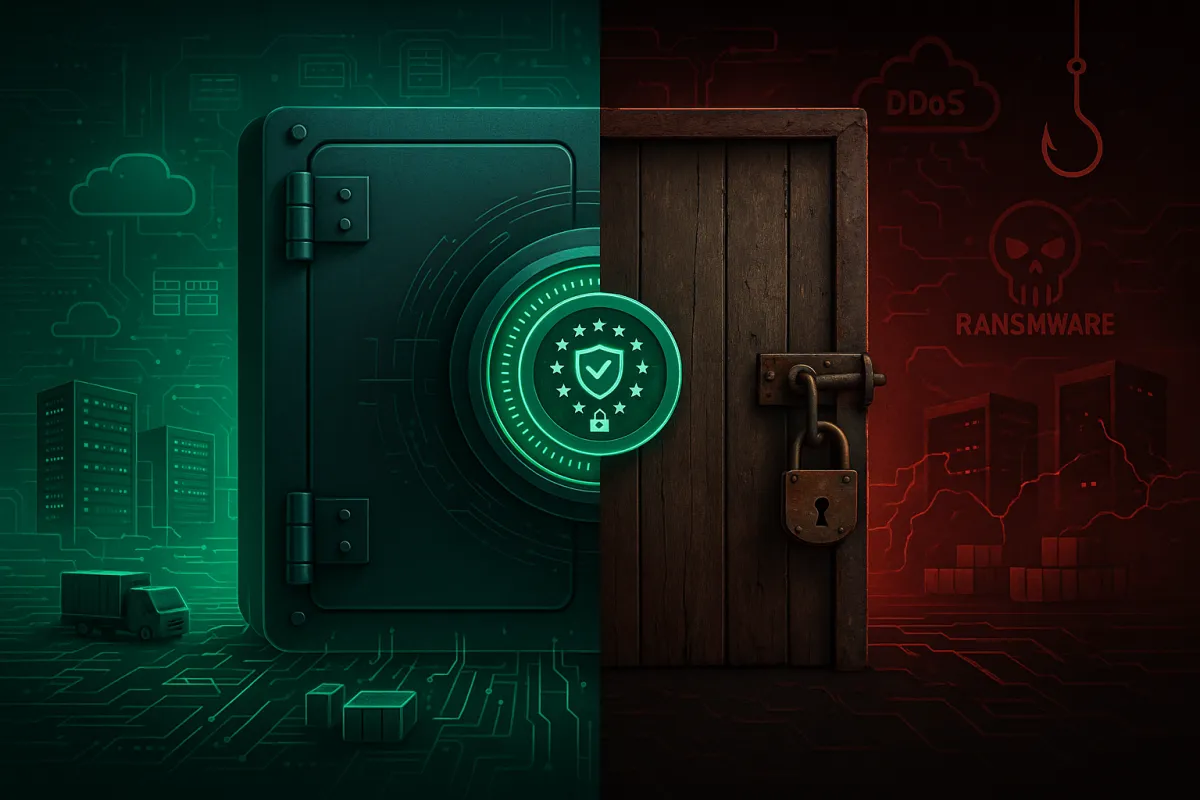
If you're still evaluating TMS vendors based solely on features and pricing, you're preparing for a €4.5 million wake-up call. The average cost of a breach is $4.18 million, and the transport sector accounted for 11% of all reported incidents, second only to attacks on the public administration sector across Europe in 2024.
What makes this even more challenging? Starting June 19, 2025, the European Union will roll out the AIS/IMPORT PLUS system—a major step in the update of import procedures across member states. Meanwhile, the new framework establishes a decentralised EU agency for customs - the EU customs authority – which will coordinate governance of the EU customs union in a number of areas. In particular, the EU customs authority will allow for EU-level risk management supporting the work of national customs authorities, using the constantly updated import and export data in the new EU customs data hub.
Your TMS cybersecurity evaluation determines whether these mandatory EU digitalization initiatives become a competitive advantage or an operational catastrophe waiting to happen.
The €4.5 Million Reality Check: Why European TMS Security Matters More Than Ever
The numbers tell a story most transport executives would prefer to ignore. In the transport industry alone, according to a 2025 report by the Cyber Defence Center of Maticmind, ransomware is the primary threat. Accounting for 38% of attacks, it is followed by DDoS (24%) and phishing (18%). 21% of all European DDoS incidents target transport. Maritime ransomware rose 467% year-on-year.
Here's what caught my attention during my own operational years: transport companies that suffered security breaches weren't necessarily the smallest or least sophisticated. They were often the ones that chose TMS vendors based on cost savings rather than security architecture. In just five years, major cyberattacks have surged by 48%, growing from 12 incidents in 2020 to 60 projected in 2025, according to a new report from the Cyber Defense Center of Maticmind. The report identifies ransomware as the primary threat, accounting for 38% of attacks, followed by DDoS (24%) and phishing (18%).
The stakes keep escalating. The 2024 ENISA threat landscape highlights the increasing number of incidents targeting EU transport, which was the 2nd most targeted sector. But transport isn't just dealing with typical cybersecurity threats anymore.
How EU Customs Digitalization Amplifies TMS Security Risks
At the core of this transformation is the creation of a European Customs Authority (EUCA), which will develop and run a new EU Customs Data Hub. The Hub will revolutionise data provision and data sharing across Member States, providing businesses with a single digital environment and customs authorities with a common risk management framework and a panoramic view of import activities.
Here's the security challenge nobody's talking about: The EU customs data hub will be a single online environment designed to collect and analyse data and deal with risk management. In order to fulfil their customs obligations for trade consignments, businesses will submit their customs information only once to this single portal, rather than to individual customs authorities.
Your TMS needs to integrate with these systems. Every API connection, every data exchange, every automated submission creates additional attack vectors. During initial rollout, users may experience temporary slowdowns or limited system availability as national customs authorities stabilize the new system. System instabilities during critical integration periods? That's when attackers typically strike.
When I managed transport operations for a €500M manufacturer, we learned this lesson the hard way during an ERP upgrade. The vulnerabilities during transition periods aren't theoretical - they're operational reality.
The Five-Layer TMS Security Assessment Framework
After evaluating TMS vendors across three different companies and seeing both spectacular security failures and impressive defense architectures, here's the structured approach that separates truly secure platforms from security theater:
Layer 1: Infrastructure and Architecture Security
Physical security and on-site protections: Unlike the majority of TMS providers, MercuryGate is both Service Organization Controls (SOC) 1 and SOC 2 compliant. In fact, MercuryGate reached the highest Service Organization Controls (SOC) designation with a Type 2 SOC 2 examination. But SOC compliance is just table stakes.
You need to dig deeper into cloud infrastructure choices. A modern multi-tenant TMS can also invest in obtaining SOC 2 Type II certification, the gold standard for verifying security performance. Unlike Type I, which merely reviews design documentation, Type II requires independent auditors to verify operation of encryption, monitoring, and access, not just at a given point in time, but over an extended monitoring period of 6-12 months.
The real question: Where is your data physically located? US-based cloud providers face conflicting requirements between GDPR and the US CLOUD Act. EU-based providers like Cargoson, Transporeon, and Alpega don't face this jurisdictional conflict. They can commit to EU data residency without legal hedging.
Layer 2: Regulatory Compliance and Certifications
Both are recognized as essential by the NIS2 Directive. Transport operators fall under NIS2's essential entity classification, which means mandatory incident reporting, risk management measures, and potential fines up to 2% of global annual turnover.
Here's what most security checklists miss: Does your TMS vendor understand NIS2's supply chain security requirements? In the EU, the revised Directive on measures for a high common level of cybersecurity across the Union (NIS2) and the additional notification provisions for security incidents aim to support a better mapping and understanding of relevant incidents.
European TMS providers typically have NIS2 compliance built into their roadmaps. US-based providers often treat EU compliance as an afterthought.
Red Flags That Should Disqualify TMS Vendors Immediately
During vendor evaluations, certain responses reveal fundamental security weaknesses that no amount of marketing can overcome:
Vague incident response planning. When you ask about their incident response procedures and get generic answers about "following industry best practices," walk away. Implementing robust monitoring and detection systems is crucial for identifying and responding to potential security breaches in real-time. Intrusion detection and prevention systems, log analysis, and security information and event management (SIEM) solutions can help identify suspicious activity and alert you to potential security incidents.
Inadequate API security. Your TMS integrates with ERPs, WMS, carrier systems, and now EU customs platforms. Transport requests may contain sensitive data, such as user credentials, financial information, or personally identifiable information (PII). If these transport requests are not properly secured, they could be intercepted and used to steal data.
Poor patch management transparency. MercuryGate's software infrastructure is updated regularly with the latest security patches - something every user should be doing on their own network as well. If vendors can't provide specific timelines for critical security updates, they're not managing risk properly.
Insufficient audit trails. Without proper monitoring and auditing, it's difficult to identify unauthorized access or changes made to transport requests. This could result in security breaches going unnoticed for long periods of time.
The European Advantage: Why Regional TMS Providers Often Deliver Better Security
After working with both US-based and European TMS providers, the regional advantages aren't just about compliance - they're about fundamental approach to data protection and incident response.
European providers design systems with GDPR principles built in from day one. They don't retrofit privacy controls. When Cargoson, Transporeon, or Alpega build features, they start with data minimization principles rather than adding privacy controls as compliance afterthoughts.
The operational benefits during crises? When security incidents happen at 2 AM CET, European providers have local incident response teams. They understand EU regulatory reporting requirements from experience, not theoretical training.
During my forwarder years, we had a security incident with a US-based provider. Their incident response team didn't understand GDPR notification timelines. We nearly missed the 72-hour reporting requirement because their legal team needed to research EU obligations.
Implementation Security: Protecting Your TMS During and After Deployment
Security doesn't end with vendor selection. Implementation phases create temporary vulnerabilities that attackers actively exploit.
To mitigate these risks, businesses... by implementing security policies and procedures, encrypting data, restricting access controls, regularly updating and maintaining software, and training employees on cybersecurity best practices.
The critical period: data migration. Legacy systems often lack modern encryption standards. During migration, you're moving years of shipment data, customer information, and carrier contracts. One of the most basic and important steps to protect data is to encrypt it both in transit and at rest. Encryption is the process of transforming data into a code that can only be deciphered by authorized parties with a key.
Integration security requires special attention. Choose platforms that provide 24/7 support, SOC 2 Type 2 security, and advanced data encryption to ensure your operations remain secure and uninterrupted. But verify their integration security practices beyond general certifications.
Post-Go-Live Security Monitoring and Maintenance
The most sophisticated attacks happen months after implementation, once systems appear stable and vigilance decreases. Another important measure to improve data security and privacy is to monitor and audit data activities in TMS. Monitoring and auditing are processes that track and record data events, such as access, modification, deletion, or transfer, and detect and report any anomalies, errors, or breaches.
Your ongoing security program should include quarterly security reviews with your TMS provider, regular penetration testing, and continuous monitoring of API integrations with EU customs systems.
Employees play a critical role in maintaining the security of your TMS. It is essential to provide comprehensive training on TMS security protocols and best practices. This includes educating employees on the importance of strong passwords, the risks of phishing attacks, and the proper handling of sensitive data.
The reality of European transport operations: your TMS security strategy determines whether mandatory EU digitalization initiatives become competitive advantages or operational nightmares. This is connected to a surge in abuse of cyber dependencies by threat actors that can amplify the impact of cyberattacks. The ENISA Threat Landscape provides valuable insights to enable informed decision-making and prioritisation to safeguard our critical infrastructure and ensure that our digital future is secure.
Start your security evaluation with the understanding that cybersecurity isn't just about protecting data - it's about protecting your ability to operate in an increasingly connected, regulated, and threat-heavy European transport environment.