The European SME Manufacturer's AI-Powered TMS Selection Framework: How to Choose the Right Transportation Management System Without Joining the 76% Implementation Failure Rate

A staggering 76% of logistics transformations never meet their budget, timeline, or performance targets, yet European SME manufacturers continue racing toward TMS implementations without adequate selection frameworks. A German automotive parts manufacturer discovered this the expensive way after their €800,000 TMS implementation couldn't handle their complex carrier network across 12 European countries.
The stakes have never been higher. WiseTech Global's $2.1 billion acquisition of E2open and Descartes Systems Group's $115 million purchase of 3GTMS in March 2025 represent the most significant TMS vendor consolidation wave in over a decade, while 61% of logistics leaders anticipate fully autonomous agentic AI within the next five years for TMS.
This comprehensive framework helps European SME manufacturers navigate AI-powered TMS selection while avoiding both implementation disasters and vendor consolidation traps that threaten your long-term operational independence.
Why Traditional TMS Selection Methods Fail for European SMEs
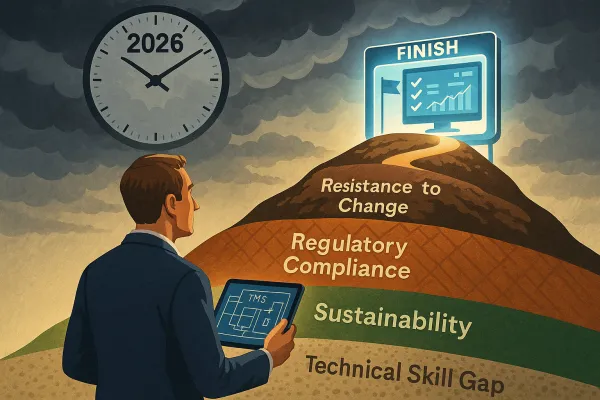
Standard feature-checklist approaches ignore the fundamental risks that derail European implementations. Only 16% of organizations report success in their digital transformation efforts, often hindered by poor digital adoption rates, while 66% of technology projects end in partial or total failure according to the Standish Group's CHAOS 2020 report.
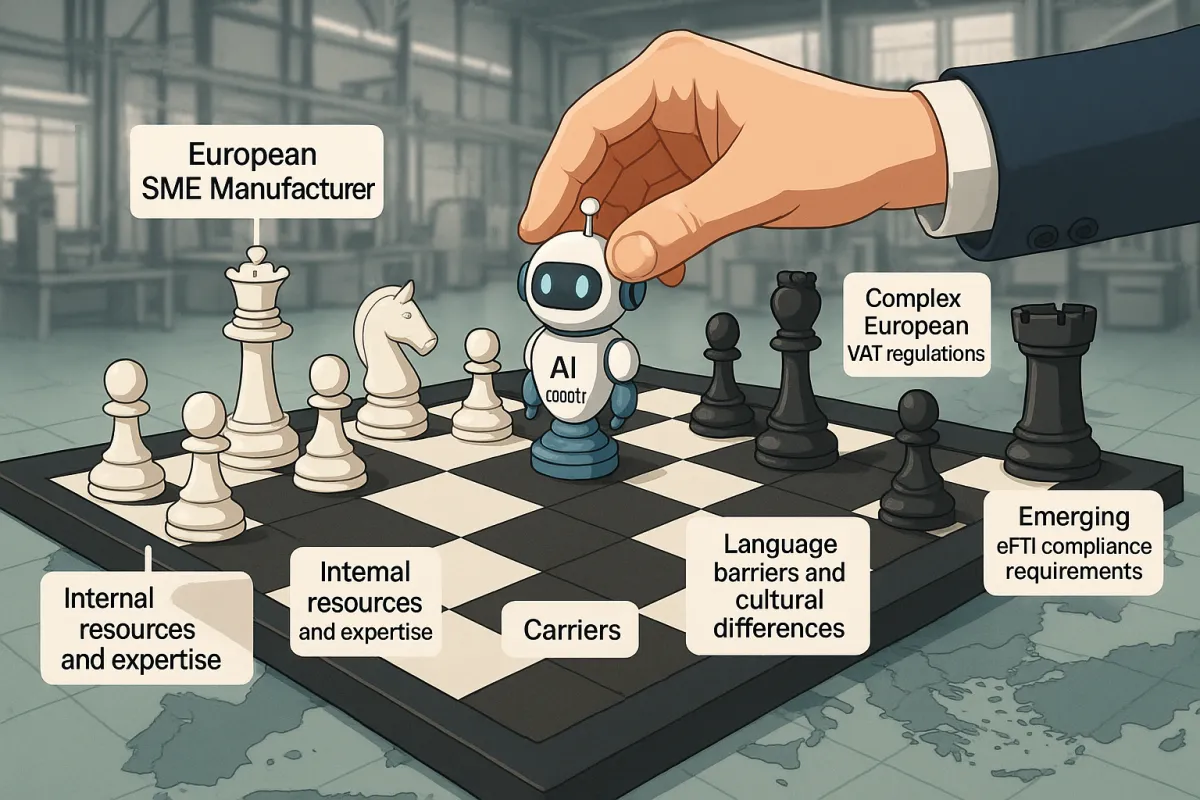
European SMEs face unique complications that amplify these failure rates. Cross-border operations span 27 different VAT rates, multiple languages, and varying carrier protocols. European transport operations compound complexity through 27 different VAT rates, multiple languages, varying carrier protocols, and emerging eFTI compliance requirements. Add limited internal resources and the pressure of vendor consolidation, and you have a perfect storm.
The Hidden Costs That Derail SME Budgets
Licensed TMS software runs €50,000-€400,000+ with annual maintenance charges ranging from 15-20% of license costs, meaning that initial €100,000 investment becomes €200,000+ in the first year when you factor in implementation, training, and infrastructure requirements.
Carrier integration represents the biggest hidden cost category for European shippers, with basic API integrations costing €5,000-€15,000, while complex ERP connections exceed €50,000. Most European manufacturers work with 20-30 regular carriers but could benefit from access to 200-300 qualified providers, with each connection requiring testing, documentation, and ongoing maintenance that vendors don't include in their initial quotes.
The German manufacturer's mistake wasn't choosing the wrong vendor. They evaluated TMS platforms like standalone software purchases instead of strategic transformations affecting every carrier relationship and integration requirement across 12 countries.
The AI Revolution in TMS: Opportunities and Risks for SMEs
The transport management system landscape stands at a critical inflection point where predictive AI gives way to agentic AI TMS platforms that don't just recommend actions but autonomously execute them, with 61% anticipating fully autonomous agentic AI within the next five years.
Recent implementations show dramatic results: Freight Technologies reported 15x domestic efficiency and 5x cross-border acceleration after deploying agentic AI across their platform, handling higher volumes with roughly half the prior operations headcount.
But AI implementation carries significant risks for SMEs. Many pilots fail because organizations lack foundational infrastructure: ontology models, telemetry, safe system integrations, governance boundaries, and human-on-the-loop operating models, without which autonomy cannot scale safely.
How to Evaluate AI Features Without Getting Overwhelmed
Start with basic automation before pursuing advanced AI capabilities. Successful implementations focus on bounded scope: single workflow, clear success criteria, measurable ROI, such as testing agentic route optimization for specific corridors or automating customs documentation for particular trade lanes rather than attempting full-scale transformation immediately.
Your data readiness determines AI success more than vendor capabilities. Assess whether you have clean master data for carriers, routes, and historical performance metrics. European logistics teams often lack the technical background to properly evaluate or implement modern TMS platforms, making implementation a blind leading the blind scenario when companies select vendors without adequate technical resources.
The 5-Dimension SME TMS Selection Framework
This framework addresses the specific challenges facing European SME manufacturers while protecting against both implementation failure and vendor consolidation risks.
Dimension 1: European Regulatory Compliance
Starting August 19, 2025, all heavy-duty vehicles registered in the EU and operating in Member States other than their registration must be fitted with G2V2 devices, while eFTI Regulation applies in full as of July 9, 2027. From July 1, 2026, vans weighing 2.5-3.5 tons performing international transport will be subject to second-generation smart tachographs, while the Carbon Border Adjustment Mechanism definitively applies from 2026.
Evaluate vendors on integrated compliance capabilities, not bolt-on modules. Platforms demonstrating native eFTI integration and automated tachograph data processing show commitment to European market requirements beyond basic transport management.
Dimension 2: Implementation Risk Assessment
Current consolidation creates three distinct vendor categories: global mega-vendors (Oracle TM, SAP TM, E2open/WiseTech), European specialists (Alpega, nShift, Transporeon), and emerging European-native solutions that focus specifically on cross-border European operations.
Assess acquisition resistance using financial health indicators, geographic focus, and feature deprecation guarantees. While WiseTech has demonstrated consistent profitability and growth, E2open has struggled with financial performance in recent years, with European buyers needing to evaluate vendor acquisition likelihood based on financial performance, market position, and strategic value to potential acquirers.
Dimension 3: AI/Automation Readiness
Evaluate both your organization's readiness and vendor capabilities. According to BCG, agentic systems already accounted for 17% of total AI value in 2025 and are projected to reach 29% by 2028, with these agents reasoning through complex logic chains, querying disparate systems (ERP, WMS, TMS), and triggering actions without constant human oversight.
Focus on vendors demonstrating practical AI implementations rather than marketing promises. Trimble's Order Intake Agent eliminates manual review in 90% of standard order entries by quickly processing orders received through various channels including email, PDFs and EDI, entering data directly into the TMS for review.
Dimension 4: Cost-Benefit Analysis
Calculate total cost of ownership beyond license fees. Include carrier integration costs, training requirements, and ongoing maintenance. Legacy systems require custom development work, while modern platforms offer pre-built connections but may charge activation fees for each carrier or service provider link.
Model scenarios for different growth trajectories and regulatory changes. Companies that implemented eFTI-compatible systems early gain operational advantages while competitors struggle with compliance deadlines.
Dimension 5: Scalability and Future-Proofing
Assess vendor development roadmaps and European market commitment. Integration timelines are extending as merged vendors focus on internal platform consolidation rather than customer-specific connectivity projects, directly impacting European shippers whose carrier networks span multiple countries with varying technological capabilities.
Consider platforms built specifically for European cross-border operations alongside global solutions. European-native vendors often provide faster feature development for region-specific requirements and more responsive support during regulatory transitions.
Implementation Success Strategies for European SMEs
Phase your implementation to balance risk with operational requirements. Start with core functionality in Q2-Q3 2025, activate AI features in Q4 2025, and ensure eFTI compliance by Q1 2026.
TMS implementation usually takes 1-2 months for smaller shippers and 3-6 months for larger, more complex networks. European SMEs typically fall somewhere between these timeframes due to cross-border complexity but smaller operational scale.
Building Your Internal Project Team
Assign dedicated resources despite limited staff. Implementation failure statistics reflect deeper challenges than poor project management, with many organizations employing hard-coded or rule-based pattern matching that results in higher abandonment rates and perceived project failures.
Include power users from day one rather than treating training as a post-implementation activity. Poor onboarding could cost up to 213% of the employee's salary, making early involvement critical for European SMEs with limited staff resources.
Platform Comparison: What European SMEs Should Consider
Cloud deployment offers significant advantages for European SMEs. The implementation of cloud-based transportation management systems offers significant advantages like scalability, flexibility, and cost-effectiveness. European manufacturers chose cloud deployment over on-premise solutions for the first time in 2025, with 63% selecting cloud-based implementations.
Evaluate integration ecosystems carefully. When comparing platforms like Cargoson, MercuryGate, Descartes, and SAP TM, assess pre-built carrier connections and API capabilities. European SMEs need platforms with extensive carrier networks across multiple countries, not just technical specifications.
Cost-Effective Implementation Timeline
Follow this 90-day implementation roadmap: Days 1-30 focus on data preparation and stakeholder alignment. Days 31-60 handle system configuration and initial integrations. Days 61-90 complete testing, training, and go-live preparation.
Budget 15-20% contingency for unexpected integration requirements. European SMEs often discover additional carrier connectivity needs or regulatory requirements during implementation that weren't apparent during evaluation.
Making the Final Decision: Your TMS Selection Action Plan
Use weighted scoring methodology evaluating technical capabilities (30%), European compliance (25%), implementation risk (20%), AI readiness (15%), and total cost of ownership (10%). This weighting reflects the critical importance of regulatory compliance and implementation success for European SMEs.
Contract negotiation priorities should include acquisition protection clauses, regulatory compliance guarantees, and clear implementation timelines. Include specific clauses requiring 12-18 months advance notice of ownership changes, with automatic contract review rights triggered by acquisition announcements.
Your go-live checklist must include comprehensive carrier testing, regulatory compliance verification, and user acceptance criteria. Regulatory deadlines create negotiation leverage that savvy buyers can exploit for better contract terms and protection against vendor lock-in, with leverage strongest when vendors need your commitment to justify their development investments.
The window for strategic TMS selection is narrowing rapidly. The convergence of capacity shortages and vendor consolidation creates urgency, but rushed decisions amplify hidden costs and implementation risks, while European shippers who act decisively within the next 90 days position themselves to navigate 2026's perfect storm successfully.
European SME manufacturers who implement this selection framework avoid joining the 76% failure rate while positioning themselves for the AI-powered future of transportation management. The key is acting strategically while options remain available.