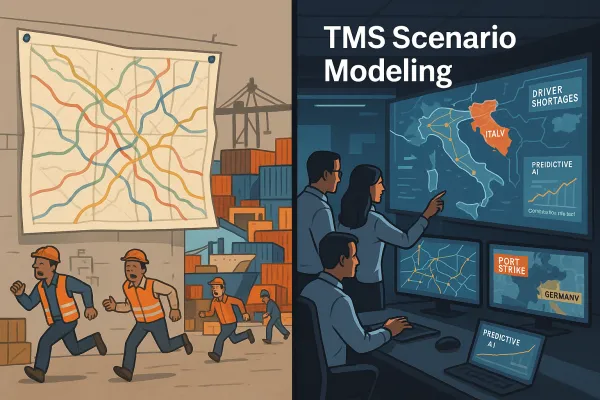
The Productivity Revolution: How European Shippers Can Leverage TMS Automation to Gain Competitive Advantage When Transport Competition Shifts From Rates to Efficiency in 2026's Capacity Crisis


European logistics managers watching the Transport Management Systems market in 2026 are seeing something unprecedented: unfilled driver positions for heavy goods vehicles (HGVs) in Europe have surged to 426,000 in 2024, marking the beginning of what industry experts call the productivity revolution. While competitors still focus on squeezing carrier rates, forward-thinking shippers are discovering that TMS productivity gains now deliver more competitive advantage than cost negotiations ever could.
This shift represents a fundamental change in how European companies compete for capacity and market position. The old playbook of rate optimization hits diminishing returns when Europe's driver shortage projected to triple by 2026, impacting half of all freight movements. Smart shippers are instead leveraging transportation management system efficiency to build sustainable competitive advantages that compound over time.
The Fundamental Shift: Why 2026 Marks the End of Rate-Based Competition
The numbers tell a stark story about Europe's transport capacity crisis. According to the IRU's 2024 Global Truck Driver Shortage Report, the number of unfilled driver positions in Europe has surged to 426,000, up significantly from 233,000 in 2023. When half a million positions remain vacant while demand continues growing, rate competition becomes secondary to operational efficiency.
This capacity shortage creates a new competitive dynamic. Companies using Manhattan Active, MercuryGate, and Cargoson are adapting differently to this environment. Some focus on carrier relationship management, others on spot market integration. But the most successful are those implementing comprehensive TMS automation that reduces dependency on manual processes entirely.
The Productivity Imperative: What's Driving This Market Evolution
European manufacturers and retailers with significant transport spend face a reality where traditional procurement advantages matter less than operational excellence. A study referenced in industry reports shows that from generating shipping documents to tracking shipments and managing carrier communications, a TMS can reduce manual tasks by up to 90%. This frees up logistics staff to focus on more strategic initiatives, while also improving accuracy and reducing the risk of human error.
The productivity imperative extends beyond simple task automation. When your operations team spends hours each day on carrier selection, rate comparison, and load planning, you're competing with organizations that complete the same work in minutes through intelligent automation. This time advantage compounds across every shipment, every day.
Quantifying the Productivity Advantage: Real Metrics That Matter
European shippers implementing strategic TMS platforms report measurable improvements that translate directly to competitive advantage. This automation reduces invoice processing time from days to hours while improving accuracy rates to above 98%. When your competitors struggle with manual processes, these efficiency gains create sustainable differentiation.
The productivity metrics that matter most in 2026's capacity-constrained environment include cycle time reduction, error elimination, and resource optimization. With automation, tasks that used to take hours can now be completed in minutes. This speed advantage becomes particularly valuable when securing capacity from preferred carriers or reacting to disruptions.
Route Planning Optimization as the New Competitive Weapon
Advanced route optimization delivers productivity gains that extend far beyond simple distance calculations. Route optimization software for trucks transforms logistics operations with measurable results: Reduces fuel costs by 20-30% through efficient routing and mileage reduction, improves on-time delivery rates to 95%+ with real-time traffic integration and dynamic rerouting.
The competitive advantage comes from systems that continuously optimize rather than plan once per day. When traffic conditions change or capacity becomes available, intelligent route planning adjusts automatically. This dynamic optimization keeps your operations running efficiently while competitors deal with disruptions manually.
The Technology Stack That Drives Productivity Gains
Modern TMS platforms create productivity advantages through integrated automation across the entire transport lifecycle. By utilizing advanced technologies, TMS automates tasks like order management, carrier selection (based on cost, capacity, and service level), and load optimization. This minimizes manual work, reduces errors, and significantly improves operational efficiency.
The technology differentiation lies in systems architecture. Cloud-native platforms like Cargoson, Blue Yonder, Oracle TM, and SAP TM offer different approaches to automation and integration. But the most productive implementations combine API connectivity, real-time data processing, and intelligent decision-making algorithms that work together seamlessly.
Load Consolidation and Capacity Utilization Optimization
Smart load planning multiplies productivity effects by maximizing vehicle utilization while minimizing empty miles. AI-driven route optimization helps minimize unnecessary mileage, reducing fuel consumption and maintenance costs. Businesses that optimize their delivery routes can save up to 20-30% on fuel costs.
Load consolidation algorithms analyze shipment characteristics, delivery windows, and vehicle capabilities to create optimized combinations that traditional manual planning cannot achieve. This optimization reduces the total number of vehicles needed while improving service levels—a crucial advantage when capacity remains constrained throughout 2026.
Implementation Strategy: Building Your Productivity Foundation
Successful TMS implementation for productivity gains requires a structured approach focused on measurable outcomes rather than feature comparisons. The framework that works in Europe's capacity-constrained environment prioritizes automation capabilities, carrier integration depth, and real-time visibility over traditional cost optimization features.
European regulatory requirements add complexity that affects productivity implementation. eFTI compliance, tachograph integration, and cross-border documentation requirements demand TMS platforms designed specifically for European operations. Solutions like Cargoson, nShift, Transporeon, and Alpega offer different approaches to regulatory compliance, but the most productive implementations automate these requirements rather than simply managing them.
Measuring and Maximizing Your Competitive Edge
Productivity-focused TMS deployment requires KPIs that capture operational efficiency rather than just cost reduction. Key metrics include processing time reduction, error rate improvement, and resource utilization optimization. In pilots, on-time delivery rose 8-15%, late-shipment rates fell 10-20%, demonstrating the service level improvements that drive competitive advantage.
The most valuable implementations track productivity gains across multiple dimensions: administrative efficiency, planning accuracy, and execution speed. When your team processes twice as many shipments with the same resources, you've created a sustainable competitive advantage that compounds over time.
The 2026 European Context: Regulatory and Market Factors
European transport regulations amplify the productivity advantage for companies with efficient TMS implementations. Compliance requirements that consume hours of manual work for competitors become automated background processes for well-implemented systems. This regulatory efficiency creates competitive differentiation that extends beyond pure operational productivity.
The market factors driving productivity competition include not just driver shortages but also increased customer expectations, sustainability requirements, and digital documentation mandates. Europe's driver shortage projected to triple by 2026, impacting half of all freight movements makes operational efficiency the primary differentiator between companies that thrive and those that struggle.
European shippers entering 2026 face a choice: continue optimizing rates in an increasingly unwinnable game, or build productivity advantages that create sustainable competitive differentiation. The companies implementing strategic TMS automation now are positioning themselves to capture market share as capacity constraints intensify throughout the year.
Your next strategic decision should focus on productivity rather than procurement. When manual processes become competitive disadvantages and operational efficiency determines market access, TMS automation transforms from a nice-to-have into a survival requirement. The question isn't whether to invest in productivity gains—it's how quickly you can implement them before your competitors do.