The Voice Revolution in European TMS: How Smart Shippers Are Deploying AI Voice Agents to Automate Carrier Communications and Driver Dispatch Before Manual Operations Become Competitive Disadvantages

European logistics teams monitoring carrier calls know the frustration well. When drivers get stuck at border crossings or sudden weather disrupts your planned routes, manual coordination becomes chaos. Recent data from the International Road Transport Union (IRU) indicates that unfilled driver positions for heavy goods vehicles (HGVs) in Europe have surged to 426,000 in 2024, creating pressure that makes every operational inefficiency costly.
VoiceInfra's dispatch AI revolutionizes logistics communication by automating up to 90% of dispatch-related calls. Our AI dispatch software handles load bookings, rate negotiations, and carrier updates instantly - while reducing operational costs and improving carrier relationships. This isn't theoretical anymore. Trimble announced future AI agents and workflows across the company's connected transportation solutions including an Order Intake Agent for Trimble's line of transportation management systems (TMS), an Invoice Scanning Agent for Trimble TMT Fleet Maintenance, and a Road Call Agent for Trimble TMT Road Call. "Our new AI agents are designed to eliminate the manual bottlenecks that slow down supply chain operations," said Michael Kornhauser, sector vice president, transportation and logistics at Trimble.
Here's what changes the game: voice AI agents don't just handle routine status updates. They can detect when your driver calls about a breakdown, collect the critical details, immediately forward the information to your maintenance team, and simultaneously update your TMS with revised ETAs. All while your logistics coordinator handles other priorities.
Why Voice AI is the Missing Link in European TMS Automation
These intelligent assistants manage high-volume calls, automate shipment updates, confirm deliveries, and support 24/7 communication across dispatch, customers, and drivers—without adding headcount. The productivity gains aren't marginal improvements; they're transformational shifts that change how European transport operations compete.
Consider this scenario: Your Hamburg facility receives notification that three shipments bound for different Italian destinations face potential delays due to weather. Automated Routing and Scheduling: AI voice agents integrate with your TMS to schedule pickups, confirm deliveries, or reroute shipments using live data. Instead of manual coordination across multiple time zones and languages, your voice AI system simultaneously contacts affected carriers in German and Italian, confirms alternate routing options, updates customer delivery windows, and logs all interactions directly in your TMS.
Traditional TMS platforms like SAP TM and Oracle handle data processing well, but they can't make those urgent 3 PM calls to carriers when capacity suddenly disappears. We support all major TMS platforms through our flexible integration layer. Whether you use a commercial TMS or proprietary system, we can ensure seamless data flow for loads, rates, and carrier information. Solutions like Cargoson take a different approach, building voice AI capabilities directly into their European-focused platform architecture.
The European Context: Multilingual Complexity and Driver Shortage Reality
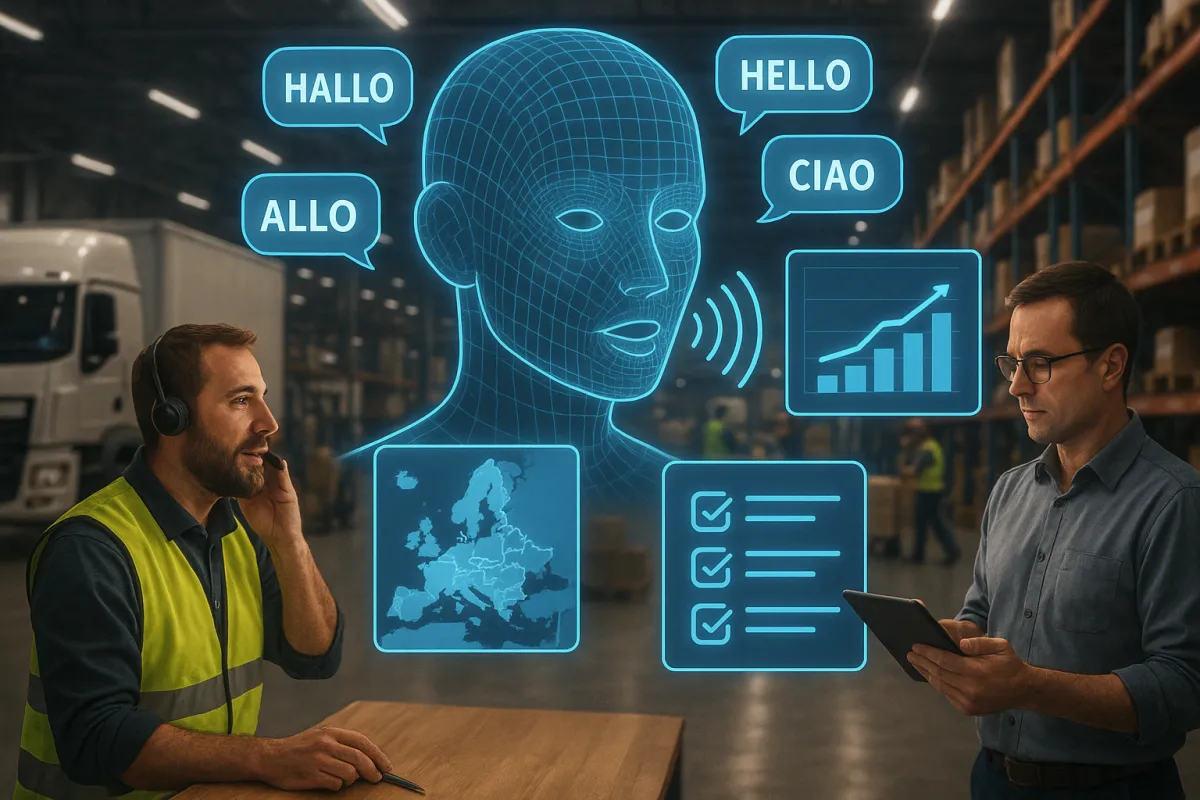
Multilingual Communication: Support across multiple languages ensures clear, native-like interaction with drivers, suppliers, and customers in different regions. This boosts service reliability and minimizes language barriers during global coordination. When your Polish driver calls about a customs delay at the German border, your voice AI needs to understand the situation in Polish, access relevant documentation systems, and coordinate with German authorities - all while updating your Amsterdam-based operations team in English.
Without action to make the driver profession more accessible and attractive, Europe could lack over two million drivers by 2026, impacting half of all freight movements and millions of passenger journeys. The European truck driver profession has an ageing population with an average age of 47. One third of truck drivers are over 55 and expected to retire in the next ten years, while less than 5% are below 25 years of age.
This shortage amplifies communication complexity exponentially. Instead of having experienced dispatchers who know carrier networks by memory, you're managing operations with newer staff handling increased volumes across shrinking capacity. Voice AI becomes the institutional memory that captures carrier preferences, handles routine negotiations, and escalates only the exceptions that require human judgment.
Practical Voice AI Applications That Actually Work in European Transport
The most successful European implementations focus on specific, measurable workflows rather than attempting universal automation. This includes an Order Intake Agent for Trimble's line of transportation management systems (TMS), an Invoice Scanning Agent for Trimble TMT Fleet Maintenance, and a Road Call Agent for Trimble TMT Road Call. These agents eliminate the manual review required for 90% of standard orders while saving operations teams 40-50 hours weekly on invoice processing.
Real deployment examples show dramatic results. Many programs report a ~15% reduction in logistics costs and faster decision cycles, while service levels improve by up to ~65% through real‑time decisions reported industry findings. Our product, virtualworkforce.ai, drafts replies and updates systems inside email, which cuts handling time from roughly 4.5 minutes to 1.5 minutes per message. In addition, it links ERP, TMS, WMS, and SharePoint, so teams avoid hunting across new systems.
Your voice AI can monitor weather patterns, cross-reference traffic data, and automatically contact affected carriers when conditions suggest delivery delays. Instead of discovering problems after they've impacted customer deliveries, your system proactively reaches out to carriers, confirms alternate routing, and updates customer expectations - all before your logistics team arrives for their morning briefing.
Think of it as having a multilingual logistics coordinator who never sleeps, never takes vacation, and instantly accesses your entire carrier database while speaking naturally with drivers, dispatchers, and customers in their preferred languages.
Real-Time Driver Communication and Emergency Response
As an AI-powered voice agent I streamline logistics operations by verifying MC (Motor Carrier) numbers, extracting shipment status, and reducing dispatcher call volume by 50%. I help facilitate effective communication among drivers, dispatchers, and brokers, ensuring fast and reliable interactions, as well as enhanced compliance.
Emergency scenarios demonstrate voice AI's biggest advantages. When drivers experience breakdowns, By interacting with customers 24/7, providing instant updates on delivery ETAs, shipment tracking, and issue resolution. Recording conversations, verifying credentials, and syncing with FMCSA, ELDs, and telematics systems. The system collects critical incident details, dispatches roadside assistance, notifies customers about potential delays, and updates delivery schedules - all while maintaining regulatory compliance logs.
Voice AI handles the routine communication that typically overwhelms dispatchers during peak hours or crisis situations. Use voice AI to confirm, reschedule, and follow up on delivery appointments. They can proactively call shippers or drivers to confirm pickup/drop-off windows, verify ETAs, and push real-time updates to your logistics systems, improving visibility and on-time performance.
European regulations add another layer of complexity that voice AI manages automatically. Your system can verify driver hours against EU tachograph regulations, confirm temperature monitoring for pharmaceutical shipments, and ensure cross-border documentation completeness - all through natural conversation with drivers who may be managing multiple delivery requirements simultaneously.
The Implementation Framework: Avoiding the 76% Failure Rate
Seventy-six percent of logistics transformations never fully succeed, failing to meet critical budget, timeline or key performance indicator (KPI) metrics, but voice AI implementations succeed when they follow proven frameworks rather than attempting comprehensive transformation immediately.
Start with bounded scope: Single workflow, clear success criteria, measurable ROI. For European shippers, this might mean testing agentic route optimization for specific corridors or automating customs documentation for particular trade lanes rather than attempting full-scale transformation immediately.
Smart implementations begin with your highest-volume, most routine communication workflows. Order confirmations, delivery scheduling, and status updates represent perfect starting points because they're predictable, measurable, and immediately show ROI. Once your team sees voice AI handling 200 routine calls monthly, they understand the potential for more complex applications.
Successful European projects follow this sequence: First, identify your three highest-volume communication workflows. Document the current manual process, including average handling time and error rates. Second, select voice AI platforms that demonstrate deep European market understanding. Traditional TMS providers like SAP TM and Oracle often struggle with these localized requirements. Their conversational AI modules are built for global markets, which means they lack the nuanced understanding of European transport corridors, seasonal capacity variations, and regulatory differences between EU member states.
Vendor selection requires technical depth beyond marketing demonstrations. Can the platform handle German VAT calculations while processing French customs documentation? Does it integrate with both API-native carriers like DHL and legacy systems that still use EDI? European-focused solutions like Cargoson build these requirements into their core architecture, while established players like MercuryGate and Blue Yonder offer robust customization capabilities that can address European complexity through configuration.
Technical Requirements and Integration Considerations
Voice agents should connect directly with your transport, warehouse, and customer systems. Integration success depends on your TMS architecture supporting event-driven APIs, secure webhooks for real-time data synchronization, and audio streaming capabilities that map voice intents to system actions.
Performance targets matter more than feature lists. Your voice AI system needs sub-300ms end-to-end latency for natural conversation flow, high automatic speech recognition accuracy with domain-specific tuning for logistics terminology, and noise suppression capabilities for warehouse and vehicle environments. Advanced NLU enables AI voice agents to interpret diverse queries and respond appropriately, even with incomplete or non-linear speech. This reduces misunderstandings and improves communication accuracy across varied use cases.
European technical requirements add complexity that many global platforms underestimate. Your system needs to handle multiple character sets for addresses, support varying phone number formats across EU countries, and integrate with local carrier systems that may use different API standards or data formats. Some carriers in Eastern Europe still rely heavily on phone communication, making voice AI integration capabilities crucial for comprehensive coverage.
Direct integration with your Transportation Management System ensures real-time synchronization of load data, rate confirmations, and carrier communications. Our platform is designed for rapid deployment with minimal disruption to existing workflows. Most European implementations complete initial deployment within 1-2 weeks when technical requirements are properly scoped upfront.
ROI Measurement and Business Case Building
If coordinators spend 60 hours monthly on tasks that TMS automates in 15 hours, that's 45 hours of freed capacity monthly. If GoComet eliminates 60 hours of manual work in the first month, that's $2,400 in immediate productivity gains.
The ROI calculation becomes compelling when you quantify manual communication costs accurately. Most companies realize a full return on their TMS investment within 6 to 18 months when adoption is real and processes are standardized. Voice AI accelerates this timeline by eliminating the learning curve for routine interactions.
Traditional dispatch operations require proportional staff increases as volume grows. Voice AI systems scale communication capacity without additional headcount. When your Amsterdam operations center handles 1,000 carrier calls monthly, adding voice AI reduces that to 300 calls requiring human attention while processing the remainder automatically. The cost comparison becomes stark: adding a second dispatcher costs €60,000 annually plus benefits, while voice AI handles the equivalent workload for a fraction of that investment.
Many transport teams that adopt these methods report measurable productivity gains, especially when they connect AI to their TMS. In 2025, adoption rose and firms invested in agentic systems for quoting and tracking. European manufacturers implementing voice AI report additional benefits beyond cost savings: improved carrier relationships through consistent communication, reduced errors in cross-border documentation, and faster response times for urgent capacity requests.
Build your business case around European-specific value drivers. Document the cost of manual translation when coordinating with multilingual carrier networks. Calculate time savings from automated VAT compliance checks. Quantify the competitive advantage of 24/7 communication capabilities when securing capacity from Eastern European carriers operating in different time zones.
European Regulatory Compliance and Voice AI
From 2026, the EU Artificial Intelligence Act will come into full effect for logistics companies, requiring high-risk AI systems to meet specific obligations including risk management systems, data governance measures, and human oversight requirements.
As of 9 July 2027: The eFTI Regulation will apply in full. Member State authorities must accept information shared electronically by operators via certified eFTI platforms. Your TMS needs to be ready, or you'll face compliance gaps that could shut down cross-border operations. Voice AI systems processing cross-border transport communications need built-in eFTI compliance capabilities.
Compliance requirements become selection criteria, not afterthoughts. Your voice AI platform must include access controls that meet EU data protection standards, encryption for voice data handling customer information, audit logs for regulatory inspections, and support for MCP (Multimodal Cargo Platform) standards. European-focused platforms like Cargoson integrate these requirements natively, while global providers may require additional compliance modules or custom development.
Document retention policies become critical when voice AI systems record carrier negotiations or customer service interactions. European regulations require specific data handling procedures for voice recordings containing personal information, with clear consent mechanisms and defined retention periods. Your implementation plan needs legal review to ensure voice AI deployments meet both GDPR requirements and industry-specific regulations.
The Strategic Window: Acting Before Voice Becomes Table Stakes
Expect to see more traction in this area in 2026 as workflow-focused platforms add more agentic AI features that can sit on top of core systems like ERP. What distinguishes 2026 from earlier waves of experimentation is maturity. 61% of logistics leaders anticipate fully autonomous agentic AI within the next five years for TMS.
By December 2026, every serious European logistics operation will run agentic systems for routine communication workflows. The question isn't whether voice AI will become standard - it's whether you'll be among the early adopters building competitive advantages or among the late majority playing catch-up when capacity remains constrained.
European transport procurement strategies built around simple rate optimization face extinction in 2026. Without action to make the driver profession more accessible and attractive, Europe could lack over two million drivers by 2026, impacting half of all freight movements, while European shippers entering 2026 facing a choice: continue optimizing rates in an increasingly unwinnable game, or build productivity advantages that create sustainable competitive differentiation.
Smart European manufacturers are positioning voice AI deployment as operational insurance against capacity constraints rather than simple efficiency improvements. When your primary carriers can't handle peak volume, voice AI systems automatically engage backup carriers using pre-negotiated rate frameworks and established communication protocols. This capability becomes invaluable when manual coordination would delay critical shipments.
The implementation window remains open, but vendor consolidation and increased demand will affect both pricing and availability. WiseTech Global's $2.1 billion acquisition of E2open and Descartes Systems Group's $115 million purchase of 3GTMS in March 2025 represent the most significant TMS vendor consolidation wave in over a decade, creating pressure on independent solutions and specialized European providers.
European shippers who act strategically within the next 90 days can secure voice AI implementations before 2026's regulatory deadlines and capacity constraints eliminate flexibility. The companies that deploy these systems successfully will operate with sustainable productivity advantages while their competitors struggle with manual processes and capacity shortages.
Your strategic decision isn't about choosing between voice AI providers - it's about positioning your European transport operations for competitive advantage when productivity matters more than price optimization.