Setting Up a Fuel Surcharge Clause for EU Carriers
Learn to build a transparent diesel floater clause for EU carrier contracts: pick an index, set the formula, and automate checks in your TMS.


Why most European fuel surcharge clauses are quietly costing you money
If your fuel surcharge clause was last touched before 2020, it is almost certainly wrong today, in one direction or the other. Most freight contracts in Europe still carry fuel surcharge clauses written in 2019 or earlier, and after three years of 30%+ peak-to-trough diesel volatility, those clauses leak margin in both directions: carriers absorb spikes they cannot pass on, shippers overpay when the pump price drops. Neither outcome is good for a long-term relationship, and both show up as invoice disputes that eat your procurement team's time.
The reason a fuel surcharge clause, sometimes called a diesel floater, matters as much as the base rate is simple arithmetic. Diesel is 28% to 35% of a European haulier's cost per kilometre, and fuel typically represents 25–35% of total road freight costs for heavy vehicles over 20 tonnes. When that big a cost block moves 15-20 cents a litre in a quarter, and your contract doesn't have a mechanism to track it, someone is absorbing risk they never priced. Carriers operating on 4% to 6% net margin cannot absorb a single 15 cent diesel move; shippers cannot accept a 5% rate increase without justification. A properly built clause settles that argument before it starts.
Before you start: what you need
You'll need four things on the table before you draft a single sentence: the current carrier contract or rate card, three to six months of invoice history broken out by lane, access to a TMS or freight audit module that can hold the surcharge as its own line item, and internal agreement on which lanes and vehicle types you're covering (FTL, LTL, groupage all behave differently). You'll know the clause is working when your recalculated surcharge, run independently against the published index, matches the carrier's next invoice within a small rounding tolerance, not when the carrier tells you it matches.
How to build the clause, step by step
Here's the sequence that produces a clause both sides can actually audit, rather than one that reads well but collapses the first time diesel moves 10% in a month.
- Choose a public reference index and name it explicitly. The EU Oil Bulletin is the most common reference for European routes because it is official, independent, and published weekly. For Spain, many contracts instead reference the Orden FOM/1882/2012 formula, where adjustments are triggered when diesel prices vary by more than 5% from the contract reference price. France has the CNR index; Germany often uses the Federal Statistical Office diesel series. Whichever you pick, write the exact name and publication source into the contract text, not "the applicable market index."
- Fix the baseline price and the exact date it was taken. "Price at signature" is not a baseline, it's an invitation to argue later. Write the litre price, the week number, and the index source into an annex.
- Set the fuel cost share for the vehicle type. This is the percentage of the base rate that fuel represents, and it isn't uniform across your network. In groupage transport, fuel costs are lower compared to FTL or LTL services, so a single blanket percentage across your whole carrier base will overpay on groupage lanes and underpay on FTL ones. The mechanism itself is identical, though: LTL and groupage rates distribute fuel costs across multiple shippers, so the per-LDM impact is smaller, but surcharges are still applied as a percentage of the base rate.
- Define a dead band. Small weekly noise in the index shouldn't trigger a recalculation every time. A ±1-2% band around baseline before any adjustment kicks in keeps the admin burden reasonable for both sides.
- Set the recalculation cadence. Monthly is the European standard and matches how most carriers already report internally. Weekly is more precise but adds administrative load that's rarely justified unless you're on a high-volume, high-volatility lane.
- Write the formula out in full, with a worked numeric example in the annex. Don't rely on prose. The calculation itself is simple: multiply the change in the fuel price index by the diesel cost share that makes up the carrier's total costs, for instance 28%. A concrete illustration removes ambiguity: if diesel prices rise from €2.10 to €2.29 per litre, and the agreed floater table says that this equals a 2.5% surcharge, the rate moves from €1.50/km to €1.5375/km. Put numbers exactly like that into your contract annex, not just the algebra.
- Add caps, floors, and make the adjustment symmetric. A clause that only moves up when diesel rises isn't a fuel surcharge clause, it's a one-way rate increase mechanism. Insist the same formula applies when the index falls.
- Add an audit clause. Require the carrier to state, in writing, the published index value and reference date used for each billing period. This single line prevents more disputes than any other part of the contract.
Automating the clause in your TMS or freight audit module
Automation only works if the surcharge lives as its own tariff line, never bundled into the linehaul rate. Define a clear tariff line for the fuel surcharge, specify the unit as a percentage of eligible charges or an amount per activity, and keep the base rate and surcharge separated on the invoice. Bundle the two and no software, and no auditor, can tell you whether the carrier applied the formula correctly.
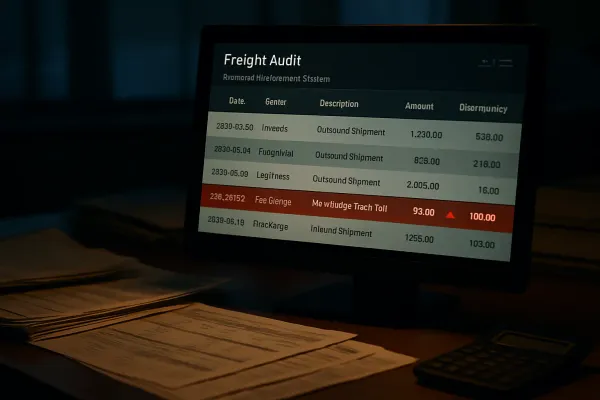
The risk of doing this in spreadsheets is well documented: when your surcharge logic lives in scattered spreadsheets, mistakes creep in: wrong index cell, outdated bands, a missing cap. A TMS or dedicated freight audit module removes that fragility by pulling the published index automatically and flagging any invoice that deviates from the agreed formula, rather than a controller manually checking a percentage against a PDF bulletin every month.
| Platform | Multi-carrier surcharge handling | Best fit |
|---|---|---|
| Transporeon (now part of Trimble) | Rate and index management across large carrier pools | Shippers running frequent tenders across many lanes |
| Alpega | TMS-integrated tariff and surcharge modules | Mid-to-large shippers with mixed FTL/LTL networks |
| Cargoson | Multi-carrier order and invoice management with tariff line separation | Shippers consolidating several carrier contracts into one workflow |
| project44 | Visibility-led platform with rate and cost data integration | Shippers prioritizing tracking alongside cost control |
Failure mode: what to do when the carrier's invoice doesn't match your calculation
This happens more often than either side admits, and it usually traces to one of three causes: the carrier is quoting from an internal proprietary table instead of the named index, the baseline in your contract is stale (renegotiated verbally but never updated in writing), or the index itself was discontinued or replaced and nobody updated the clause.
The fix is procedural, not confrontational. Require the carrier to reference the named public index and publish the weekly value used for each billing period, then compare that figure against your own pull of the same bulletin for the same date. If the numbers still don't reconcile, cite the audit clause directly in your query, in writing, and ask for the calculation to be shown line by line. Insist on a transparent formula rather than a carrier-defined table; the Orden FOM/1882/2012 method is widely accepted as a fallback reference if your own contract language is ambiguous. If the dispute drags on, your freight audit module's discrepancy report becomes the evidence you bring to the next rate review rather than a one-off argument settled by email.
When to revisit the clause
Tie the fuel surcharge review to your retender cycle, not to whenever diesel makes headlines. Every retender resets the baseline anyway, so treat that reset as a deliberate lever rather than something that happens to you. Set a quarterly review cadence with your carriers specifically for fuel surcharge terms, even outside full retenders, so a clause never drifts three years out of date again. Pull your last twelve months of invoices, recalculate what the surcharge should have been against the published index for each period, and use the gap, if there is one, as the opening data point in your next negotiation.