The €4,700 Van Fleet Transformation: How European Shippers Can Turn Mandatory G2V2 Tachograph Implementation Into Strategic TMS Advantage Before July 2026's Bottlenecks Crush Unprepared Competitors


From 1 July 2026, vans with a gross vehicle weight of 2.5–3.5 tonnes used for international goods transport will be required to use second-generation smart tachographs (G2V2), fundamentally transforming how European manufacturers manage their light commercial vehicle fleets. The financial impact extends far beyond the advertised device costs, with logistics professionals in Poland reporting that installation costs can reach 3,500-4,700 EUR per vehicle, which, combined with other costs such as purchasing software and employee training, can seriously threaten the profitability of small enterprises. The regulatory deadline isn't just another compliance hurdle. For example, in April 2024, the Spanish association Fenadismer reported that only 10% of the total number of buses and trucks required to switch to G2V2 had done so. Without strategic planning, your van fleet faces the same installation bottlenecks that devastated competitors during the heavy vehicle rollout.
The G2V2 Van Fleet Compliance Reality Check: Why €4,700 Per Vehicle Is Just the Beginning
Most European shippers focus on the headline tachograph costs while missing the multiplication effect that transforms "simple compliance" into major budget overruns. The financial impact extends far beyond the advertised device costs, with logistics professionals in Poland reporting that installation costs can reach 3,500-4,700 EUR per vehicle, which, combined with other costs such as purchasing software and employee training, can seriously threaten the profitability of small enterprises.
Hardware is only the opening cost (around EUR 1000 for purchase and installation). The real workload follows: driver cards and company cards, staff training, procedure updates, and reliable software for data reading/archiving. The hidden costs compound quickly: company cards cost €150-200 per vehicle, driver cards run €40-80 each, and workshop slots book 3-6 months in advance during peak periods.
The Three-Million Vehicle Challenge: Understanding Scope and Timing
From 1 July 2026, vans with a gross vehicle weight above 2.5 t up to 3.5 t performing international carriage of goods or cabotage for remuneration will be brought fully under the rules on driving time, rest periods, tachographs and driver posting. This affects up to three million vehicles across Europe, creating unprecedented demand for specialized workshops and certified installations.
Importantly, it is not the vehicle class itself that determines the obligation, but rather the commercial purpose and type of transport. Domestic operations remain exempt, but any cross-border movement triggers the requirement. Van-trailer combinations where the combined weight exceeds 2.5 tonnes also fall under the mandate.
The Workshop Bottleneck Crisis: Learning From Heavy Vehicle Implementation Disasters
Experience from the G2V2 rollout has shown that leaving retrofits until the last moment creates bottlenecks. Workshops face high demand, waiting times increase, and costs can rise unexpectedly. The heavy vehicle implementation provides a stark warning: For example, a Czech company ran into trouble near Dresden in the very first days — in addition to a fine of €1,500 (for a first-generation smart tachograph that had not been replaced), the truck had to remain in service and wait its turn for installation.
Those waiting until Q2 2026 faced installation costs 40-60% higher than early adopters. Workshop capacity constraints mean that companies scheduling installations 6-9 months before the deadline typically secure better rates and avoid premium pricing. Time slots at certified workshops are also limited, especially when the deadline is fast approaching.
Enforcement hits immediately. At the same time, there is the threat of heavy penalties for non-compliance – up to 1,500 euros in Germany and up to 3,328 euros in Italy. Companies can't rely on grace periods or delayed enforcement this time.
The TMS Integration Opportunity: Transforming Compliance Into Competitive Advantage
Automated tachograph data integration through TMS platforms delivers operational benefits that extend far beyond compliance requirements. Fleet visibility improvements enable better route optimization and load consolidation. Driver performance analytics support targeted efficiency improvements. Real-time compliance monitoring prevents costly violations before they occur.
European operations often see 15-25% improvements in transport administrative efficiency within the first year of successful TMS data integration. These improvements come from reduced manual data entry, automated compliance reporting, and enhanced visibility across transport networks. Major platforms including Cargoson, Oracle TM, SAP TM, and MercuryGate offer different approaches to G2V2 integration, with varying degrees of automation and European regulatory support.
Real-Time Data Integration: Beyond Basic Compliance
G2V2 devices deliver significantly enhanced data capabilities compared to previous generations. They automatically record border crossings, eliminating the need to stop the vehicle and manually enter this data. They also record location data every three hours and information about loading and unloading. These devices are equipped with a Bluetooth interface, enabling integration with external fleet management systems. Additionally, they have increased memory capacity, allowing storage of driver activity data for 56 days (compared to the previous 28 days).
Integration with tachograph data, working time rules, and cost monitoring ensures compliance and financial oversight. The Bluetooth interface enables seamless pairing with fleet telematics platforms, providing richer data streams for compliance monitoring and route management that connect tachograph information directly to existing fleet management software.
The Strategic Implementation Framework: Avoiding the 76% Failure Rate
The first step should be a fleet analysis to determine which vehicles will require G2V2 tachographs. It is also advisable to book installation appointments at authorised workshops well in advance, as demand is expected to increase closer to the deadline. At the same time, companies should apply for driver and company cards, plan staff training and update internal procedures.
Budget overruns hit 75% of European TMS implementations, and 66% of technology projects end in partial or total failure. The phased implementation approach that works: fleet analysis in Q2 2025, workshop booking by Q3 2025, TMS vendor selection by Q4 2025, and integration testing starting Q1 2026.
European regulatory requirements add complexity that affects implementation success rates. eFTI compliance, tachograph integration, and cross-border documentation requirements demand TMS platforms designed specifically for European operations. Vendors like Cargoson, Transporeon, and Alpega offer European-specific solutions with built-in regulatory support.
Cost Management and ROI Optimization: Making the Numbers Work
European shippers who implemented bulk procurement strategies achieved 15-25% cost reductions compared to individual vehicle installations. Companies scheduling installations 6-9 months before the deadline typically secured better workshop rates and avoided premium pricing. The cost control framework that works focuses on total cost of ownership rather than initial purchase prices.
TMS automation reduces ongoing administrative costs substantially. European operations often see 15-25% improvements in transport administrative efficiency within the first year of successful TMS data integration. Smart shippers are calculating ROI based on administrative time savings, compliance cost avoidance, and operational efficiency gains rather than just regulatory compliance.
Smart European shippers view G2V2 implementation as infrastructure investment rather than regulatory expense. The financial justification for executive buy-in should emphasize the productivity gains that offset compliance costs over time.
The Procurement Window: Securing TMS Contracts Before Vendor Consolidation Hits
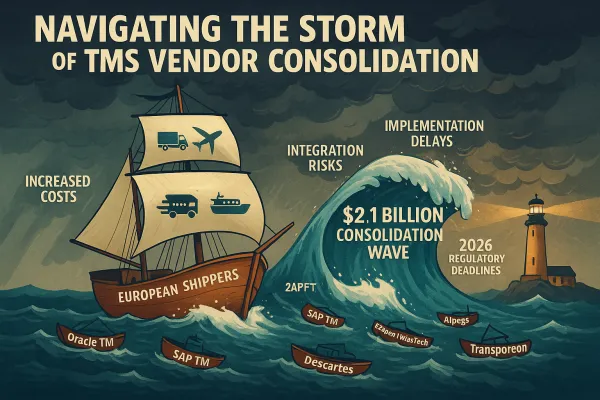
Europe could lack over two million drivers by 2026, impacting half of all freight movements, while WiseTech Global's $2.1 billion acquisition of E2open and Descartes Systems Group's acquisition of 3GTMS for USD 115 million signal the most significant vendor consolidation wave in TMS market history. The vendor consolidation happening now directly impacts your future integration options. WiseTech's acquisition of E2open in 2025, Descartes' purchase of 3GTMS for $115 million in March 2025, and Körber's transformation of MercuryGate into Infios following their 2024 acquisition represent just the beginning of a fundamental market restructuring that's forcing European shippers to reconsider their entire TMS procurement strategy.
The regulatory convergence of 2026 creates procurement opportunities that won't repeat. The regulatory pressure of 2026 creates a procurement opportunity that won't repeat. Use these converging deadlines to secure TMS contracts that deliver both compliance certainty and operational excellence.
Vendor selection criteria should emphasize European regulatory support capabilities over generic features. This means evaluating vendors like Cargoson, Manhattan Active TMS, Blue Yonder, and Oracle TM based on their demonstrated regulatory compliance capabilities, not just their routing algorithms or carrier connectivity. Vendors without robust compliance roadmaps will struggle to support your operations post-2026, regardless of their current feature set.
Performance Guarantee Structures: Build regulatory deadlines directly into your implementation timeline and penalty clauses. If a vendor can't deliver eFTI compliance by January 2026 or tachograph integration by July 2026, that's grounds for contract adjustment or termination. Contract terms should protect against compliance cost escalation and include specific deliverables for G2V2 data integration capabilities.
European manufacturers who build comprehensive G2V2 implementation frameworks early position themselves for sustained competitive advantages. For European shippers managing cross-border operations, it represents a potential €4,700-per-vehicle cost explosion that could crush unprepared companies while rewarding those who build comprehensive cost management frameworks early. The companies that act now secure implementation capacity, avoid workshop bottlenecks, and transform mandatory compliance into strategic advantage. Those who wait face cost overruns, installation delays, and missed optimization opportunities that could impact profitability for years.