The European Shipper's 2026 Regulatory Compliance Advantage: How to Turn 8 Critical Transport Deadlines Into Strategic TMS Procurement Power Before Vendor Options Disappear


The most significant regulatory convergence in European transport history is happening right now. The year 2026 promises to be exceptionally challenging for the transport industry in Europe. Stricter regulations regarding the transport of dangerous goods will come into effect, as well as new vehicle safety requirements, the obligation of tachographs in vans, and the digitization of international documents. While most European shippers view these deadlines as compliance headaches, procurement teams who understand the strategic implications can leverage this regulatory pressure into significant TMS contract advantages before vendor options disappear.
The 2026 Compliance Perfect Storm: 8 Critical Deadlines Converging
European shippers face an unprecedented convergence of regulatory requirements in 2026 that fundamentally alters the TMS procurement landscape. From November 2, 2025, with full implementation by June 24, 2026, new rules for the transport of dangerous goods will be in force. From 1 July 2026, international freight transport performed by vans up to 3.5 tonnes enters the tachograph regime: second-generation smart tachographs (G2V2) become mandatory, affecting thousands of light commercial vehicles across Europe.
2026 won't be "one more regulatory year" for European road freight — it's a stack of changes landing close to each other: dangerous goods enforcement gets stricter, vans enter the tachograph era, new safety tech becomes standard in newly produced heavy vehicles, and cost drivers (wages, tolls, access restrictions) keep climbing. The deadlines include ADR enforcement by June 2026, G2V2 tachographs for vans by July 2026, digital ECMT permits from January 2026, and progressive eFTI platform certification starting January 2026.
What makes 2026 particularly challenging is that these aren't isolated compliance requirements. Paper documents are becoming history, requiring integration with ERP and TMS systems and staff training in handling new procedures. For carriers, this means the need to update operational processes, transport schedules, and planning of international transport outside the EU and EFTA. Your TMS selection directly impacts how well your organization navigates this regulatory maze.
The Hidden Cost of Regulatory Scrambling: Why 75% of TMS Implementations Fail
The regulatory pressure of 2026 is colliding with an already problematic TMS implementation landscape. Budget overruns hit 75% of European TMS implementations, yet most shippers focus only on subscription costs when evaluating systems. Implementation costs range from €30,000 to €900,000, and for shippers with freight spend exceeding $250M annually, implementation can cost 2-3 times the subscription fee.
A German automotive parts manufacturer discovered their €800,000 TMS implementation mistake the hard way. Six months into deployment, they found their European carriers couldn't integrate without costly custom development work - turning their "smart procurement decision" into a complete platform re-implementation. This failure pattern becomes even more dangerous when combined with regulatory deadlines.
The root cause isn't technical complexity alone. European shippers consistently underestimate TMS implementation costs because they conflate software subscription fees with total project expense. The "long pole of the tent" of implementation time, and therefore cost, resides in the design, build, and testing of integrations. Adding regulatory compliance requirements to already complex integrations multiplies both risk and cost exponentially.
Flipping the Negotiation Script: From Compliance Burden to Procurement Weapon
Instead of treating 2026 regulatory requirements as obstacles, procurement-savvy European shippers are using these deadlines as vendor selection criteria and contract negotiation leverage. The approach works because vendors face the same deadline pressures but with greater exposure to customer demands.
Smart procurement teams are structuring their TMS evaluations around compliance readiness rather than traditional feature checklists. This means evaluating vendors like Cargoson, Manhattan Active TMS, Blue Yonder, and Oracle TM based on their demonstrated regulatory compliance capabilities, not just their routing algorithms or carrier connectivity.
The key insight? Vendors without robust compliance roadmaps will struggle to support your operations post-2026, regardless of their current feature set. To keep service levels stable in 2026, treat compliance as a procurement and planning topic — not only a carrier problem. Update tender requirements: specify emission class, zone access readiness, and tachograph compliance where relevant. Ask for evidence, not declarations: ADR procedures/training, tachograph rollout plan, cards/software readiness for vans.
The Certification Timeline Advantage: Making Vendors Prove Their Regulatory Readiness
The eFTI implementation timeline creates specific negotiation windows that smart procurement teams can exploit. September 2025: The European Commission will finalise technical and functional requirements for IT systems and define the certification process for eFTI platforms and service providers. January 2026: eFTI platforms and service providers start preparing for operations, while national authorities may begin accepting digital freight data for inspections.
As of January 2026: eFTI platforms and service providers can start preparing for operations. Member States authorities may start accepting data stored on certified eFTI platforms for inspection. This voluntary period provides testing opportunities, but only for vendors with actual eFTI integration capabilities.
Use these specific dates as contract delivery milestones. Vendors claiming eFTI readiness should demonstrate functional integration by January 2026, not just promise compliance by the July 2027 mandate. As of July 2027, this data may be shared via secure, eFTI-certified IT platforms that can be easily integrated into companies' existing data management systems. The companies will then be able to share standardised freight transport data with the authorities and business partners.
The Strategic Procurement Framework: 5 Steps to Leverage Regulatory Pressure
Here's the systematic approach European shippers are using to turn compliance deadlines into procurement advantages:
Step 1: Map Compliance Requirements to Business Impact. Don't just list regulatory requirements – quantify their operational impact. Failure to comply with the regulations can result in severe penalties, which in some countries can reach up to 30,000 euros. Companies must account for costs of purchasing and installing devices (3,000-5,500 PLN per vehicle), expenses for driver cards (150-200 PLN) and company cards (about 283 PLN), as well as training in tachograph operation.
Step 2: Establish Vendor Compliance Benchmarks. Create specific evaluation criteria around regulatory readiness. This includes eFTI platform certification status, G2V2 tachograph data integration capabilities, ADR documentation management, and ECMT digital permit handling.
Step 3: Structure Contracts Around Compliance Milestones. Build regulatory deadlines directly into your implementation timeline and penalty clauses. If a vendor can't deliver eFTI compliance by January 2026 or tachograph integration by July 2026, that's grounds for contract adjustment or termination.
Step 4: Demand Regulatory Training and Support. Implementation Support Requirements: Demand vendor-provided training and support for regulatory transitions. This isn't just nice-to-have – it's essential for avoiding compliance penalties. Include specific training hours and support availability in contract terms.
Step 5: Negotiate Compliance Guarantees. Structure contracts so vendors share financial risk for regulatory non-compliance. This aligns their incentives with your operational needs and regulatory obligations.
Timing Your Market Entry: The 18-Month Window Before Options Disappear
The TMS vendor consolidation wave is eliminating procurement choices while regulatory urgency grows. WiseTech Global's $2.1 billion acquisition of E2open, expected to complete in 1H26, alongside Descartes Systems Group's $115 million acquisition of 3GTMS in March 2025, represents the most significant TMS vendor consolidation wave in recent history.
The most significant TMS vendor consolidation wave in over a decade is reshaping European procurement decisions right now. WiseTech's acquisition of E2open in 2025, Descartes' purchase of 3GTMS for $115 million in March 2025, and Körber's transformation of MercuryGate into Infios following their 2024 acquisition represent just the beginning of a fundamental market restructuring that limits future options.
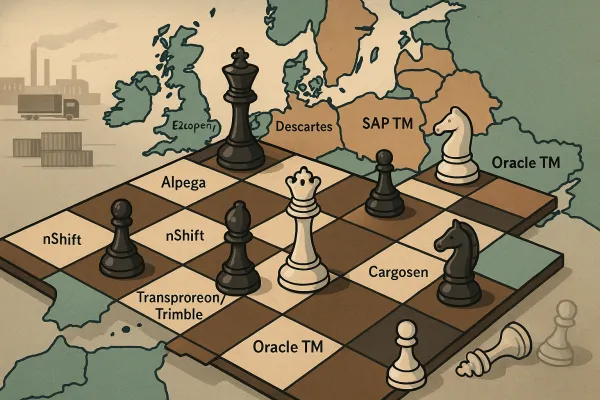
The remaining independent vendors with strong European compliance capabilities represent shrinking procurement opportunities. The post-consolidation landscape reveals three distinct categories: global mega-vendors (Infios/MercuryGate, Descartes, SAP TM, Oracle TM, E2open/WiseTech), European specialists (Alpega, nShift, Transporeon/Trimble), and emerging European-native solutions (including Cargoson) that focus specifically on cross-border European operations. Each category presents different risk-reward profiles. Mega-vendors offer comprehensive functionality but come with integration complexity and potential feature deprecation risks.
The procurement window is narrowing because regulatory pressure is forcing vendor priorities. Companies that haven't initiated TMS selection processes by mid-2026 will find significantly fewer viable options as vendors focus resources on existing customer compliance rather than new client acquisition.
Contract Negotiation Tactics: Turning Regulatory Requirements into Better Terms
The regulatory convergence gives procurement teams unprecedented negotiation leverage. Vendors need to prove compliance capabilities to win deals, creating opportunities for more favorable contract terms.
Flip the Risk Profile. Traditional TMS contracts place compliance risk on the shipper. Use regulatory deadlines to shift this risk to vendors. Build specific compliance guarantees into your contracts, including financial penalties for missed regulatory deadlines or failed certifications.
Demand Implementation Acceleration. Vendors claiming regulatory readiness should deliver faster implementations to prove their capabilities. Off-the-shelf TMS solutions offer faster deployment (8-16 weeks), lower upfront costs, proven functionality, and vendor-supported updates - ideal for organisations with standard logistics processes and limited IT resources. If compliance capabilities are real, implementation should be straightforward.
Structure Performance-Based Pricing. Link subscription costs to compliance performance. Vendors confident in their regulatory capabilities should accept pricing models that reward successful compliance delivery and penalize failures.
Negotiate Extended Support Requirements. It will reduce administrative burdens for operators and authorities, enhance data security, and ensure compliance with EU and national freight regulations. Anticipated annual savings of €1 billion in operational and administrative costs for the EU transport and logistics sector. Demand that vendors provide extended support through the 2026-2027 regulatory transition period at no additional cost.
The Post-Implementation Advantage: Building Compliance Into Operations
Smart contract negotiations extend beyond initial implementation to ongoing compliance management. Your TMS vendor should be a regulatory compliance partner, not just a software provider.
Build ongoing compliance reporting requirements into your contracts. The regulation mandates that authorities in all EU Member States will be required to accept electronic data when shared by businesses via eFTI-compliant platforms. Your vendor should provide regular compliance status reports, audit preparation support, and regulatory update notifications.
European shippers who approached TMS procurement strategically during the 2026 regulatory convergence gained sustainable competitive advantages. They secured better contract terms, avoided implementation disasters, and built operations capable of adapting to future regulatory changes. Those who treated compliance as an afterthought paid premium prices for rushed implementations and ongoing support.
The regulatory pressure of 2026 creates a procurement opportunity that won't repeat. Use these converging deadlines to secure TMS contracts that deliver both compliance certainty and operational excellence. Your competitors are still viewing regulations as obstacles – turn them into strategic advantages before vendor options disappear.