The European Shipper's Agentic AI TMS Implementation Guide: How to Deploy Autonomous Transport Management Systems That Actually Execute Decisions Without Joining the 76% Failure Rate


The transport management system landscape stands at a critical inflection point where predictive AI gives way to agentic AI TMS platforms that don't just recommend actions but autonomously execute them. Next-generation platforms are expected to adopt AI agents that independently make key decisions like scheduling appointments, choosing routes, and negotiating rates, with 61% anticipating fully autonomous agentic AI within the next five years for TMS. Yet despite this momentum, European shippers face a sobering reality: seventy-six percent of logistics transformations never fully succeed, failing to meet critical budget, timeline or key performance indicator (KPI) metrics, with more than 80% of respondents attempting four transformations in fewer than five years.
This failure rate becomes particularly problematic as European manufacturers and retailers navigate increasing regulatory complexity, cross-border documentation requirements, and the need for real-time decision-making across multi-modal transport networks. The question isn't whether autonomous transportation management represents the future—it's how European shippers can implement these systems successfully while avoiding the implementation pitfalls that derail most projects.
What Agentic AI Actually Does in Transport Management
Unlike traditional TMS platforms that analyze data and provide recommendations, agentic AI systems take autonomous action across your entire transport ecosystem. Most AI deployments summarize and recommend—but agentic AI autonomously executes actions across ERP, WMS, and TMS systems, compressing the detect–decide–act loop. This means your system doesn't just identify a delivery exception; it re-promises dates, re-allocates inventory, opens supplier claims, and coordinates clean escalations automatically.
The practical applications extend far beyond basic automation. One transportation company uses agents in their buying process, with buyers initiating agentic workflows that request quotes from approved suppliers and rank responses autonomously. In European contexts, this translates to systems that understand the documentation differences between Manchester-to-Rotterdam shipments versus Manchester-to-Dublin routes, factoring in border controls, VAT implications, and origin requirements that affect carrier selection.
The McLeod-Qued integration demonstrates this capability at scale, reducing appointment scheduling from 18 manual steps to zero human intervention. It is the inter-systemic process of converting a signal into a controlled sequence of actions: re-promising dates, re-allocating inventory, opening a supplier claim, placing inventory on hold, moving a load, documenting decisions for audit purposes. In most companies, this process is still completely manual across ERP, WMS, TMS, emails, spreadsheets, and human handoffs.
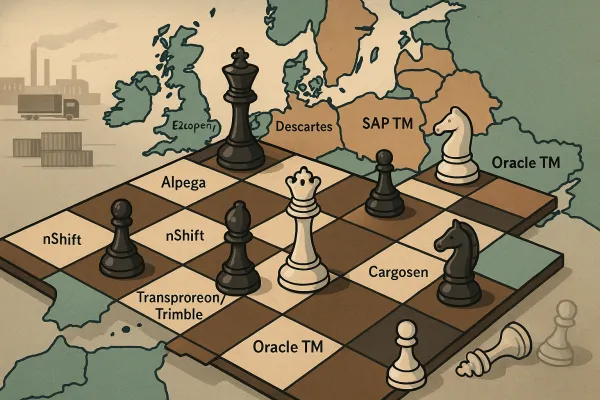
European shippers evaluating platforms should understand that vendors like MercuryGate (now Infios), Blue Yonder, Oracle TM, and Cargoson are implementing these capabilities differently, with varying levels of European market focus and regulatory compliance understanding.
The European Implementation Challenge: Why 76% Fail
The implementation failure statistics reflect deeper challenges than poor project management. Many organizations still employ hard-coded or rule-based pattern matching with small rule-sets for their conversational interfaces, which results in higher abandonment rates, low engagement, and perceived project failures. European transport operations compound this complexity through 27 different VAT rates, multiple languages, varying carrier protocols, and emerging eFTI compliance requirements.
Many pilots fail because organizations lack foundational infrastructure: ontology models, telemetry, safe system integrations, governance boundaries, and human-on-the-loop operating models. Without these, autonomy cannot scale safely. The knowledge gaps become particularly acute in European contexts where many European logistics teams lack the technical background to properly evaluate or implement modern TMS platforms. When a company selects Transporeon, nShift, or Alpega without adequate technical resources, implementation becomes a blind leading the blind scenario.
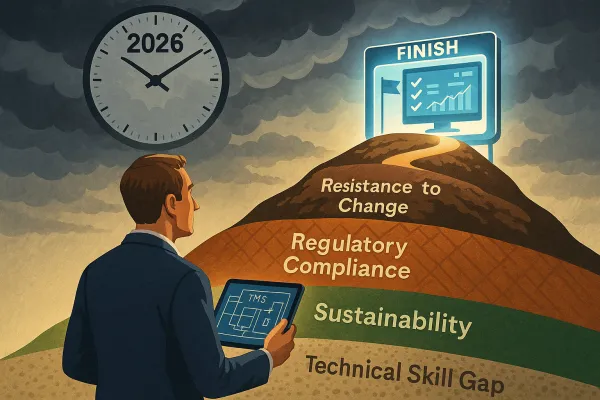
Consider the regulatory complexity alone. From January 2026, eFTI platforms can start preparing for operations, while July 2027 brings full mandatory compliance. From July 1, 2026, vans weighing 2.5-3.5 tons performing international transport will be subject to second-generation smart tachographs (G2V2). Simultaneously, as of 1 January 2026, the transitional phase of the Carbon Border Adjustment Mechanism (CBAM) has ended with importers now subject to full financial obligations. Your agentic AI implementation must handle these requirements from day one, not as an afterthought.
Building Your Agentic AI Evaluation Framework
Expect to see more traction in this area in 2026 as workflow-focused platforms add more agentic AI features that can sit on top of core systems like ERP. What distinguishes 2026 from earlier waves of experimentation is maturity. Rather than pursuing universal AI assistants, successful implementations focus on specific use cases where autonomous decision-making provides clear business value.
Your evaluation framework should start with pilot programs tied directly to measurable outcomes. Start with bounded scope: Single workflow, clear success criteria, measurable ROI. For European shippers, this might mean testing agentic route optimization for specific corridors or automating customs documentation for particular trade lanes rather than attempting full-scale transformation immediately.
Platform maturity varies significantly across vendors. Many ERP, TMS and WMS platforms now come with native AI and even agentic capabilities. These features still need configuration and time to learn, but are increasingly available right out of the box. Expect to see more traction in this area in 2026 as workflow-focused platforms add more agentic AI features.
When evaluating traditional providers like SAP TM, Oracle, and Descartes against AI-native platforms, consider that traditional TMS providers like SAP TM and Oracle often struggle with localized European requirements. Their conversational AI modules are built for global markets, which means they lack the nuanced understanding of European transport corridors, seasonal capacity variations, and regulatory differences between EU member states.
Technical Prerequisites and Data Requirements
Agentic AI implementation success depends entirely on data foundation quality, yet most organizational data isn't positioned to be consumed by agents that need to understand business context and make decisions. European operations face additional complexity through multi-currency handling, cross-border documentation standards, and varying carrier data formats across 27 member states.
Companies recognize that the success of agentic AI depends on data readiness. By 2027, companies that do not prioritize high-quality, AI-ready data will struggle to scale GenAI and agentic solutions, resulting in a loss of productivity. This means investing in data structure improvements before implementing autonomous systems.
The integration challenge extends beyond basic connectivity. Integration complexity often gets underestimated. Automating everything requires seamless integration among TMS, WMS (warehouse), ERP (enterprise), and external data sources. Many companies still run siloed systems, bridging them is a must. For European shippers, this includes connecting with national customs systems, carrier telematics platforms, and regulatory reporting requirements that vary by jurisdiction.
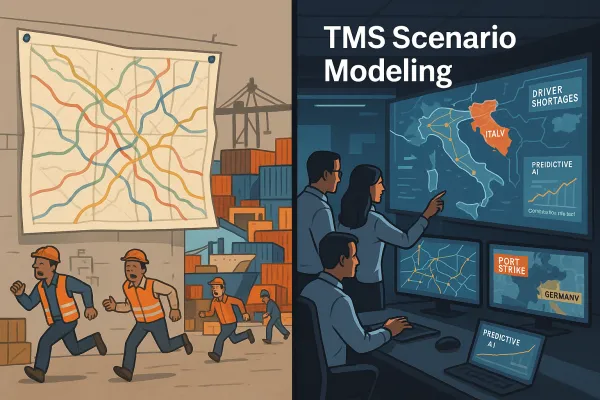
Scenario modeling accuracy depends entirely on data integrity across these connected systems. When your agentic AI suggests route changes or carrier selections, those recommendations rely on real-time capacity data, accurate cost information, and current regulatory status across your entire network. Modern TMS scenario modeling capabilities represent a fundamental shift from reactive execution to proactive strategic planning. Transport planners can simulate "what if" scenarios, test route changes, and model the impact of shifting demand patterns without touching live systems.
Implementation Roadmap and Risk Mitigation
Successful agentic AI TMS implementations follow a structured three-phase approach that balances automation benefits with governance requirements. Phase 1 focuses on data foundation establishment (8-12 weeks), ensuring your systems can provide the clean, contextual information autonomous agents require for decision-making.
Phase 2 involves baseline scenario development (4-6 weeks), where you define the specific workflows and decision trees your agentic systems will manage. This includes establishing the governance boundaries and escalation procedures that prevent autonomous actions from exceeding defined risk thresholds. Every decision must be explainable, auditable, and policy-compliant.
Phase 3 represents the actual AI integration (6-8 weeks), where autonomous agents begin handling defined workflows with human oversight mechanisms in place. Strong guardrails and governance by design: Winning organisations bake in controls, auditability, escalation paths, and human-in-the-loop thresholds from day one. Those that fall behind treat governance as an afterthought—leading to trust issues, halted deployments, or regulatory friction.
Change management represents a critical success factor often underestimated by European transport teams. Change management requires more attention than the technology itself. Teams used to manual control may resist handing over decision-making. Achieving the right balance between human oversight and automation requires trust and clear governance. Your coordinators need clear understanding of when to trust AI recommendations and when to intervene.
European implementations face additional complexity through vendor consolidation pressures. The most significant TMS vendor consolidation wave in over a decade is reshaping European procurement decisions right now. WiseTech's acquisition of E2open in 2025, Descartes' purchase of 3GTMS for $115 million in March 2025, and Körber's transformation of MercuryGate into Infios following their 2024 acquisition create implementation timeline pressures that must be factored into your roadmap.
Measuring Success and Scaling Strategies
ROI should be measured using operational performance indicators such as: These metrics determine whether expanding AI autonomy is safe and economically justified. Focus on impact metrics rather than activity volume: cost reduction, service level improvements, cycle time compression, and planner productivity gains provide clearer success indicators than automation rates or system usage statistics.
Early pilot programs demonstrate significant potential returns. Companies leveraging AI-driven logistics are cutting empty miles by up to 41%, improving asset utilization by 30%, and resolving supply chain disruptions nearly twice as fast. European implementations show similar patterns, with annual gains breaking down to: €85K in fuel savings through route optimization (4.25% of transport spend), €120K in productivity gains from automated planning, €25K in dispute reduction through improved documentation. A well-optimized TMS typically generates 15 to 25% kilometer savings.
Scaling success requires redesigning workflows with agent-first thinking rather than layering autonomous capabilities onto legacy processes. Leading organizations are discovering something different: True value comes from redesigning operations, not just layering agents onto old workflows. This means building agent-compatible architectures, implementing robust orchestration frameworks, and developing new management approaches for digital workers.
Long-term competitive advantages emerge from operational performance improvements that compound over time. European-specific benefits include cross-border documentation accuracy improvements reducing customs delays by 15-20%. Automated compliance reporting eliminates manual audit preparation costs averaging €50,000-75,000 annually for mid-sized operations. These benefits become particularly valuable as regulatory complexity increases through 2027.
The organizations that successfully implement agentic AI TMS platforms will be those that treat the technology as a strategic transformation rather than a software upgrade. By December 2026, every serious organization will be running at least one agentic 'factory' directly tied to revenue growth or risk reduction. Domains of focus include claims, billing, supply chain, or underwriting. In 2026, experimentation gives way to execution; agentic systems move from pilot to mainstream production. Your implementation timeline should align with this industry trajectory while maintaining the careful governance approach that separates successful deployments from the 76% that fail to meet their objectives.