The European Shipper's TEN-T Fragmentation Survival Guide: How to Build Corridor-Resilient TMS Implementation Strategies Before Rail Integration Delays Paralyze Your Multimodal Operations

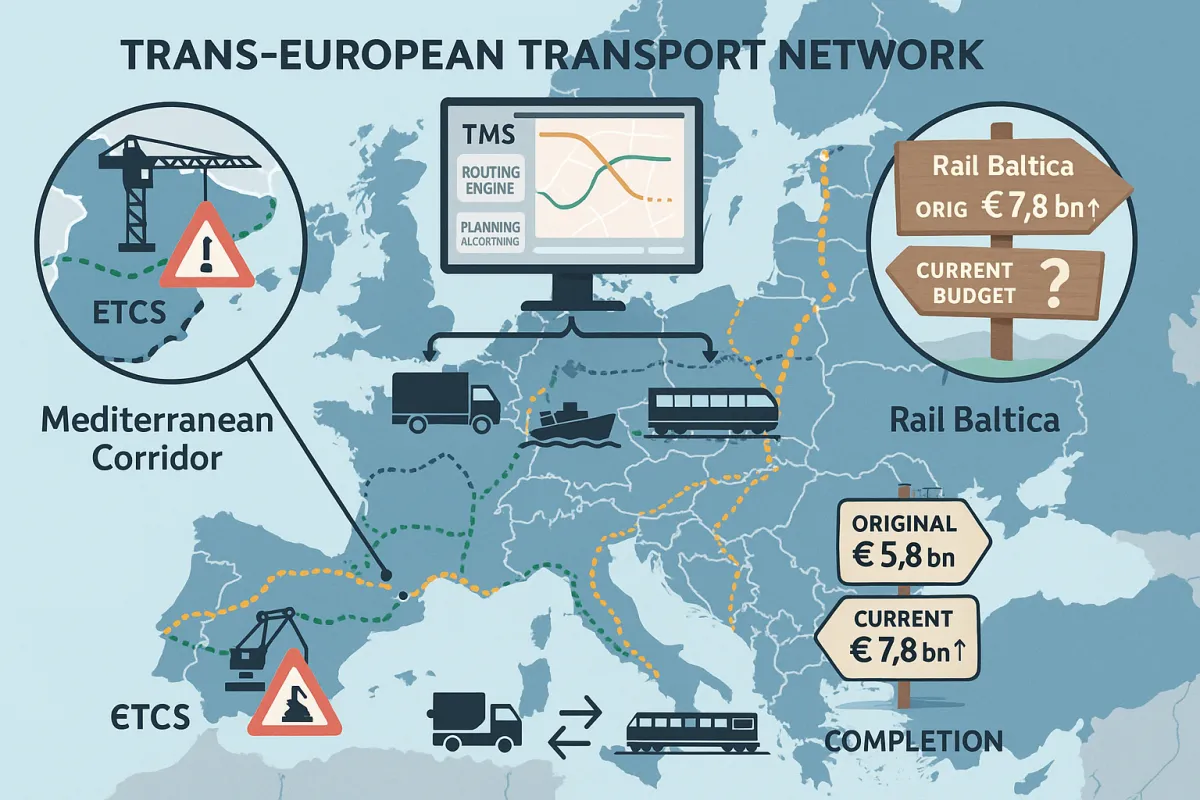
The €515 billion Trans-European Transport Network faces delays that would make Deutsche Bahn punctuality statistics look optimistic. European Court of Auditors confirm the 2030 deadline will "undoubtedly be missed", with flagship cross-border rail projects facing an average delay of 17 years. For European shippers planning TMS implementation strategy, this represents more than an infrastructure headache - it's a fundamental challenge to multimodal transport management that requires immediate strategic response.
Spain has invested over €7 billion since 2018 to implement ETCS on the Mediterranean Corridor, expecting completion by 2030. Meanwhile, France postpones its crucial Montpellier-Perpignan ETCS implementation until 2042. This 12-year gap creates operational nightmares that no amount of TMS optimization can solve at the infrastructure level, but smart implementation strategies can build resilience around these constraints.
Rail Baltica costs have exploded from €5.8 billion to €23.8 billion - a 291% increase that makes budget variance reports read like fantasy novels. The project now lacks any confirmed completion date for its second phase, turning what should be a strategic Baltic transport corridor into an indefinite planning variable. For multimodal operations dependent on north-south European connectivity, this uncertainty demands contingency-first TMS architecture from day one.
Mapping TMS Requirements Against Fragmented Corridor Realities
Traditional TMS implementation assumes infrastructure operates as designed. European corridor delays shatter this assumption. Your TMS implementation strategy must account for operational gaps, varying deployment timelines, and infrastructure that exists in multiple completion phases simultaneously.
Consider the cross-border handover challenge. The ERTMS deployment map for 2030 shows Spain's corridor fully operational with ETCS while the French section remains incomplete. This creates a technical interoperability gap that affects documentation requirements, terminal capacity, and operational procedures. Your TMS needs routing engines sophisticated enough to handle these transition zones without manual intervention.
Different TMS platforms handle this fragmentation with varying levels of sophistication. Enterprise solutions like SAP TM and Oracle TM typically require extensive customization to accommodate corridor inconsistencies. Mid-market platforms including Descartes, Alpega, and Cargoson often provide more flexible routing engines that can adapt to infrastructure gaps without major development work. The key lies in selecting platforms that treat corridor reliability as a variable, not a constant.
The Cross-Border Handover Challenge
Each incomplete corridor segment creates unique documentation and operational requirements. The Spain-France rail gap forces freight to navigate different signaling systems, documentation protocols, and potentially different gauge requirements depending on final implementation decisions. Your TMS must handle these transitions seamlessly while maintaining compliance with varying national requirements.
Terminal capacity constraints during construction periods add another layer of complexity. Construction work reduces available slots, increases dwell times, and creates unpredictable delays that ripple through entire transport networks. Modern platforms like Manhattan Active, E2open, and emerging solutions such as Cargoson build these capacity fluctuations into their planning algorithms, but legacy systems often struggle with real-time capacity adjustments.
Building Contingency-First TMS Architecture
Standard TMS implementation follows infrastructure capabilities. Corridor delays demand the opposite approach: build systems that assume infrastructure will fail and design resilience from the ground up. This means multi-route planning capabilities, real-time rerouting, and alternative mode selection that activates automatically when primary corridors face disruptions.
The border regions between Spain and France have become notorious for logistical delays, with long waiting times and capacity loss despite digital automation efforts. Your TMS architecture must anticipate these bottlenecks and maintain alternative routing options that can execute without human intervention when delays exceed acceptable thresholds.
Leading platforms approach contingency planning differently. Blue Yonder integrates machine learning to predict corridor disruptions based on historical patterns and real-time data feeds. FreightPOP focuses on mode flexibility, automatically switching between rail, road, and short-sea options based on performance criteria. Solutions like nShift and Cargoson emphasize European-specific routing intelligence that understands TEN-T construction schedules and their operational implications.
The Alternative Mode Integration Framework
Rail delays don't eliminate transport demand - they shift it to roads already operating near capacity. Your TMS needs road transport backup systems that can handle sudden volume increases without compromising service levels. This requires carrier relationship management that maintains dormant capacity agreements and pricing structures that remain competitive during peak demand periods.
Short-sea shipping provides another alternative for problematic land bridges. The Mediterranean Corridor delays make Italy-Spain connections via sea transport increasingly attractive for non-time-sensitive freight. Your TMS should integrate with maritime booking platforms and understand port capacity constraints that affect sailing schedules and berth availability.
Air freight integration becomes critical for high-value, time-sensitive deliveries when rail connections fail. Platforms like Transporeon, 3Gtms, and Cargoson maintain APIs with major air cargo systems, enabling automatic escalation to air transport when surface options exceed delivery commitments.
Data Integration Strategies for Fragmented Networks
Fragmented infrastructure creates fragmented data streams. Your TMS must connect with multiple, often incompatible corridor management systems while maintaining data quality and real-time visibility. This includes ERTMS data standards, national rail operators' APIs, and terminal operating systems that may not communicate effectively with each other.
The technical challenge extends beyond simple API integration. Different completion phases of the same corridor may use different data formats, update frequencies, and availability windows. Your implementation strategy needs data normalization layers that translate between systems and maintain consistent visibility regardless of underlying infrastructure complexity.
Major TMS providers handle this challenge through different approaches. Shiptify and Uber Freight focus on standardized API frameworks that work across multiple carrier types. ShippyPro and Shipmondo emphasize European-specific integrations that understand local data requirements and regulatory variations. Solutions like Cargoson build corridor-specific intelligence that adapts to infrastructure completion phases automatically.
The data integration challenge intensifies when corridors operate in mixed completion states. A single shipment might traverse ETCS-enabled Spanish sections, non-ETCS French sections, and different signaling systems in connecting countries. Your TMS needs data fusion capabilities that maintain shipment visibility across these technical transitions without losing tracking accuracy or regulatory compliance.
Regulatory Compliance Across Incomplete Corridors
Unified European transport regulations assume unified infrastructure. TEN-T delays create regulatory fragmentation that affects eFTI implementation, customs procedures, and safety standards. Your TMS implementation strategy must navigate these variations while preparing for eventual harmonization.
eFTI (electronic Freight Transport Information) implementation varies by country and corridor completion status. Some routes support digital documentation while others still require paper processes. Your TMS needs flexible document management that can switch between digital and physical workflows based on route requirements without manual intervention.
Customs procedures during construction periods add complexity. Temporary routing may require different customs declarations, transit procedures, or bonding requirements. Modern TMS platforms maintain regulatory databases that update automatically, but implementation requires careful attention to routing-specific compliance requirements that may change as infrastructure completes.
Safety standard differences between national systems create another compliance layer. Your TMS must understand which vehicles, drivers, and equipment qualifications apply to specific route segments. This becomes particularly complex when single shipments cross multiple jurisdictions with different completion statuses and regulatory requirements.
Performance Measurement in Uncertain Infrastructure
Traditional transport KPIs assume stable infrastructure performance. Corridor delays require new metrics that account for infrastructure variability and measure true operational resilience rather than simple transit time optimization.
Transit time variability becomes more important than average transit time when infrastructure completion status changes frequently. Your TMS should track delivery window compliance rather than schedule adherence, measuring ability to meet customer commitments despite infrastructure uncertainties.
Corridor reliability scoring helps identify routes most likely to face disruptions. This involves tracking construction schedules, capacity constraints, and historical performance patterns to build predictive models for route selection. Platforms with strong analytics capabilities can identify patterns that manual analysis might miss.
Alternative route cost analysis reveals the true cost of infrastructure delays. This includes not just direct transport costs, but also inventory carrying costs, customer service impacts, and operational complexity that results from route diversions and modal shifts.
The Corridor Readiness Assessment Framework
Regular infrastructure status monitoring becomes essential when completion dates remain uncertain. Your TMS should integrate with corridor management systems to track construction progress, capacity changes, and operational status updates that affect routing decisions.
Capacity constraint identification helps predict when alternative routes will face congestion from displaced traffic. This requires understanding not just your own transport needs, but industry-wide patterns that shift when major corridors face delays or capacity reductions.
Alternative scenario planning enables rapid response when infrastructure status changes unexpectedly. Your TMS should maintain multiple routing scenarios for each major lane, with cost and service level implications clearly understood before disruptions occur.
European shippers face infrastructure uncertainty that will persist well beyond 2030. The European Court of Auditors changed their assessment from "unlikely to be met" to "will not be met" for TEN-T completion deadlines. Your TMS implementation strategy must account for this reality, building systems that thrive in fragmented infrastructure rather than waiting for unified networks that may not arrive for another decade.
The successful approach prioritizes flexibility over optimization, contingency over efficiency, and adaptability over standardization. Platforms that understand European transport complexity - from established solutions to emerging providers like Cargoson - offer better long-term value than those designed for stable infrastructure environments that simply don't exist in today's European transport landscape.