
The European Shipper's TMS Data Integration Survival Guide: How to Build Bulletproof Implementation Frameworks That Avoid the 75% Failure Rate While Meeting eFTI and ERP Compliance Requirements

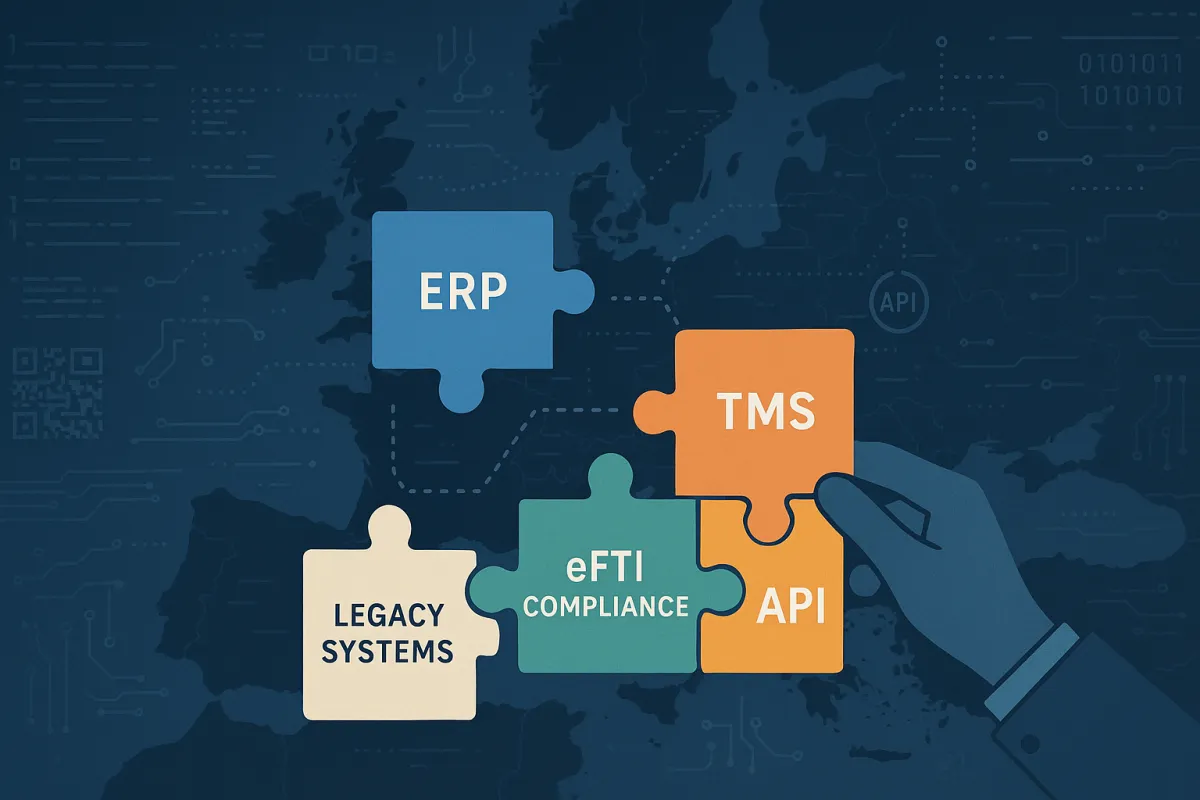
European shippers face a sobering reality: 66% of technology projects end in partial or total failure, while 17% of large IT projects go so badly, they threaten the very existence of the company. When it comes to TMS data integration specifically, the stakes climb even higher. Basic API integrations cost €5,000-€15,000, while complex ERP connections exceed €50,000. For shippers with annual freight under management exceeding €250M, implementation costs often run 2-3x the subscription fees.
Add mandatory eFTI compliance by 9 July 2027, where Member State authorities must accept information shared electronically by operators via certified eFTI platforms, and you're looking at a perfect storm. Most European manufacturers are underestimating the complexity of building integration frameworks that satisfy both business requirements and regulatory mandates while avoiding the catastrophic budget overruns plaguing 75% of implementations.
The regulatory pressure cooker intensifies every month. Beyond eFTI, European shippers must navigate ICS2 customs requirements, EU ETS emissions reporting, and country-specific digital documentation standards. A German automotive parts manufacturer discovered their €800,000 TMS implementation mistake the hard way. Six months into deployment, they found their European carriers couldn't integrate without costly custom development work - turning their "smart procurement decision" into a complete platform re-implementation.
The Five Critical Integration Failure Points European Shippers Must Address
Data mapping complexity between transportation management systems, ERP platforms, and legacy systems creates the first major failure point. European operations span 27 different regulatory frameworks, each requiring specific data formats, reporting schedules, and compliance documentation. Your TMS needs to harmonize master data across these varying requirements while maintaining real-time synchronization capabilities.
Carrier connectivity protocols vary dramatically by country. French carriers might use different API standards than German logistics providers, while Scandinavian forwarders often require specialized integration approaches. A basic domestic shipper requires 10-15 integrations minimum, potentially totaling 1,000-1,500 hours of labor. This complexity multiplies when you're managing pan-European operations with dozens of carrier relationships.
Real-time synchronization requirements for eFTI compliance represent the third failure point. QR code generation and machine-readable format requirements become mandatory by July 2027. Your TMS must generate these automatically for every shipment across all transport modes. Most existing systems lack this capability, requiring substantial development work or complete platform replacement.
Master data harmonization across different regulatory frameworks challenges even experienced IT teams. Product classifications that work for German customs might fail Danish environmental reporting requirements. Vehicle specifications acceptable to French authorities could violate Italian safety standards. Your integration strategy must account for these variations while maintaining operational efficiency.
The vendor landscape adds another complexity layer. Major players like Cargoson, MercuryGate, Descartes, SAP TM, and Oracle TM each take different integration approaches. Some prioritize API-first architectures, others focus on file-based exchanges, and several offer hybrid solutions. WiseTech's acquisition of E2open in 2025, Descartes' purchase of 3GTMS for $115 million in March 2025, and Körber's transformation of MercuryGate into Infios following their 2024 acquisition. Companies undergoing integration often experience 12-18 months of reduced innovation while they harmonize platforms and teams.
Building Your Pre-Integration Assessment Framework
System compatibility evaluation methodology starts with comprehensive auditing of your current technology stack. Document every system touching transport data: your ERP platform, warehouse management system, customer portals, carrier EDI connections, and reporting tools. Map data flows between these systems, identifying transformation points, storage locations, and access patterns.
Data quality audits reveal hidden integration challenges. European operations often accumulate inconsistent master data over years of growth and acquisition. German subsidiaries might use different product codes than French operations, while UK legacy systems could contain outdated carrier information post-Brexit. Clean this data before integration begins, not during implementation when costs spiral.
Regulatory compliance mapping requires detailed analysis of eFTI requirements, customs reporting obligations, and emissions tracking mandates. From 2027, authorities in all EU Member States must accept electronic freight data shared via eFTI-compliant platforms. The use of eFTI platforms is expected to save the EU transport and logistics sector €1 billion annually by enabling real-time data sharing, improving logistics planning, and strengthening multimodal transport coordination.
Resource and skill gap analysis often reveals the most significant implementation risks. Your internal team needs expertise in API management, data transformation, testing protocols, and change management. Most European manufacturers lack these skills internally, requiring external expertise or extensive training programs.
Timeline development must consider regulatory deadlines alongside business requirements. Member States authorities may start accepting data stored on certified eFTI platforms for inspection from January 2026. Use this voluntary period for real-world testing and staff training. Build testing phases, pilot programs, and gradual rollouts into your implementation schedule.
The European TMS Integration Architecture Blueprint
Hub-and-spoke versus point-to-point integration strategies create fundamentally different operational outcomes. Hub-and-spoke architectures centralize data transformation and business logic, simplifying compliance management and reducing maintenance overhead. Point-to-point connections offer lower initial costs but create complex webs of dependencies that become expensive to maintain and modify.
API-first integration strategies provide superior flexibility for European operations. Modern TMS platforms from providers like nShift, Transporeon, Alpega, and Cargoson prioritize RESTful APIs with standardized data formats. This approach enables rapid carrier onboarding, simplified compliance reporting, and easier adaptation to regulatory changes. File-based integrations, while sometimes necessary for legacy carriers, should represent exceptions rather than primary strategies.
Real-time versus batch processing decisions impact both operational efficiency and regulatory compliance. eFTI requirements favor real-time data sharing, enabling immediate document generation and compliance verification. However, batch processing remains appropriate for certain scenarios: daily rate updates, weekly performance reporting, and monthly financial reconciliations.
Data governance frameworks become essential for multi-country operations. Establish clear policies for data ownership, access control, and modification rights. German operations shouldn't modify French carrier master data without appropriate workflows. Italian subsidiaries need access to EU-wide performance metrics while maintaining local operational autonomy.
Security and compliance considerations require specialized attention for European operations. GDPR compliance affects all data handling processes, while individual countries maintain additional requirements. Your integration architecture must support data localization where required, encryption for data in transit, and comprehensive audit trails for regulatory inspections.
Implementation Phase Management and Risk Mitigation
Phased rollout strategies minimize business disruption while building operational confidence. Start with a single country or business unit, preferably one with simpler carrier networks and fewer regulatory complications. The competitive landscape will favor early adopters. Companies implementing eFTI-compatible systems now gain operational advantages while competitors struggle with compliance deadlines.
Testing protocols for complex European carrier networks require systematic approaches. Build test scenarios covering different transport modes, varying document requirements, and diverse compliance scenarios. Test German automotive shipments separately from French food-grade transport, as regulatory requirements and carrier capabilities differ significantly.
Change management for transport teams across multiple countries demands cultural sensitivity and practical training programs. Scandinavian teams might embrace digital transformation quickly, while southern European operations could require more extensive support and training. Develop country-specific training materials and support resources.
Contingency planning for integration failures should include fallback procedures, alternative carrier options, and emergency support protocols. Budget for emergency carrier onboarding fees, spot rate premiums when contracted carriers can't deliver, and expedited integration costs for backup providers. Plan for 15-20% budget increases in 2026-2027 if reactive, or 8-12% if proactive with proper contract protection.
Performance monitoring and optimization frameworks must track both technical metrics and business outcomes. Monitor API response times, data synchronization success rates, and error frequencies alongside operational measures like carrier onboarding speed, compliance reporting accuracy, and cost savings achievement.
Post-Implementation: Measuring Success and Continuous Improvement
ROI measurement frameworks extend beyond simple cost savings calculations. Track operational improvements like reduced manual data entry, faster carrier onboarding, improved compliance reporting accuracy, and enhanced visibility across your transport network. European operations often see 15-25% improvements in transport administrative efficiency within the first year of successful TMS data integration.
Performance KPIs for integrated TMS-ERP environments should include data accuracy rates, real-time synchronization success, exception handling efficiency, and regulatory compliance metrics. The introduction of Electronic Freight Transport Information could save the EU transport and logistics sector up to €1 billion per year. Over 20 years, EUR 27 billion could be saved in the next 20 years.
Ongoing maintenance and optimization requirements increase as your integrated system matures. Plan for regular API updates, carrier connectivity changes, and regulatory requirement modifications. European operations need quarterly reviews of compliance requirements and semi-annual assessments of carrier integration performance.
Preparing for future regulatory changes requires proactive monitoring of EU transport legislation, country-specific requirements, and industry standards development. The transport regulatory landscape will continue evolving beyond 2027, requiring flexible integration architectures that adapt to new requirements without major re-implementation projects.
Your 90-Day Integration Action Plan
Start with an immediate assessment checklist covering your current system inventory, data quality evaluation, and resource availability analysis. Document every system currently handling transport data, assess data cleanliness across all platforms, and identify internal skills gaps requiring external support or training.
Vendor evaluation criteria specific to European requirements should prioritize eFTI compliance capabilities, multi-country support, carrier network breadth, and regulatory update management. Evaluate how potential vendors handle Brexit-related documentation, German dangerous goods requirements, French driver working time regulations, and Scandinavian environmental reporting mandates.
Budget planning must account for hidden costs including data cleansing, staff training, carrier onboarding support, and contingency reserves for regulatory changes. Base your calculations on realistic timelines, not vendor promises. Add 20-30% contingency reserves for European implementations, given the complexity of multi-country operations and evolving regulatory requirements.
As of 9 July 2027: The eFTI Regulation will apply in full. Member State authorities must accept information shared electronically by operators via certified eFTI platforms. Your timeline planning must align with this immovable deadline while building in sufficient testing and optimization phases.
Success in European TMS data integration requires understanding that you're building more than software connections. You're creating the operational foundation for regulatory compliance, competitive advantage, and sustainable growth across one of the world's most complex transport markets. The 75% failure rate plaguing most implementations isn't inevitable - it's avoidable through proper planning, realistic budgeting, and systematic execution of proven integration strategies.