The European Shipper's TMS Disruption Management Revolution: How to Transform Basic Transportation Tracking Into Proactive Crisis Prevention That Saves €2.8M Per Year in Supply Chain Failures

When Leipzig-based automotive parts distributor Heinrich Schmitт Gruppe's procurement director watched their transport monitoring dashboard flash red across 17 routes simultaneously in February 2026, she knew reactive tracking was no longer enough. In disrupted years, 60% of automotive companies lose more than a month of operations. Four in five report more customer complaints, 72% have lost business or contracts, and 63% say their brand reputation has suffered. What started as isolated border delays had cascaded into €340,000 in expedited shipping costs within 48 hours. Sound familiar?
European manufacturers are discovering that their transport management systems, originally built for optimization and cost control, now face an entirely different challenge: data shows a strategic blind spot costing $13 billion a year. disruptions could cost the sector over $13 billion annually – close to 5% of an automotive logistics market valued at $295 billion.
The €2.8 Million Crisis: Why European Shippers Can't Afford Reactive Transport Management
The perfect storm is already here. A dynamic random-access memory (DRAM) shortage is looming in 2026 as AI data-center demand overwhelms supply, pushing chipmakers to prioritize higher-margin customers over automakers, leading to automotive supply chain challenges. This automotive semiconductor shortage could cause automotive-grade DRAM prices to spike 70–100%, triggering panic buying and production disruptions across the industry. Meanwhile, Industry reporting points to hundreds of thousands of unfilled truck driver roles across Europe, a constraint that caps capacity even when demand exists. For example, IRU reporting has cited 426,000 unfilled truck driver jobs in Europe - a number that will triple by 2028 without intervention.
The cumulative impact? Research on supply chain disruption risk highlights that disruptions are not rare one-offs; they recur and the cumulative impact can be significant. For instance, McKinsey Global Institute analysis has noted that companies can expect major disruptions with meaningful duration and that the financial fallout can be material over time. In a driver-constrained environment, the probability and severity of disruption rises because there's less slack capacity to absorb shocks.
The Perfect Storm of 2026: When Multiple Crises Converge
European supply chains face simultaneous pressure points that traditional TMS systems simply cannot handle independently. According to the IRU's European driver shortage report, the EU, Norway and the UK are collectively short of over 233,000 truck drivers. That figure is projected to exceed 745,000 by 2028 as retirements outpace recruitment. The age profile explains why: one third of European truck drivers are over 55 and expected to retire within the next decade.
Add to this the infrastructure constraints: The Red Sea disruptions that emerged from Houthi activity in late 2023 were still constraining service patterns in early 2026, and carriers' plans to return to the Suez Canal this year are now indefinitely shelved. Carriers had been cautiously returning selected east-west services to the Suez Canal in recent months, following years of Cape of Good Hope rerouting prompted by Houthi attacks. Those plans are now shelved indefinitely.
The result is what industry analysts call a "complexity cascade" - where individual disruptions amplify each other. A driver shortage injects friction into every supply chain simultaneously: Manufacturers can't reliably sequence inbound parts, so they hold more inventory "just in case" (tying up cash) or suffer stop-start production. Retailers face unpredictable replenishment, forcing expensive last-minute rerouting, substitute sourcing, or stock-outs. Construction and infrastructure projects miss delivery windows, leaving labour idle and timelines slipping. Exporters miss port cut-offs, pushing shipments to the next sailing, increasing working capital needs and contract risk. When enough companies experience this at once, the macro impact becomes obvious: reduced output, higher costs and lower competitiveness, especially for sectors that depend on "just-in-time" logistics.
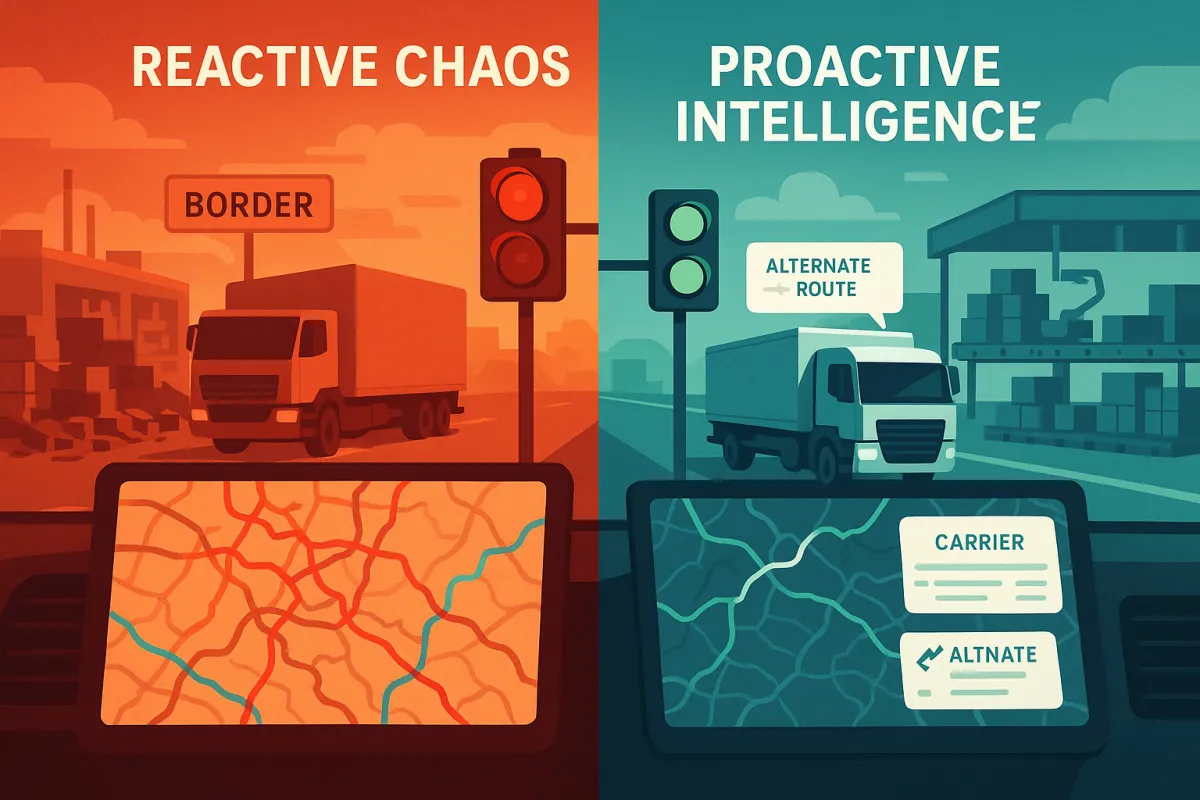
From Reactive Chaos to Proactive Intelligence: The TMS Disruption Management Revolution
The evolution from basic tracking to predictive intervention represents more than a technology upgrade - it's a fundamental shift in how European shippers approach risk. Smart algorithms now do more than plan routes. They anticipate disruptions, suggest alternate carriers, and adjust plans automatically when variables shift. Rather than simply supporting planners, transportation software now provides actionable recommendations. Its based on historic patterns and live signals, helping teams optimize delivery schedules and cost levers faster.
Modern TMS disruption management operates on three fundamental principles: detect, prioritize, and act. These AI-powered solutions coordinate complex multi-stop, multimodal journeys, continuously adapting to changes like traffic congestion, fuel prices, or severe weather. By recalculating routes instantly when disruptions arise, you reduce delays and extra expenses, ensuring goods arrive when and how they're expected.
The difference between reactive and proactive systems becomes clear during crisis moments. Where traditional TMS platforms rely on manual escalation and human decision-making, modern disruption management platforms like Cargoson, Blue Yonder, and project44 can detect, assess, and respond to disruptions within minutes rather than hours.
The Three Pillars of Proactive Disruption Management
1. Predictive Detection: With global disruptions still unpredictable, transportation management software now includes risk scoring based on weather, geopolitical volatility, port congestion, and carrier performance. Organizations can use these risk models to forecast potential weak points, adjust network design proactively, and build contingency plans that keep deliveries on track even in tumultuous conditions.
2. Intelligent Prioritization: A modern TMS monitors shipments continuously and automatically detects exceptions such as delays, missed pickups, weather disruptions, or route deviations. A big advantage of a centralised transportation system is the ability to review large amounts of shipment data simultaneously. For example, you can conduct a performance analysis based on carriers, products and routes to enable informed decision-making and optimise your operation for future deliveries.
3. Autonomous Response: From the user's perspective, the value lies not only in detecting potential issues, but in the system's ability to respond automatically—recalculating routes, adjusting delivery windows, and proposing viable alternatives in real time. This shifts transportation management from a reactive to a predictive model, reducing disruptions, penalties, and hidden costs.
Building Your Disruption-Resistant TMS Architecture: The European Implementation Guide
Focus on the scenarios that pose the highest financial risk to European operations. According to transport procurement specialists, these typically include: port delays at Rotterdam, Antwerp, and Hamburg; capacity reductions during peak agricultural seasons; border slowdowns due to customs automation failures; sudden carrier bankruptcies; and severe weather events affecting Alpine corridors.
The technical foundation requires what industry experts call "data convergence." A modern TMS cannot operate in isolation. By 2026, organizations are seeking full integration across the entire supply chain ecosystem: ERP, WMS, planning systems, visibility platforms, and financial tools. The objective is to eliminate data silos and latency, ensuring that all systems operate on a single, consistent version of operational reality.
European implementation requires special attention to regulatory complexity. The EU's Mobility Package has introduced new operational requirements including cooling-off periods for cabotage operations and return vehicle requirements mandating trucks return to their member state of establishment every 8 weeks. These aren't just compliance boxes to check - they're capacity constraints that affect disruption response capabilities.
For European-focused solutions, platforms like Cargoson, Alpega, and Transporeon offer native understanding of EU transport regulations, while global platforms like Oracle TM and SAP TM provide broader functionality but may require additional customization for European compliance requirements.
Scenario Planning That Actually Works
Digital twin technology, virtual counterparts of physical assets and networks, was once a nice-to-have. Now it's a business-critical tool embedded in advanced TMS solutions. Transport planners and operators can simulate "what if" scenarios, test route changes, and model the impact of shifting demand patterns without touching live systems.
Effective scenario planning requires carrier mix optimization that evaluates cost, service level, and risk trade-offs. Many European shippers discover they have 40% of their volume dependent on carriers with questionable financial stability - a vulnerability that becomes apparent only through systematic risk modeling.
Modal shift contingencies are particularly relevant for European operations, where rail and intermodal options provide alternatives to road transport. The key is building these alternatives into automated response protocols rather than manual escalation procedures.
Real-Time Visibility: Beyond Simple Tracking to Operational Intelligence
A major European e-commerce player reduced SLA breaches by 20% through predictive exception management - identifying potential delays before they occurred and automatically implementing mitigation strategies. Instead of reacting to shipment delays or congestion after the fact, predictive layers can simulate outcomes and recommend optimal actions before risks materialize. Customers expect accurate ETAs. Shippers demand live insights. Transportation management solutions are embedding real-time tracking and visibility deeply into workflows. IoT devices and telematics feed into transportation software to provide minute-by-minute status and enable proactive alerts. This up-to-the-second view increases operational control and enhances customer communication, boosting satisfaction and reducing exception handling.
Early warning systems for port congestion and carrier delays enable proactive rescheduling rather than reactive firefighting. Modern visibility platforms like project44, FourKites, and Shippeo, along with Cargoson's integrated approach, provide the data foundation needed for proactive disruption management.
The Automation Advantage: When Minutes Matter
The speed advantage of automated systems becomes critical during disruptions. When your business is equipped with transportation management system software, the work that once took 4-6 hours daily now takes minutes. TMS processes complex optimisation calculations in seconds enabling rapid response to changing conditions.
The procurement time compression is equally significant: manual tender processes that previously required 18-28 hours can be completed in 45 minutes through marketplace-connected TMS automation, allowing rapid capacity securing when disruptions hit primary routes.
Vendor Selection for Crisis-Ready Operations: The 2026 Evaluation Framework
Given the recent consolidation in the TMS market, contract terms should include 12-18 months advance notice for ownership changes and migration assistance rights to protect against vendor disruption.
Blue Yonder, the AI company for supply chain, has again been recognized as a Leader in the 2026 Gartner Magic Quadrant for Transportation Management Systems (TMS), based on Ability to Execute and Completeness of Vision. This is the 19th consecutive time that Blue Yonder has secured this designation in the report. Blue Yonder is one of only two companies assessed as a Leader across the three Gartner Magic Quadrant reports covering Supply Chain Planning, Transportation Management Systems and Warehouse Management Systems. Blue Yonder continues to solidify its position as a pioneer in the transportation management space, demonstrating remarkable growth and innovation. The company credits its success to its recently launched Cognitive Solutions, which are agentic, AI-driven and designed to operate at machine speed, scale, and precision.
Platform comparison should focus on disruption management capabilities specifically. Infios leverages its global visibility platform to offer hyper-accurate ETAs by factoring in real-time port congestion and localised labour shifts. Its 2026 roadmap prioritises "autonomous orchestration," where the system doesn't just flag a delay but automatically re-routes shipments and adjusts warehouse labour schedules to match the new arrival time - exactly the type of proactive response European shippers need.
For European-specific requirements, Cargoson provides deep understanding of European routing complexities and regulatory requirements, while platforms like FreightPOP offer modal flexibility essential for disruption response, and Oracle TM or SAP TM provide enterprise-scale integration capabilities.
Implementation Timeline and Risk Mitigation
Realistic implementation timelines require 8-12 months for full disruption management capabilities, though baseline functionality should be operational within 6-8 weeks. The phased approach protects against vendor disruption by establishing core functionality first, then adding advanced predictive capabilities.
Change management becomes critical for disruption response workflows. This evolution reduces manual oversight and empowers transportation teams to act, not just observe. Training teams to work with automated systems during crisis situations requires different skills than traditional manual coordination.
Measuring Success: KPIs That Matter in Crisis Management
The shift from rate optimization to productivity gains has become a competitive necessity. Brock Johns, director analyst in Gartner's logistics and technology team, expects more of the same at least through the first couple of quarters of 2026. "Cost management is still front and center, and the market doesn't look ready to snap back," says Johns. Understanding where AI can actually drive value in an operation remains a challenge. A modern transportation management system (TMS) can help organizations manage costs, work more effectively with carriers and determine where tools like AI can actually make a difference.
Response time metrics should measure detection-to-resolution cycles rather than just tracking accuracy. Cost avoidance measurement frameworks need to capture prevented disruptions, not just realized savings. Service level protection during disruptions becomes a key competitive differentiator.
ROI calculation for disruption prevention should include the avoided costs of expedited shipping, customer compensation, and lost sales opportunities. Based on the €2.8 million average annual impact of supply chain failures, European manufacturers typically achieve payback within 18 months on modern TMS disruption management capabilities.
The reality is clear: reactive transport management is no longer viable in the volatile European logistics environment of 2026. The question isn't whether to upgrade your TMS for proactive disruption management, but how quickly you can implement systems that transform transportation chaos into competitive advantage.