The TMS Data Quality Measurement Crisis: How European Shippers Can Build Bulletproof Implementation Frameworks That Deliver Measurable ROI While Meeting 2026's Regulatory Requirements


European shippers face a sobering reality: 66% of technology projects end in partial or total failure, while a German automotive parts manufacturer discovered their €800,000 TMS implementation mistake the hard way. Six months into deployment, they found their European carriers couldn't integrate without costly custom development work - turning their "smart procurement decision" into a complete platform re-implementation. A staggering 76% of logistics transformations never meet their budget, timeline, or performance targets, yet European manufacturers continue racing toward TMS implementations without adequate data quality frameworks. Here's why your next TMS project could join these statistics – and how to build bulletproof data quality measurement systems that actually deliver measurable ROI while meeting 2026's regulatory requirements.
The €800,000 Data Quality Reality Check That's Breaking European TMS Projects
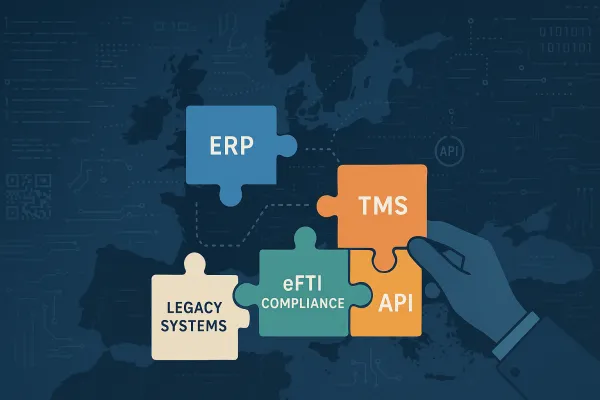
The numbers don't lie about data quality failures in European TMS implementations. Data mapping complexity between transportation management systems, ERP platforms, and legacy systems creates the first major failure point. European operations span 27 different regulatory frameworks, each requiring specific data formats, reporting schedules, and compliance documentation. Your TMS needs to harmonize master data across these varying requirements while maintaining real-time synchronization capabilities.
European operations span 27 different regulatory frameworks, each requiring specific data formats, reporting schedules, and compliance documentation. Your TMS needs to harmonize master data across these varying requirements while maintaining real-time synchronization capabilities. A basic domestic shipper requires 10-15 integrations minimum, potentially totaling 1,000-1,500 hours of labor. This complexity multiplies when you're managing pan-European operations with dozens of carrier relationships.
The vendor landscape compounds these challenges. Major players like Cargoson, MercuryGate, Descartes, SAP TM, and Oracle TM each take different integration approaches. Some prioritize API-first architectures, others focus on file-based exchanges, and several offer hybrid solutions. WiseTech's acquisition of E2open in 2025, Descartes' purchase of 3GTMS for $115 million in March 2025, and Körber's transformation of MercuryGate into Infios following their 2024 acquisition create additional uncertainty for data integration planning.
Companies undergoing integration often experience 12-18 months of reduced innovation while they harmonize platforms and teams. When your TMS can't handle carrier connectivity protocols that vary dramatically by country – French carriers might use different API standards than German logistics providers, while Scandinavian forwarders often require specialized integration approaches – you're looking at costly custom development work that wasn't in your original budget.
The European Regulatory Data Quality Imperative - Why 2026 Changes Everything
As of January 2026, eFTI platforms and service providers can start preparing for operations while Member States authorities may start accepting data stored on certified eFTI platforms for inspection. From 9 July 2027, all national authorities will be obliged to accept freight documentation in electronic form via certified eFTI platforms.
This creates a hard deadline for TMS data quality frameworks. This data will only be shared with authorities upon explicit inspection request, using unique access links in machine-readable formats such as QR codes. Your TMS must generate these automatically for every shipment across all transport modes. Most existing systems lack this capability, requiring substantial development work or complete platform replacement.
Beyond eFTI, the year 2026 promises to be exceptionally challenging for the transport industry in Europe. Stricter regulations regarding the transport of dangerous goods will come into effect, as well as new vehicle safety requirements, the obligation of tachographs in vans, and the digitization of international documents. The forthcoming Euro 6e-bis emissions standard and the fitment of smart tachograph Gen2V2 (by July 2026) ensure all commercial vehicles will carry advanced telematics.
The regulatory pressure cooker intensifies every month. Beyond eFTI, European shippers must navigate ICS2 customs requirements, EU ETS emissions reporting, and country-specific digital documentation standards. Failure to comply with the regulations can result in severe penalties, which in some countries can reach up to 30,000 euros.
The Five Critical Data Quality Dimensions Every European TMS Must Measure
European shippers need specific measurement frameworks that account for cross-border complexity. Transportation management KPIs and metrics are quantifiable measures used to evaluate the performance and efficiency of transportation operations. They track various key aspects like on-time delivery rates, order accuracy, transit times, transportation costs, asset utilization, customer satisfaction, safety incidents, and regulatory compliance.
Performance KPIs for integrated TMS-ERP environments should include data accuracy rates, real-time synchronization success, exception handling efficiency, and regulatory compliance metrics. For European operations, you need to measure:
Completeness: Focusing on the right transportation performance metrics – from on-time delivery to freight cost per shipment – is crucial for a well-run logistics department. By tracking these KPIs, you can identify bottlenecks, reduce costs, and enhance service levels in a multi-carrier network. Track missing data fields across all regulatory frameworks – a shipment might be complete for German customs but missing required environmental data for Danish authorities.
Accuracy: In the logistics industry, an on-time delivery rate of 95% or higher is a typical benchmark. Invoice Accuracy measures what percentage of freight invoices from carriers match the originally quoted or calculated cost without requiring disputes or adjustments. For European operations, accuracy must account for currency conversions, VAT calculations across different jurisdictions, and regulatory classification consistency.
Consistency: Product classifications that work for German customs might fail Danish environmental reporting requirements. Vehicle specifications acceptable to French authorities could violate Italian safety standards. Your integration strategy must account for these variations while maintaining operational efficiency.
Timeliness: Average Transit Time tracks the actual speed of your shipments. This KPI measures the average time it takes from when an order ships to when it's delivered. For example, you might calculate transit time in days or hours across all shipments or for specific routes. European compliance requires real-time data sharing capabilities that many legacy systems can't support.
Validity: Cross-border documentation accuracy improvements reduce customs delays by 15-20%. Automated compliance reporting eliminates manual audit preparation costs averaging €50,000-75,000 annually for mid-sized operations. Data must pass validation rules for each regulatory framework your operations touch.
Building Your TMS Data Quality Measurement Framework - The Practical Implementation Guide
System compatibility evaluation methodology starts with comprehensive auditing of your current technology stack. Document every system touching transport data: your ERP platform, warehouse management system, customer portals, carrier EDI connections, and reporting tools. Map data flows between these systems, identifying transformation points, storage locations, and access patterns.
Start with data flow mapping across your European operations. Performance benchmarking should establish baseline metrics before telematics integration. Measure current manual processes, documentation accuracy, and compliance costs. These tools help identify opportunities for improvement, measure the impact of process changes, and quantify the TMS implementation value.
Phased rollout strategies minimize business disruption while building operational confidence. Start with a single country or business unit, preferably one with simpler carrier networks and fewer regulatory complications. This approach allows you to establish measurement baselines before expanding to more complex operations.
API integration strategies matter for European operations. EDI integrations may take several months, whereas, API integrations can take a matter of weeks, if not days, and files may have complex formats requiring the labor of specialists. This timing difference becomes critical when manufacturers need to onboard new carriers or adapt to changing regulatory requirements across European markets.
Data governance frameworks become essential for multi-country operations. Establish clear policies for data ownership, access control, and modification rights. German operations shouldn't modify French carrier master data without appropriate workflows. Italian subsidiaries need access to EU-wide performance metrics while maintaining local operational autonomy.
The ROI Measurement Framework That Actually Works for European Transport Operations
European TMS implementations deliver specific efficiency improvements when properly measured. Framework for measuring integration ROI should include: reduced manual processes (typically 60-70% reduction in transport coordination time), improved carrier performance (15-20% improvement in on-time delivery), decreased exceptions handling (30-40% reduction in shipment issues), and compliance cost avoidance (estimated €25,000-50,000 annually per regulatory framework).
The measurement framework needs to account for European-specific benefits. A study referenced in industry reports shows that from generating shipping documents to tracking shipments and managing carrier communications, a TMS can reduce manual tasks by up to 90%. This frees up logistics staff to focus on more strategic initiatives, while also improving accuracy and reducing the risk of human error.
Leading TMS platforms offer dashboards and reports on KPIs like delivery times, costs per route, and carrier performance. Many systems now include AI-based forecasting for demand planning and route simulation, helping teams move from reactive to predictive logistics. For European operations, these platforms must handle multiple currencies, languages, and regulatory requirements simultaneously.
Real-world examples demonstrate measurable results. Romanian operator Altec Logistic increased revenue 41.7% and doubled net profit through integrated telematics, automation, and emissions monitoring. Their success came from treating telematics data as strategic business intelligence rather than simple vehicle tracking.
KPIs include on-time delivery, cost per shipment, carrier performance, and delivery accuracy. On-time delivery rates track the percentage of deliveries made within the promised timeframe. Cost per shipment measures the cost-effectiveness of your logistics operations. Carrier performance tracks the efficiency and reliability of the carriers you use. Setting these KPIs upfront will help you measure the impact of your TMS on your logistics operations.
Data Quality Governance and Continuous Improvement - Avoiding the Implementation Graveyard
Data quality audits reveal hidden integration challenges, but ongoing governance prevents them from becoming project killers. Security and compliance considerations require specialized attention for European operations. GDPR compliance affects all data handling processes, while individual countries maintain additional requirements. Your integration architecture must support data localization where required, encryption for data in transit, and comprehensive audit trails for regulatory inspections.
Monitor both technical and operational measures continuously. Track API response times, data synchronization success rates, and error frequencies alongside operational measures like carrier onboarding speed and compliance reporting accuracy. Testing methodologies prevent expensive discoveries late in implementation. Use actual historical data for integration testing, not synthetic test cases. Validate data flows under peak load conditions, not just steady-state operations. Test failure scenarios and recovery procedures before production deployment.
Vendor capabilities vary significantly for European operations. Leading TMS providers like MercuryGate, Descartes, and Cargoson are already preparing eFTI-compatible solutions. The key is choosing platforms that combine regulatory compliance with transport optimization capabilities. European shippers evaluating platforms should understand that vendors like MercuryGate (now Infios), Blue Yonder, Oracle TM, and Cargoson are implementing these capabilities differently, with varying levels of European market focus and regulatory compliance understanding.
Establish regular audit cycles that account for regulatory changes. European transport regulations continue evolving rapidly. QR code generation and machine-readable format requirements become mandatory by July 2027. Your TMS must generate these automatically for every shipment across all transport modes.
Future-Proofing Your TMS Data Framework for Post-2026 European Operations
The data explosion is just beginning. The Europe Telematics Market size is estimated at 24.49 million units in 2025, and is expected to reach 49.77 million units by 2030, marking the most significant data explosion European shippers have faced. The number of active telematics devices in Europe is expected to reach 49.77 million by 2026 – growth that reflects not a trend but a structural shift.
eFTI compliance creates a hard deadline that makes telematics integration mandatory, not optional. As of 9 July 2027: The eFTI Regulation will apply in full. Member State authorities must accept information shared electronically by operators via certified eFTI platforms. The timeline provides an 18-month implementation window, but procurement and integration typically require 12-15 months for complex European operations.
Market consolidation creates both risks and opportunities. The most significant TMS vendor consolidation wave in over a decade is reshaping European procurement decisions right now. WiseTech's acquisition of E2open in 2025, Descartes' purchase of 3GTMS for $115 million in March 2025, and Körber's transformation of MercuryGate into Infios following their 2024 acquisition represent just the beginning of a fundamental market restructuring.
The measurement frameworks you build today determine your competitive position post-2026. While competitors still focus on squeezing carrier rates, forward-thinking shippers are discovering that TMS productivity gains now deliver more competitive advantage than cost negotiations ever could. This shift represents a fundamental change in how European companies compete for capacity and market position. The old playbook of rate optimization hits diminishing returns when Europe's driver shortage projected to triple by 2026, impacting half of all freight movements. Smart shippers are instead leveraging transportation management system efficiency to build sustainable competitive advantages that compound over time.
Your next strategic decision should focus on building measurement capabilities that survive regulatory changes, vendor consolidations, and market disruptions. The European TMS landscape won't wait for your convenience – but companies with robust data quality frameworks and measurement capabilities will navigate these changes successfully while their competitors struggle with failed implementations and mounting compliance costs.