Groupage vs FTL: What Shippers Need to Know
Groupage vs FTL explained: what each mode costs, when to use it, and how European shippers decide between consolidated and full truck loads.

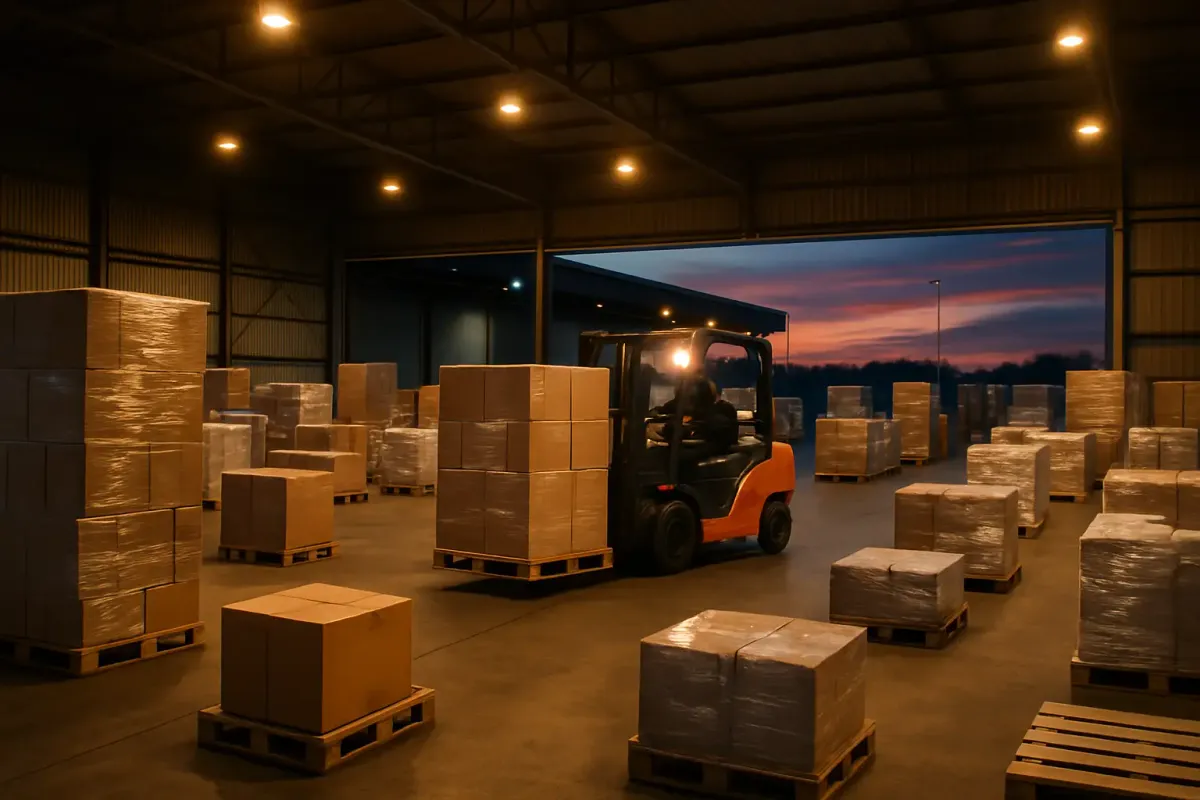
Ask five freight forwarders what groupage means and you'll get five slightly different answers, half of which will call it "LTL" and confuse everyone. Here's the precise version: groupage transport is a consolidated road freight service where a carrier combines pallets or general cargo from multiple, unrelated shippers into one trailer, moving them through a hub network so each shipper only pays for the space they actually use. Groupage transport, simply known as groupage, defines a special type of transport consisting in grouping together goods dispatched by several different companies into a same load. It's Europe's default term for what shippers in North America usually call less-than-truckload, and in international trade, the abbreviation LTT (Less Than Truckload) is frequently used, referring to groupage transport. Same underlying mechanic, different vocabulary depending which side of the Atlantic (or which forwarder's glossary) you're reading.
Groupage vs FTL vs part-load: how they actually differ
The three modes sit on a single spectrum defined by one question: how much of a trailer does your freight fill, and how much are you willing to pay to avoid sharing it? FTL means one shipper books the whole vehicle for a direct move. Groupage means many shippers share one trailer through a hub network. Part-load sits in between, larger consignments than groupage but still short of a full trailer, with less cross-docking involved.
Because an FTL freight shipment travels directly from collection to delivery, without detours or intermediate stops, it's the fastest and simplest option. Groupage works the opposite way: it relies on scheduled European departures, professional pallet consolidation, and cross-docking for efficient routing, which adds time but strips out the cost of moving an underfilled trailer.
| Mode | Typical pallet range | Cost basis | Typical transit | Handling touches |
|---|---|---|---|---|
| Groupage | 1-6 pallets | Pay per pallet/space used | Longer, hub-dependent | Multiple (collection, hub, deconsolidation) |
| Part-load | 9-20 pallets | Shared trailer, fewer stops | Faster than groupage | Fewer than groupage |
| FTL | 10-26 pallets or full trailer | Fixed price for whole vehicle | Fastest, direct | Loaded and unloaded once |
The customer can send a load of 1 to 6 pallets in a typical groupage booking, while groupage shipments are typically less than 8 pallets whilst part-loads are typically between 9 and 20. On the FTL side, that volume needs to climb into a range of 10 to 26 pallets or 20+ cubic meters before booking the whole truck starts making financial sense. Book FTL below that threshold and it's great value for money when you're utilizing most of the load capacity, but costly when you only have three pallets in a 13.6m trailer.
How a groupage shipment physically moves
A groupage pallet doesn't go straight from your dock to the customer's. It takes a longer, more supervised route:
- A local carrier collects your pallets along with other shippers' freight on a pickup route.
- Everything gets unloaded at a consolidation hub, where goods are collected or delivered to a logistics hub and combined with other shipments that have a similar destination or route.
- The consolidated load moves by linehaul to a regional hub near the destination.
- At that hub, the truck departs for the distribution area, and at a regional hub, the goods are sorted again and transported to the final delivery location.
- A local delivery run drops each shipper's pallets at their respective addresses.
Each of those extra touches costs a day. That's why average groupage delivery time might be 7 days for international shipments within the EU for some networks, against a much tighter window for FTL, which moves point-to-point with no intermediate sort. If you run just-in-time or just-in-sequence lines feeding an assembly plant, that gap between "scheduled" and "direct" is the whole ballgame.
Worked example: 3 pallets vs a full trailer, Rotterdam to Milan
Say a Rotterdam-based manufacturer needs to move 3 pallets to a customer in Milan. Three pallets falls squarely in groupage territory, well under the 1-6 pallet range carriers price as groupage bookings. Booking a dedicated 13.6m trailer for those 3 pallets means paying for roughly 85-90% empty space, which is exactly the scenario that makes FTL "costly when you only have three pallets in a 13.6m trailer," as noted above. Groupage lets that manufacturer share the trailer with other shippers' freight heading the same direction and pay only for the pallet space used.
Now flip the scenario: the same manufacturer has a 26-pallet order for the same Milan customer, enough to fill the trailer. At that volume, FTL is the obvious call. Fewer handling touches, a direct route, and a fixed price for the whole vehicle rather than a per-pallet rate that stacks up fast once you're past 8-10 pallets.
The hard part isn't the two extremes, it's everything in between, and this is where a rate-shopping layer earns its keep. Comparing groupage network rates against FTL spot and contract rates for the same order, pallet by pallet, isn't something a planner should be doing manually for every booking. Platforms like Cargoson, alongside broader TMS players such as MercuryGate, Alpega, and 3Gtms, exist specifically to automate that mode decision rather than leave it to whoever's booking freight that week defaulting to "we always use the same carrier."
Common mistakes shippers make with mode selection
A few patterns show up again and again once you start auditing how orders actually get booked:
- Defaulting to FTL out of habit for every order above a handful of pallets, paying for empty trailer space that groupage or part-load would have covered for less.
- Ignoring stackability and dimensional rules that change groupage pricing, then getting surprised by a reweigh charge at the hub.
- Booking single small orders as they come in instead of batching a week's shipments to the same region to hit part-load or FTL thresholds.
- Using groupage for a genuinely time-critical JIT line and getting caught out when a hub delay pushes a shipment a day late.
That last one is the expensive mistake. Groupage is built for shippers who prioritise cost over speed, not the other way round, which is why this mode of transport should be particularly interesting to those companies for which optimization of transport costs is a priority, not transit time. If a line stops without that pallet, groupage was the wrong call regardless of what it saved on paper.
FAQ
Is groupage the same as LTL?
Functionally, yes, in most everyday usage. Groupage is the term Europe uses for what's called less-than-truckload elsewhere, and in international trade, the abbreviation LTT (Less Than Truckload) is frequently used, referring to groupage transport. Some UK and European forwarders now use LTL and groupage as distinct tiers by pallet volume, but the core mechanic, sharing a trailer across multiple shippers, is identical.
Does groupage always cost less per pallet than FTL?
Only up to a point. Below roughly 6-8 pallets, groupage almost always wins because the company shares all transport costs with the other senders and only pays for the space it occupies. Once your volume approaches a full trailer, the per-pallet economics flip and FTL becomes cheaper.
How long does groupage take across the EU?
It varies by network and lane, but average delivery time might be 7 days for international shipments within the EU on some carrier networks, against domestic runs that can move in under two days.
What's the pallet-count breakeven point between groupage and FTL?
There's no single number, but the ranges carriers quote give a working guide: groupage typically covers 1 to 6 pallets, part-load picks up from 9 and 20, and FTL becomes cost-effective from roughly 10 to 26 pallets or 20+ cubic meters.
Can groupage shipments be tracked like FTL?
Most established networks offer tracking through each hub stage, though visibility is typically checkpoint-based (collection, hub arrival, hub departure, delivery) rather than the continuous GPS ping you'd get from a dedicated FTL trailer.