The 75% TMS Implementation Disaster Rate: How European Manufacturers Can Build Failure-Proof Deployment Strategies While Navigating Vendor Consolidation and Regulatory Compliance Before 2027's Deadline Crisis

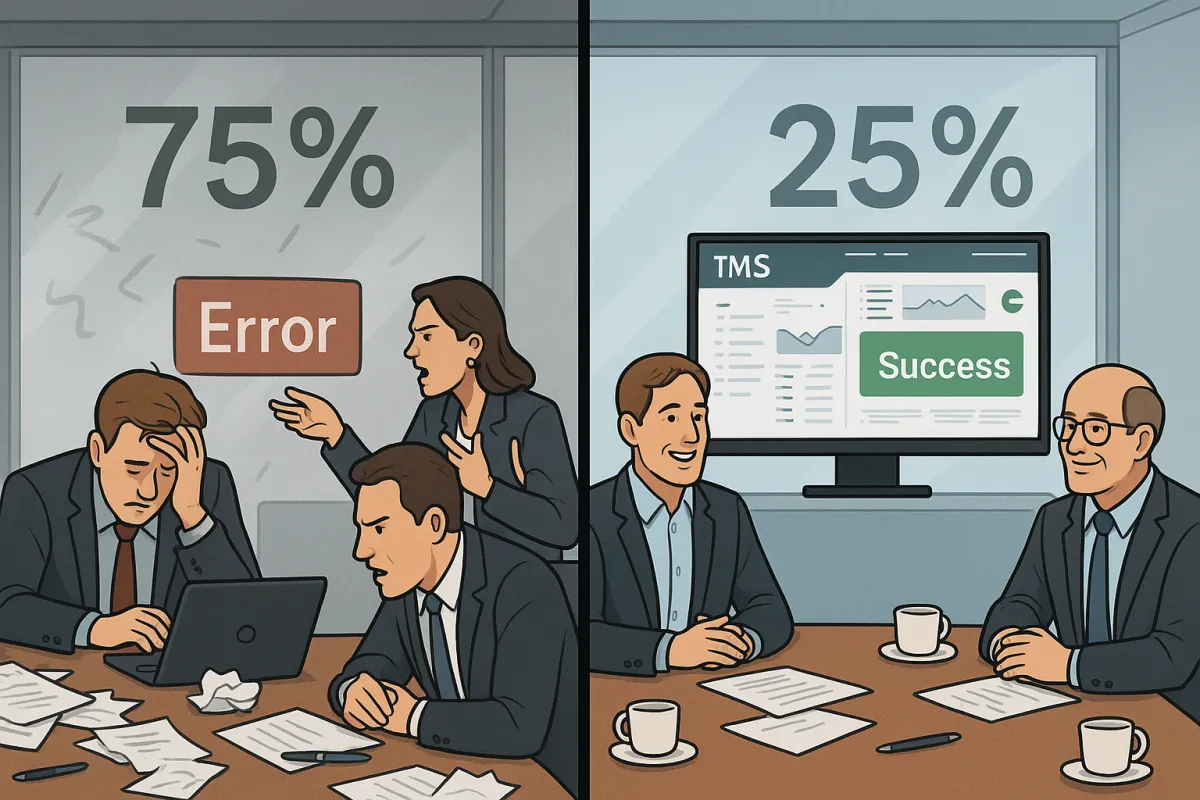
Budget overruns hit 75% of European TMS implementations, and 66% of technology projects end in partial or total failure. Yet most European manufacturers are charging ahead with TMS procurements as if these statistics don't apply to them. A German manufacturer's €800,000 mistake highlights a critical gap in most procurement processes.
You're not just buying software. You're making a decision that will determine whether your transport operations thrive or collapse under the weight of regulatory deadlines converging in 2026-2027, including eFTI compliance by July 9, 2027, and CBAM obligations taking effect January 1, 2026. Meanwhile, WiseTech Global's completed $2.1 billion acquisition of E2open and Descartes' $115 million purchase of 3GTMS represent the most aggressive vendor consolidation wave the industry has ever seen.
This procurement window runs through Q1 2026, after which your leverage disappears as regulatory pressure forces decisions. Here's how to avoid becoming another statistic.
The Crisis Behind the Numbers
According to the Standish Group's CHAOS 2020 report, 66% of enterprise technology projects end in partial or total failure across an analysis of 50,000 projects globally. For TMS implementations specifically, European manufacturers face even steeper odds because of cross-border complexity that doesn't exist elsewhere.
The €50,000+ budget overruns hitting most European manufacturers aren't inevitable - they're the predictable result of treating complex cross-border integration requirements like simple software purchases. Enterprises running SAP ECC or Oracle E-Business Suite incur integration bills of USD 500,000 to USD 3 million when layering a cloud TMS, as legacy systems lack modern APIs.
The regulatory pressure amplifies existing implementation challenges. Carriers and importers must integrate ERP and TMS systems with the ICS2 platform, with failure to report potentially resulting in a fine of up to 5,000 euros, especially with a large volume of shipments. Starting August 19, 2025, all heavy-duty vehicles registered in the EU and operating in Member States other than their Member State of registration must be fitted with G2V2 devices. This creates massive data streams requiring automated processing rather than manual analysis.
North American implementations typically succeed because they deal with single regulatory frameworks and established carrier networks. European projects face 27 different regulatory environments, varying documentation requirements, and carrier connectivity protocols that change by country.
How Vendor Consolidation Eliminates Your Options
WiseTech Global completed the acquisition of E2open for $3.30 per share in cash equating to an enterprise value of $2.1 billion, fully debt funded from a new syndicated debt facility. The transaction closed in August 2025. Companies undergoing integration often experience 12-18 months of reduced innovation while they harmonize platforms and teams. Post-acquisition integration timelines typically span 12-18 months, during which platform development stagnates and support quality deteriorates.
Descartes' 32nd acquisition since 2016 demonstrates a different consolidation model—systematic capability building rather than transformational market expansion. But the outcome is the same: fewer independent vendors competing for your business.
Companies that haven't initiated TMS selection processes by mid-2026 will find significantly fewer viable options as vendors focus on existing customer compliance rather than new acquisitions.
The Five Implementation Failure Points That Destroy European TMS Projects
The most common causes are poor change management, underestimated ERP integration complexity, inadequate data migration planning, and selecting a system that doesn't match the organisation's actual operational requirements.
Legacy ERP Integration Hell: Legacy ERP integration challenges hit mid-market companies disproportionately hard because they lack the internal expertise to manage complex system integrations. Basic API integrations cost €5,000-€15,000, while complex ERP connections exceed €50,000. Your procurement team quotes the €15,000 figure to the CFO. Six months later, you're explaining why the actual cost is €150,000.
Carrier Connectivity Chaos: European operations require connections to hundreds of carriers across different countries. Each market has established players using different protocols. Smart buyers negotiate carrier integration costs upfront and prioritize TMS providers with extensive pre-connected networks to control connectivity expenses. European-focused platforms often provide better value through pre-built carrier connections and regional expertise compared to global solutions requiring extensive customization.
Regulatory Compliance Gaps: Your vendor promises ICS2 compliance. What they don't mention is that compliance means different things in different EU markets. Vendors claiming regulatory readiness should demonstrate functional integration by January 2026, not just promise compliance by the July 2027 mandate. This timeline separation allows you to evaluate actual capabilities rather than marketing promises.
Change Management Breakdown: When the logistics team maintains a separate spreadsheet to track what the TMS is supposed to track, or uses email chains for communication the TMS was configured to automate, the software has been effectively abandoned in practice. If your logistics team logs in only to complete a specific task and exits immediately, or if certain modules have never been used after go-live, you are not realizing the intended value of the implementation.
Vendor Consolidation Risks: When two TMS platforms merge, customers inevitably face decisions about which system to standardize on, what features will be deprecated, and how long dual support will continue. These transitions often require additional implementation costs, data migration expenses, and integration redevelopment that weren't included in original TCO calculations.
The Failure-Proof Implementation Framework
Start with core functionality in Q2-Q3 2025, activate AI features in Q4 2025, and ensure eFTI compliance by Q1 2026. TMS implementation usually takes 1-2 months for smaller shippers and 3-6 months for larger, more complex networks.
Your vendor stability assessment needs to go beyond traditional financial metrics. Look beyond current revenue figures to understand how recent acquisitions impact the vendor's cash flow, development priorities, and customer service capacity. Product roadmap uncertainties are already surfacing.
Hub-and-spoke versus point-to-point integration strategies create fundamentally different operational outcomes. Hub-and-spoke architectures centralize data transformation and business logic, simplifying compliance management and reducing maintenance overhead. Point-to-point connections offer lower initial costs but create complex webs of dependencies that become expensive to maintain and modify.
Risk mitigation requires pilot programs designed around your specific failure points. Use the voluntary eFTI period starting January 2026 for real-world testing and staff training. Build testing phases, pilot programs, and gradual rollouts into your implementation schedule.
European-Specific Risk Mitigation Checklist
Modern TMS platforms from providers like nShift, Transporeon, Alpega, and Cargoson prioritize RESTful APIs with standardized data formats. But evaluation must include actual regulatory requirements, not just technical capabilities.
Currency and language localization matters more than most procurement teams realize. Your German operations need German-language interfaces. Your Polish subsidiary requires zloty pricing displays. Brexit adds another complexity layer for UK-EU movements.
GDPR compliance for data residency requires understanding where your transport data gets processed and stored. Some vendors route European data through US servers, creating compliance risks your legal team won't discover until after implementation.
Acquisition-Resistant Contract Structures
These clauses should specify minimum support periods (typically 18-24 months) for any features marked for deprecation, plus requirements for equivalent replacement functionality or assisted migration to alternative solutions.
Your contracts need 12-18 month advance notice clauses for ownership changes. This gives you time to evaluate new ownership and renegotiate terms if necessary. Functionality preservation guarantees become critical when the parcel management space shows redundancy, with e2open's multi-carrier parcel solutions overlapping with WiseTech's parcel platform, illustrating how acquisition-driven feature consolidation creates exactly the risks these clauses address.
Performance milestone payment structures protect you from paying for incomplete implementations. Structure payments around measurable deliverables rather than time-based schedules.
Success Measurement KPIs
Monitor API response times, data synchronization success rates, and error frequencies alongside operational measures like carrier onboarding speed, compliance reporting accuracy, and cost savings achievement. ROI measurement frameworks extend beyond simple cost savings calculations. Track operational improvements like reduced manual data entry, faster carrier onboarding, improved compliance reporting accuracy, and enhanced visibility across your transport network.
European operations often see 15-25% improvements in transport administrative efficiency within the first year of successful TMS data integration. Track these improvements through specific metrics, not general satisfaction surveys.
Monitor carrier onboarding speed, data quality metrics, and user adoption rates to identify budget risks before they become disasters. Leading indicators predict problems while you can still fix them.
The 90-Day Action Plan
European shippers who act decisively within the next 90 days—with proper frameworks accounting for both capacity and consolidation scenarios—position themselves to navigate 2026's perfect storm successfully, while those who delay risk joining the statistics of failed implementations and budget overruns plaguing reactive procurement strategies.
Days 1-30: Complete vendor stability assessment using consolidation-aware criteria. Review vendor financial statements, ownership structure, and market positioning. Identify potential acquirers by analyzing which larger players lack capabilities in your vendor's specialization areas.
Days 31-60: Focus on regulatory compliance verification. Test actual eFTI integration capabilities, verify G2V2 connectivity, and evaluate CBAM reporting functionality rather than accepting vendor assurances.
Days 61-90: Negotiate contract protection and finalize implementation timeline. Plan for 15-20% budget increases in 2026-2027 if reactive, or 8-12% if proactive with proper contract protection.
The vendor landscape will look fundamentally different by mid-2026. The market now divides into distinct categories with different risk profiles. Global mega-vendors (Oracle TM, SAP TM, E2open/WiseTech, Descartes), European specialists (Alpega, nShift, Transporeon), and emerging European-native solutions like Cargoson that maintain development focus specifically on European regulatory requirements.
Your window for securing optimal procurement terms closes fast. The companies that act now secure vendor attention and favorable contract terms. Those who wait will face reduced vendor capacity, higher prices, and limited negotiation leverage as regulatory deadlines force rushed decisions.
Don't become another budget disaster statistic. Start your evaluation process this week.