The Complete Guide to TMS Total Cost of Ownership: How European Manufacturers Can Build Bulletproof 5-Year Cost Models That Prevent the €800,000 Budget Disasters Hitting 75% of Implementations

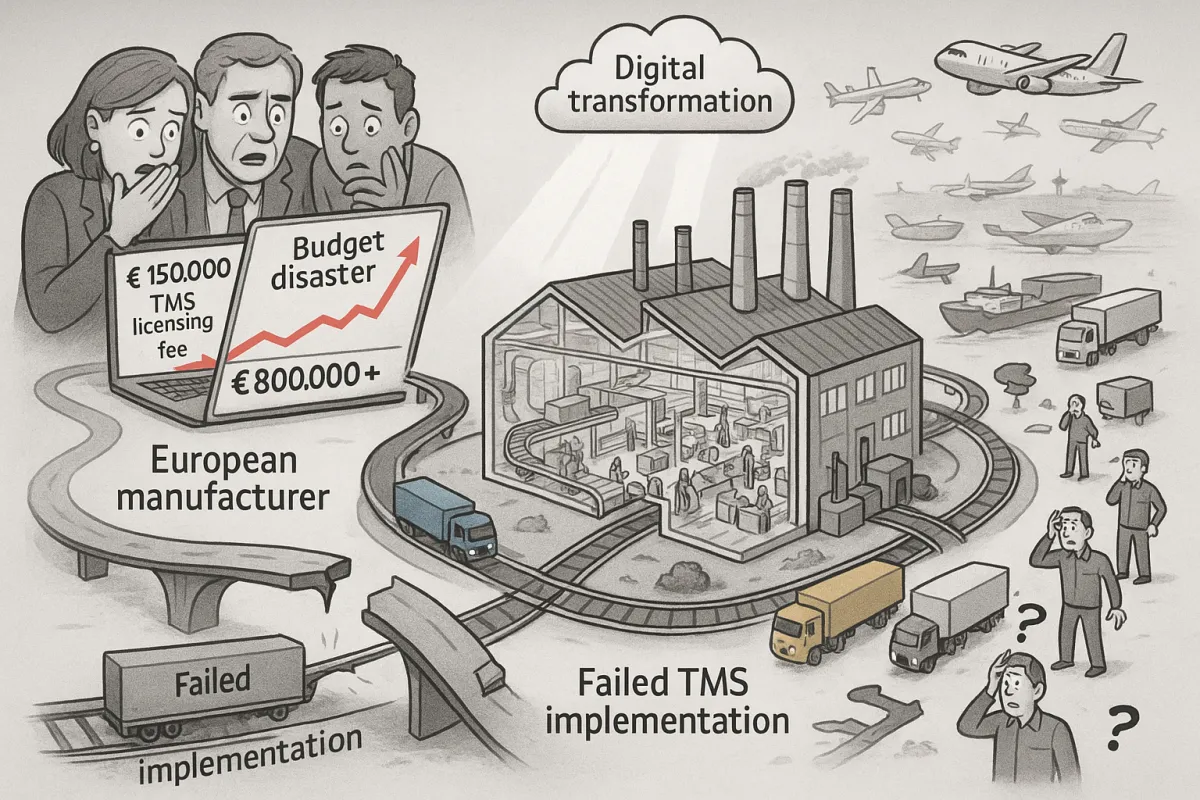
A German automotive manufacturer's finance director stared at his screen in disbelief. The €150,000 TMS licensing fee had somehow turned into an €800,000+ budget disaster over six months. Six months in, €800,000 spent, and they realized their new system couldn't handle their complex carrier network across 12 countries. The procurement team had fallen into the same trap affecting 75% of European TMS implementations: treating software licensing like a simple purchase instead of understanding the complete transformation ahead.
Your TMS implementation budget is probably wrong. Software license is typically only 20–25% of total cost of ownership—so "cheap" tools can still get expensive fast. While procurement teams obsess over subscription fees and feature checklists, the real costs lurk in integration complexity, carrier connectivity, and ongoing maintenance that vendors rarely discuss upfront. Hidden costs in TMS procurement consistently add 25-30% more than initial estimates, turning what looked like smart investments into budget disasters.
The Hidden Reality Behind European TMS Budget Disasters
The German manufacturer's disaster highlights a critical misunderstanding about TMS total cost of ownership. European shippers consistently underestimate TMS implementation costs because they treat licensing like a simple software purchase rather than understanding it as a complex transformation affecting every carrier relationship, integration requirement, and operational workflow.
The statistics paint a sobering picture: 66% of enterprise technology projects end in partial or total failure across an analysis of 50,000 projects globally. For European TMS implementations, the failure rate reaches even higher due to cross-border complexity that doesn't exist elsewhere. 76% of logistics transformations fail to achieve their performance objectives because procurement teams focus on feature comparisons and license fees while the real financial impact lives in implementation complexity, carrier integration charges, and ongoing maintenance expenses.
Consider the real cost breakdown across different TMS platforms. Licensed TMS software costs $50,000-$400,000+ and typically includes annual/monthly maintenance and support fees. Oracle TM and SAP TM exemplify this pricing complexity through multi-layered fee structures that include base licenses, user counts, transaction volumes, and regional modules. Meanwhile, cloud TMS pricing ranges from $1.00 to $4.00 per freight load booked in the system, while licensed options demand significant upfront investment plus ongoing maintenance fees.
European-native platforms approach pricing differently. European specialists like Cargoson and Alpega typically offer more transparent cloud-based pricing models designed specifically for European cross-border operations. Traditional enterprise vendors like Manhattan Active, MercuryGate, and Oracle TM often separate implementation services from licensing, creating multiple budget line items that can spiral beyond initial projections.
Breaking Down the True TCO Components
Building an accurate TCO model requires understanding five critical cost categories. Consider these TCO components: base licensing (20-30% of total), implementation services (25-40%), carrier integration (15-25%), customization and training (10-20%), and ongoing support (15-20%). A 3-Year Total Cost of Ownership (TCO) calculation should include license fees (20-25% of TCO), implementation, integration, training, and ongoing support.
The labor requirements reveal why budget projections fail. A basic domestic shipper needs 10-15 integrations minimum, totaling 1,000-1,500 hours of labor, while most shippers today require an average of 40 integrations. For shippers with freight spend exceeding $250M annually, implementation can cost 2-3 times the subscription fee. This multiplier effect explains why seemingly affordable cloud solutions can exceed traditional licensed software costs during the first year.
European operations face additional complexity multipliers. Your typical mid-sized manufacturer requires integrations with domestic carriers, cross-border specialists, customs systems, and multiple ERP modules. Each connection demands testing, documentation, and maintenance that vendors exclude from initial quotes. Most European manufacturers work with 20-30 regular carriers but could benefit from access to 200-300 qualified providers. Each connection requires testing, documentation, and ongoing maintenance that vendors exclude from initial quotes.
Implementation and Integration Costs
Integration expenses create the biggest budget surprises for European shippers. Basic API integrations cost €5,000-€15,000, while complex ERP connections exceed €50,000. Enterprises running SAP ECC or Oracle E-Business Suite incur integration bills of USD 500,000 to USD 3 million when layering a cloud TMS, as legacy systems lack modern APIs.
The integration complexity stems from European operational requirements. European manufacturers discover that a basic domestic shipper requires 10-15 integrations minimum, potentially totaling 1,000-1,500 hours of labor, while for shippers with freight spend exceeding $250M annually, implementation can cost 2-3 times the subscription fee. Your carrier network spanning multiple countries, each with different technological capabilities, multiplies these requirements exponentially.
Modern platforms approach integration differently. API-first platforms like Cargoson reduce integration complexity through pre-built connections, while legacy EDI approaches require custom development for each carrier relationship. Cloud TMS platforms help avoid typical implementation pitfalls, with average installations taking two to three months maximum, compared to licensed software that takes longer to implement and requires extensive upfront planning.
The European Regulatory Cost Multiplier
European compliance requirements represent the most underestimated cost category in TMS budgets. A German automotive manufacturer signed a three-year TMS renewal without regulatory compliance pricing protection, and when their vendor introduced eFTI compliance as a premium add-on module nine months later, the additional licensing costs reached €800,000 annually.
The regulatory timeline creates urgent implementation pressure. From 9 July 2027, all national authorities will be obliged to accept freight documentation in electronic form via certified eFTI platforms. Meanwhile, the forthcoming Euro 6e-bis emissions standard and the fitment of smart tachograph Gen2V2 (by July 2026) ensure all commercial vehicles will carry advanced telematics. Carriers and importers must integrate ERP and TMS systems with the ICS2 platform, with failure to report potentially resulting in a fine of up to 5,000 euros, especially with a large volume of shipments.
European-native vendors often build compliance capabilities into their base platform pricing, while global enterprise platforms treat regulatory requirements as premium add-ons. Cargoson and nShift focus specifically on European regulatory frameworks, while platforms like Descartes and MercuryGate require additional modules for eFTI and ICS2 compliance. This architectural difference creates long-term TCO implications that traditional procurement frameworks miss.
Building Your 5-Year TCO Calculator Framework
Plan for 15-20% budget increases in 2026-2027 if reactive, or 8-12% if proactive with proper contract protection. European shippers who build comprehensive TCO frameworks before vendor selection avoid the budget disasters that plague reactive procurement approaches.
Your TCO calculator must account for hidden cost categories that emerge during implementation. Start with base licensing costs, then add implementation services at 25-40% of licensing fees. Factor in carrier integration at €5,000-€15,000 per connection for basic APIs, with complex ERP integrations potentially reaching €50,000+. Include training at 10-20% of total project cost, and budget ongoing support at 15-20% annually.
Regulatory compliance costs require separate line items. European operations must budget for eFTI platform integration, ICS2 reporting capabilities, and smart tachograph connectivity. Traditional enterprise vendors like Oracle TM and SAP TM charge separately for these modules, while platforms focused on European operations may include compliance in their base pricing.
Vendor consolidation adds another risk layer. WiseTech Global's $2.1 billion acquisition of E2open, expected to complete in 1H26, alongside Descartes Systems Group's $115 million acquisition of 3GTMS in March 2025, represents the most significant TMS vendor consolidation wave in over a decade. When vendors merge, customers face decisions about platform standardization, feature deprecation, and ongoing support timelines.
Cloud vs Licensed TCO Models
Cloud and licensed TMS models create different cost profiles over five years. Licensed TMS software runs $50,000-$400,000+ with annual maintenance charges ranging from 15-20% of license costs. For a mid-sized operation, that initial €100,000 investment becomes €200,000+ in the first year when you factor in implementation, training, and infrastructure requirements.
Cloud TMS implementations often conclude within eight weeks, compared to 6-18 months for traditional systems. For many European shippers, this translates to predictable monthly costs that scale with business growth rather than fixed infrastructure investments. A good "rule of thumb" for a top tier cloud TMS is anywhere from $1.00 to $4.00 a shipment. This fee is dependent on the total number of shipments moved a month.
The cost structure differences become significant at scale. When business reaches peak seasons, the SaaS transportation management system software cost increases in sync with turnover. A custom TMS, on the other hand, allows you to process an unlimited number of transactions. European manufacturers with seasonal volume swings of 30-50% need to model these variable costs carefully against fixed licensing alternatives.
Vendor Consolidation Impact on Long-Term TCO
The current vendor consolidation wave creates unprecedented TCO risks for European buyers. Companies undergoing integration often experience 12-18 months of reduced innovation while they harmonize platforms and teams. When two TMS platforms merge, customers inevitably face decisions about which system to standardize on, what features will be deprecated, and how long dual support will continue.
These transitions often require additional implementation costs, data migration expenses, and integration redevelopment that weren't included in original total cost of ownership calculations. Integration timelines are extending as merged vendors focus on internal platform consolidation rather than customer-specific connectivity projects. This directly impacts European shippers whose carrier networks span multiple countries with varying technological capabilities.
European-native alternatives provide consolidation resistance. Vendors like Cargoson, Alpega, and Transporeon maintain specialized European focus that mega-vendors often dilute post-acquisition. European-native vendors often provide better insulation against global consolidation dynamics while maintaining specialized corridor expertise.
Risk mitigation strategies include contract clauses that protect against acquisition-driven price increases, platform migration requirements, and feature deprecation. Your procurement framework should evaluate vendor financial stability, acquisition likelihood, and post-merger integration track records when building long-term TCO models.
Practical TCO Implementation Timeline
European manufacturers face a compressed procurement timeline driven by regulatory deadlines and vendor consolidation. European shippers who act decisively within the next 90 days position themselves to navigate 2026's perfect storm successfully, while those who delay risk joining the statistics of failed implementations and budget overruns plaguing reactive procurement strategies.
Your 90-day framework should start with comprehensive TCO modeling in days 1-30, including all hidden cost categories and regulatory compliance requirements. Days 31-60 focus on vendor evaluation using consolidation-aware criteria, examining financial stability, European regulatory roadmaps, and post-acquisition integration capabilities. Days 61-90 complete contract negotiations with specific protection clauses for budget overruns, regulatory compliance pricing, and consolidation scenarios.
TMS implementation usually takes 1-2 months for smaller shippers and 3-6 months for larger, more complex networks. European mid-market manufacturers typically fall between these timeframes due to cross-border complexity combined with smaller operational scale than enterprise implementations. Plan your implementation timeline to include core functionality in Q2-Q3 2025, AI features activation in Q4 2025, and eFTI compliance by Q1 2026.
Monitor carrier onboarding speed, data quality metrics, and user adoption rates to identify budget risks before they become disasters. Establish 60-day checkpoints to validate integration progress and cost tracking. Warning signs of budget overruns include extended integration timelines, additional customization requests, and carrier connectivity challenges that require manual workarounds.
European manufacturers building comprehensive TCO frameworks avoid joining the 75% failure statistics while positioning themselves for competitive advantage in the post-2026 regulatory environment. Your TMS selection determines whether vendor consolidation and regulatory requirements become operational strengths or budget disasters. Build your TCO framework now, before procurement options disappear and implementation costs spiral beyond control.