The €3 Cross-Border Transformation: How European Shippers Can Turn July 2026's EU Customs Revolution Into Strategic TMS Advantage While Competitors Struggle With Compliance Chaos

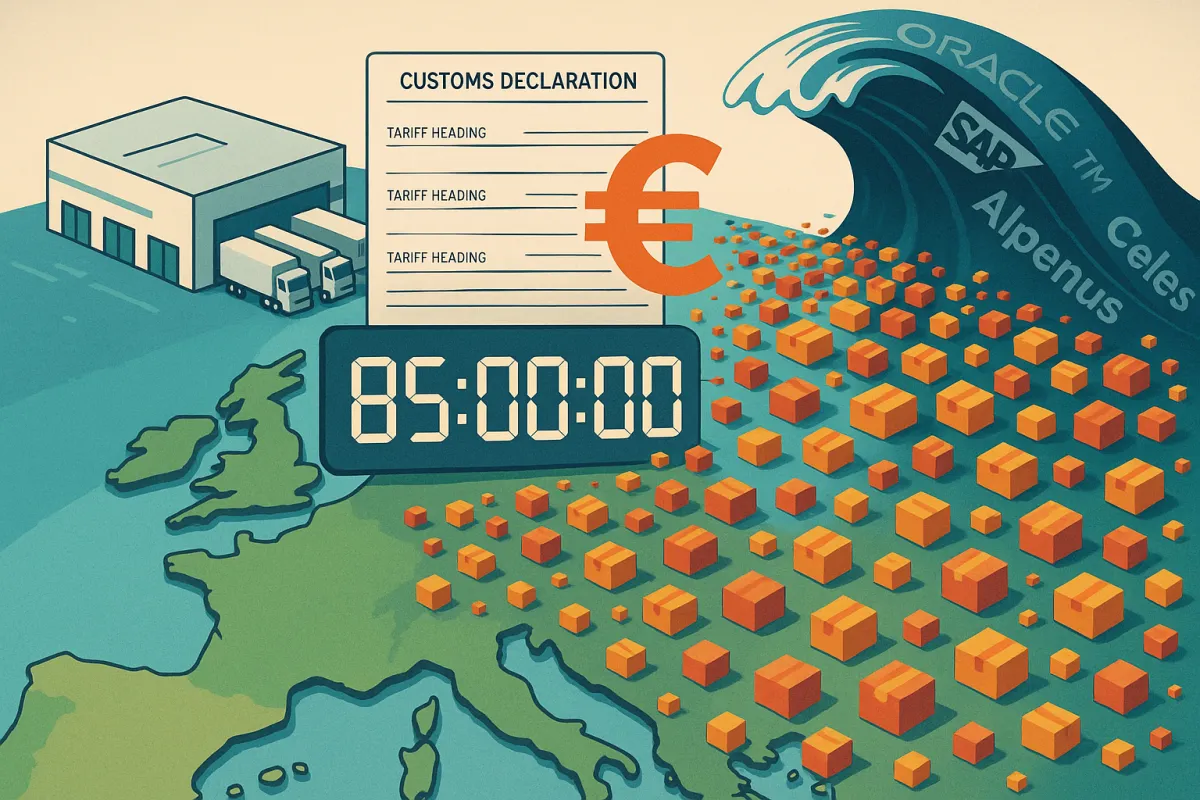
The €4.6 billion low-value parcel market flowing into the EU just hit a regulatory wall. Some €4.6 billion low-value items under €150 were imported to the EU in 2024, representing an average of 12 million parcels per day, with around 91% originating from China. Starting July 1, 2026, goods entering the EU in small consignments and valued at less than €150 will be subject to a fixed €3 customs duty applied to each different item, according to their tariff headings, contained in a consignment.
While your competitors scramble with compliance chaos, forward-thinking European manufacturers and retailers can transform this regulatory disruption into strategic TMS advantage. The timing creates an unprecedented opportunity: post-consolidation landscape reveals three distinct categories: global mega-vendors (Oracle TM, SAP TM, E2open/WiseTech, Descartes), European specialists (Alpega, nShift, Transporeon), and emerging European-native solutions like Cargoson that maintain development focus specifically on European regulatory requirements.
You have exactly 85 days to position your transport operations ahead of both the customs revolution and the TMS vendor consolidation wave that's eliminating procurement options by the month.
The Operational Reality Behind That "Simple" €3 Number
Don't let the flat €3 rate fool you into thinking this is straightforward. The €3 duty is charged per item based on tariff classification, not simply per parcel or per shipment. Each distinct product in a consignment, identified by its customs tariff heading, attracts a separate €3 duty. A parcel containing one smartphone, a charger, and earphones will be treated as three distinct items, each with its own tariff heading, resulting in a total duty of €9.
The complexity multiplies when you add the expected €2 Customs Handling Fee likely to be introduced in October 2026. Your actual cost per item becomes €3 plus your share of the €2 handling fee divided by items in the consignment. A three-item parcel now carries €11 in fees - €9 in duties plus €2 handling.
Most TMS platforms struggle with this level of customs complexity. Traditional EDI-based systems lack the real-time classification capabilities needed for accurate pre-shipment cost calculation. While global vendors like Avalara promise automation solutions, European-focused TMS providers including Cargoson, Alpega, and nShift typically offer better integration with EU customs data requirements.
The Strategic Window: Converting Compliance Burden Into Competitive Advantage
Large Chinese e-commerce platforms are already adapting their supply chains by increasing the use of EU-based warehousing. This indicates an acceptance that per-parcel costs may affect demand and that faster delivery times will become an even more important competitive differentiator, particularly when competing with established players such as Amazon, which already operates highly efficient fulfilment networks across the EU.
Here's your advantage: while platforms scramble to adjust their supply chains, you can optimize your TMS infrastructure to handle both the immediate €3 duty requirements and the permanent customs reform arriving when the EU Customs Data Hub becomes operational. Current projections suggest the hub will be ready by 2028.
The vendor consolidation happening simultaneously creates procurement leverage. WiseTech's acquisition of e2open for $3.30 per share in cash equating to an enterprise value of $2.1 billion marks the largest TMS industry acquisition to date, while Descartes Systems Group has acquired Columbus, Ohio-based 3Gtms for $115 million USD in cash, reshaping vendor options for European buyers.
Companies undergoing integration often experience 12-18 months of reduced innovation while they harmonize platforms and teams. Post-acquisition integration timelines typically span 12-18 months, during which platform development stagnates and support quality deteriorates. Smart procurement teams can exploit this by securing better terms from vendors seeking stable revenue during integration periods.
Your 85-Day Implementation Framework
Phase 1 (Days 1-30): Current-State Assessment and Vendor Stability Evaluation
Start with brutal honesty about your current TMS capabilities. Can your system handle per-item customs classification automatically? Does it integrate with IOSS registration data for VAT compliance? For non-EU marketplaces and sellers targeting EU consumers, the new duty underscores the importance of IOSS registration not only for VAT compliance but also for customs treatment during the transitional period. EU-established sellers operating under OSS are unaffected by the €3 duty, which heightens the competitive advantage of having tax and commercial operations inside the EU.
Evaluate your current vendor's acquisition vulnerability. Companies that haven't initiated TMS selection processes by mid-2026 will find significantly fewer viable options as consolidation eliminates redundant platforms. Financial stability matters more than feature lists when 18-month integrations follow acquisitions.
Document your cross-border shipment patterns. If you send shipments into the EU, you should take stock of the countries of origin, value bands, HS codes, shipping services, and fulfilment models of your goods/materials. Identify which shipments currently rely on the €150 exemption, and how many will now become dutiable.
Phase 2 (Days 31-60): TMS Platform Selection with Customs Compliance Capabilities
Focus on vendors demonstrating actual customs functionality, not promises. Vendors claiming regulatory readiness should demonstrate functional integration by January 2026, not just promise compliance by the July 2027 mandate. This timeline separation allows you to evaluate actual capabilities rather than marketing promises.
European-focused solutions offer advantages during this transition. nShift's cross-border analysis shows their deep understanding of EU requirements, while traditional players like MercuryGate (now part of Körber's Infios) and Blue Yonder bring enterprise scale but may deprioritize European compliance during their own integration challenges.
Global platforms like Oracle TM and SAP TM provide enterprise integration advantages and broader functional scope but may deprioritize European-specific features during consolidation activities. The choice depends on organizational priorities between regional optimization and global standardization.
Phase 3 (Days 61-85): Implementation and Testing Before July 1 Deadline
Compressed implementation timelines demand focused scope. Prioritize customs classification and duty calculation over advanced analytics. Your July 1 deadline is non-negotiable - unlike previous regulatory changes that offered grace periods, these deadlines operate as hard cutoffs. Economic operators who hadn't upgraded their systems by this date faced immediate disruption, with customs authorities simply refusing to process shipments that didn't meet the new standard.
Test with multiple product categories and shipment scenarios. Remember that multiple identical units of the same tariff heading attract the duty on a per unit basis. Your system must handle both mixed-product parcels and quantity-based calculations accurately.
Build testing partnerships with forward-thinking carriers. Those investing in eFTI compliance ahead of the 2027 mandate can provide better integration support during your implementation window.
The Cost-Benefit Reality: Hidden Savings vs Obvious Costs
A €15 product shipped directly from a non-EU seller to a French consumer attracts a €3 duty plus an approximately €2 handling fee - a €5 addition to the landed cost that didn't exist before. Multiply this across your cross-border volume, and the numbers add up quickly.
But the automation savings offset much of this cost. Manual customs classification costs €3-€8 per shipment in processing time. Automated systems reduce this to pennies while improving accuracy. The introduction of Electronic Freight Transport Information could save the EU transport and logistics sector up to €1 billion per year, but only through proper implementation.
Total cost of ownership calculations must include hidden compliance costs. Plan for 15-20% budget increases in 2026-2027 if reactive, or 8-12% if proactive with proper contract protection. The premium for rush implementations far exceeds proactive platform investment.
Factor in your competitive positioning. For EU merchants who have long had to factor duty costs into their pricing, this is a structural correction rather than a new burden. The playing field isn't yet perfectly level - full tariff rates only apply when the EU Customs Data Hub goes live in 2028 - but the direction is clear and the effect is immediate.
Future-Proofing Beyond July 2026
This €3 duty is explicitly designed as a temporary solution. It will remain in force until the EU's broader customs reform package becomes operational, notably the EU Customs Data Hub scheduled for launch in 2028. Once that system is live, low-value e-commerce imports will move to a permanent regime under which standard EU customs tariffs apply, based on the nature and classification of the goods rather than a flat rate.
Your TMS investment strategy must account for this evolution. Platforms that handle the €3 flat rate but struggle with complex tariff calculations will become liabilities by 2028. European vendors like Cargoson, Alpega, and Transporeon typically maintain closer alignment with EU regulatory roadmaps than global vendors managing worldwide priorities.
The regulatory landscape extends beyond customs. From July 1, 2026, vans weighing 2.5-3.5 tons performing international transport of goods will be subject to the obligation to use second-generation smart tachographs (G2V2), fundamentally transforming how European manufacturers manage their light commercial vehicle fleets.
Your 48-Hour Decision Framework
The procurement window is closing rapidly. The procurement window for securing optimal TMS platforms before vendor consolidation eliminates choices and capacity shortages worsen cost structures runs through Q1 2026. You need decision criteria that account for both immediate compliance and long-term vendor viability.
Financial stability trumps feature richness. Standard TMS contracts rarely address acquisition scenarios directly. Include specific clauses requiring 12-18 months advance notice of ownership changes, with automatic contract review rights triggered by acquisition announcements. Price protection clauses should lock pricing for 24 months following ownership changes, preventing immediate cost increases during integration periods.
Regulatory readiness requires proof, not promises. Demand functional demonstrations of customs classification, IOSS integration, and eFTI preparation. European specialists often outperform global vendors in regulatory implementation speed, while mega-vendors provide better enterprise integration but slower compliance adaptation.
The perfect storm of customs reform, TMS consolidation, and capacity constraints creates both unprecedented risk and opportunity. Companies that act decisively within this narrow window - with proper frameworks addressing both vendor stability and regulatory compliance - position themselves to navigate 2026's perfect storm successfully. Those who delay risk joining the growing statistics of failed implementations and budget overruns that plague reactive procurement strategies. Your procurement decisions in the next 90 days will determine whether you secure a stable, regulation-ready platform or become another cautionary tale about the costs of waiting too long in a consolidating market.
The €3 customs duty represents more than a cost increase - it's a market reset that rewards preparation and punishes procrastination. Your competitive advantage depends on acting before your competitors recognize what's at stake.