The €500K ERP Transport Module vs. Standalone TMS Decision: How European Manufacturers Can Navigate Vendor Consolidation and Choose the Right Architecture Before 2026's Regulatory Deadlines Force Expensive Mistakes

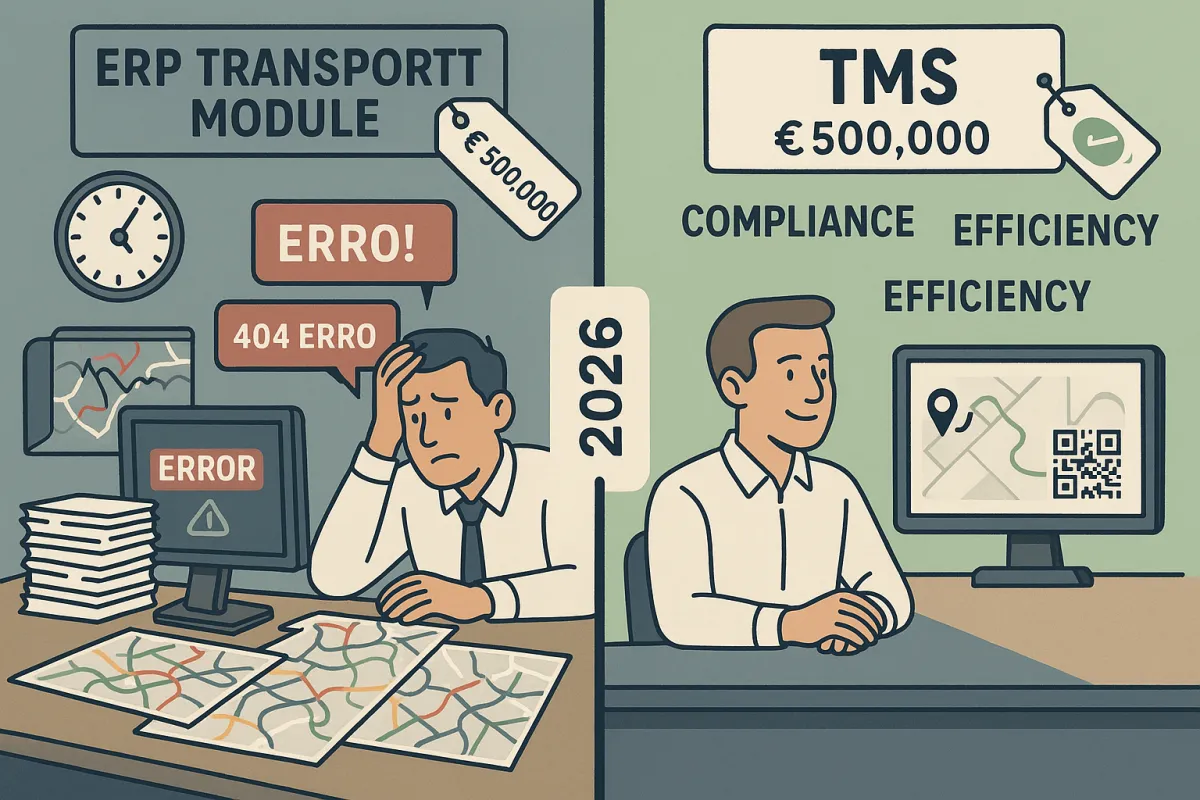
A German automotive manufacturer thought they had it figured out. ERP transport modules were "good enough" for their domestic operations, and the €500,000 price tag for standalone TMS integration seemed excessive. Six months after signing with their ERP vendor's transport add-on, a German manufacturer's €800,000 mistake highlights a critical gap in most procurement processes. They discovered their system couldn't generate QR codes for eFTI compliance, handle multi-carrier rate shopping across borders, or support the complex customs documentation required for their expanding Eastern European operations.
This scenario repeats across European boardrooms as vendor consolidation accelerates. WiseTech Global's $2.1 billion acquisition of E2open and Descartes' $115 million purchase of 3GTMS represent the most aggressive market consolidation wave the industry has seen. Meanwhile, budget overruns hit 75% of European TMS implementations, and 66% of technology projects end in partial or total failure. European manufacturers face a decision point that will determine whether their transport operations thrive or collapse under regulatory pressures converging in 2026-2027.
The Hidden Capability Gap That Renders ERP Transport Modules Insufficient
Most ERP vendors position their transport modules as comprehensive solutions, but the reality tells a different story. Native ERP transport functionality typically covers less than 30% of what dedicated Transportation Management Systems deliver. You can manage basic shipment documentation and generate simple reports, but when it comes to sophisticated rate shopping, multi-carrier optimization, or cross-border compliance automation, the gaps become operational failures.
SAP Transportation Management, despite its enterprise pedigree, struggles with real-time rate comparisons across multiple European carriers. Oracle's ERP transport capabilities handle domestic workflows reasonably well but fail when you need to manage complex customs documentation for shipments crossing from Germany through Poland into Lithuania. The systems were designed for single-market operations, not the multi-jurisdictional complexity that defines European manufacturing supply chains.
Consider the specific functionality gaps: dynamic routing optimization that accounts for driver hours regulations, automated dangerous goods documentation that meets ADR requirements across borders, and intelligent load consolidation that factors in country-specific weight restrictions. These aren't edge cases - they're daily operational requirements for manufacturers managing transport spend above €10 million annually. ERP modules treat these as customization opportunities, which means additional cost, longer implementation timelines, and ongoing maintenance complexity that negates the supposed simplicity advantage.
The European specialists understand this complexity differently. Solutions like Cargoson, Alpega, and nShift were built specifically for cross-border European operations, with native support for country-specific regulations and carrier requirements. They handle the operational reality that a shipment from Milan to Hamburg might require different documentation, routing, and compliance checks than identical cargo moving from Hamburg to Milan.
2026 Regulatory Compliance: The Architecture Test That Exposes ERP Limitations
European regulatory requirements approaching in 2026-2027 create a natural experiment for evaluating transport architecture choices. The eFTI Regulation will apply in full by 9 July 2027, requiring Member State authorities to accept information shared electronically by operators via certified eFTI platforms. As of January 2026, the majority of EU member states require full ICS2 compliance for all transport modes.
These deadlines expose fundamental architectural differences between ERP transport modules and standalone TMS platforms. eFTI platforms require data sharing with authorities using unique access links in machine-readable formats such as QR codes. Most ERP transport modules cannot generate these QR codes natively, cannot structure data according to eFTI common datasets, and lack the certification pathways required for compliance.
The ICS2 requirements create similar challenges. Under ICS2 Release 3, forwarders must submit an Entry Summary Declaration (ENS) for rail cargo entering the EU, completed before the train departs from China. This requires real-time data exchange with customs systems, automated validation of commodity descriptions, and integration with carrier booking systems - capabilities that exist in dedicated TMS platforms but require expensive customization in ERP environments.
The certification burden alone should influence architecture decisions. eFTI compliance requires platform certification through national competent authorities, ongoing audit requirements, and technical specifications that evolve as regulations mature. The Commission plans to adopt remaining eFTI implementing specifications by December 2026, providing detailed functional and technical requirements for IT systems. ERP vendors cannot provide the same level of regulatory focus as specialized TMS providers whose business depends on maintaining these certifications.
Total Cost Reality: Why ERP Integration Often Costs More Than Standalone Solutions
European manufacturers consistently underestimate the true cost of ERP transport module implementation versus standalone TMS deployment. The subscription pricing appears favorable, but integration complexity creates budget overruns that eliminate any initial savings. Enterprises running SAP ECC or Oracle E-Business Suite incur integration bills of $500,000 to $3 million when layering a cloud TMS, as legacy systems lack modern APIs.
The cost structure works differently for each approach. Basic TMS APIs cost €5,000-€15,000 for standard integrations, but complex ERP connections requiring custom middleware can reach €50,000 or more. ERP transport modules avoid integration costs initially but create hidden expenses through customization requirements, extended implementation timelines, and ongoing maintenance complexity.
Consider a practical example from recent implementations. A Dutch manufacturer with €25 million annual transport spend evaluated both approaches. The SAP transport module appeared to cost 40% less than a standalone TMS over five years, but the total cost calculation revealed the opposite reality. Custom development for cross-border documentation added €150,000, integration with their existing WMS required another €75,000, and ongoing maintenance consumed 15-20% of the initial investment annually. The standalone TMS implementation cost more upfront but delivered full functionality without customization and required significantly less ongoing technical support.
The maintenance cost differential becomes more pronounced over time. TMS vendors handle regulatory updates, carrier API changes, and feature enhancements as part of standard operations. ERP transport modules require internal IT resources to manage these updates, creating ongoing technical debt that increases operational costs and reduces agility when regulations change or business requirements evolve.
Vendor Consolidation Impact: How Market Changes Reshape Your Architecture Options
The current vendor consolidation wave affects standalone TMS options more dramatically than ERP-embedded solutions, but the implications aren't straightforward. WiseTech Global's $2.1 billion acquisition of E2open represents the largest logistics software transaction in history, creating a combined entity that serves both logistics service providers and direct shippers across complementary markets.
The acquisition expands WiseTech's customer base with a network of 500,000 connected enterprises including major connectivity with ocean carriers and numerous blue-chip shippers. This scale creates advantages for customers through enhanced carrier connectivity and potentially lower integration costs, but it also concentrates market power in fewer vendors.
European specialists like Transporeon (now part of Trimble), Alpega, and Cargoson maintain different market positions. They focus specifically on European operational requirements rather than global scale, providing deeper functionality for cross-border compliance and carrier integration within Europe. The consolidation pressure affects their ability to compete on price against mega-vendors but potentially strengthens their value proposition around specialized European functionality.
The consolidation creates specific timing pressures for architecture decisions. Vendors being acquired often freeze major development initiatives during integration periods, creating 12-18 month gaps in feature development. Customers face pressure to commit to roadmaps before understanding how acquired capabilities will integrate with existing platforms. This uncertainty window extends through Q2 2026 for most major acquisitions, after which regulatory deadlines force decisions regardless of vendor readiness.
Decision Framework: Matching Architecture to Operational Complexity and Geographic Scope
European manufacturers need systematic evaluation criteria that account for complexity, volume, and geographic scope when choosing between ERP transport modules and standalone TMS platforms. The decision framework should evaluate four key dimensions: operational complexity, regulatory requirements, integration needs, and growth trajectory.
ERP transport modules work best for manufacturers with straightforward domestic operations, limited carrier networks, and minimal cross-border complexity. If your transport operations involve fewer than 5 carriers, handle primarily domestic shipments within 2-3 countries, and generate fewer than 100 shipments weekly, the ERP approach provides adequate functionality without excessive customization requirements.
Standalone TMS becomes necessary when operational complexity exceeds ERP capabilities. This includes manufacturers managing more than 10 carriers, handling significant cross-border volumes, requiring real-time rate shopping, or facing complex regulatory requirements across multiple jurisdictions. The complexity threshold often correlates with transport spend - companies exceeding €10 million annual transport spend typically require capabilities beyond what ERP modules provide.
The geographic scope test provides another decision criterion. Single-country operations might work within ERP limitations, but multi-country European operations require the specialized functionality that TMS platforms provide. Cross-border documentation requirements, country-specific carrier integrations, and varying regulatory compliance needs create operational complexity that ERP transport modules cannot handle efficiently.
Implementation timelines differ significantly between approaches. TMS deployments typically require 4-6 months from contract signing to full operations, while ERP transport module implementations often extend 15-20 months due to customization requirements and integration complexity. This timeline difference becomes critical when regulatory deadlines approach and internal resources are constrained.
Implementation Strategy: Building Failure-Proof Deployment Regardless of Architecture Choice
Success depends on phased approaches and proper change management regardless of whether you choose ERP transport modules or standalone TMS platforms. Budget overruns hit 75% of European TMS implementations, and 66% of technology projects end in partial or total failure, but these statistics reflect common implementation mistakes rather than inherent technology limitations.
The phased approach starts with core functionality rather than comprehensive feature deployment. Begin with dispatch, tracking, and basic compliance capabilities, then add sophisticated features like dynamic routing, advanced analytics, and multi-carrier optimization once the foundation stabilizes. This strategy reduces implementation risk and allows teams to adapt to new workflows before introducing additional complexity.
Risk mitigation requires specific attention to integration testing and data quality validation. Most implementation failures trace back to integration issues that surface after launch, creating operational disruption when systems go live. Establish 72-hour testing protocols that validate carrier connections, document generation, and data exchange under realistic load conditions before committing to live operations.
Change management becomes more critical for ERP transport module implementations because users often expect familiar interfaces but encounter new workflows. The integration between ERP and transport functionality creates dependencies that require careful coordination between logistics and IT teams. Standalone TMS implementations face different challenges around user adoption and process standardization but typically offer more intuitive interfaces designed specifically for transport operations.
Start your evaluation process now rather than waiting for regulatory pressure to force decisions. The eFTI Regulation will apply in full by 9 July 2027 and as of January 2026, the majority of EU member states require full ICS2 compliance. The procurement window for favorable vendor negotiations and adequate implementation timelines closes by Q1 2026, after which regulatory deadlines force expensive rush implementations that increase failure risk.