The European Shipper's Complete TMS Total Cost of Ownership Framework: How to Expose Hidden Costs and Build Bulletproof Budgets Before Vendor Consolidation Eliminates Your Options

A mid-sized German automotive parts manufacturer thought their TMS implementation was going smoothly. Six months into implementation, €800,000 spent, they realized their new system couldn't handle their complex carrier network across 12 countries. Sound familiar? You're not alone.
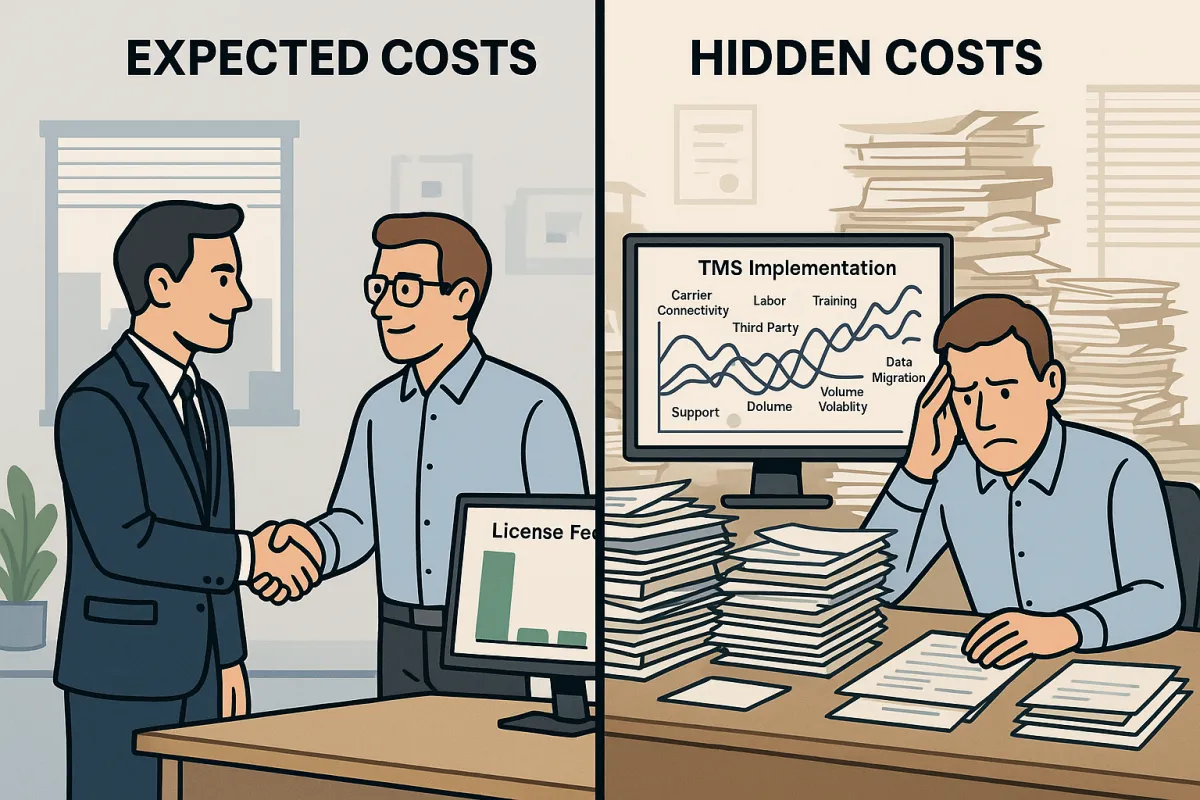
Hidden costs in TMS procurement consistently add 25-30% more than initial estimates, turning what looked like smart investments into budget disasters. While procurement teams focus on feature checklists and license fees, the real financial impact lives in implementation complexity, carrier integration charges, and ongoing maintenance expenses that vendors rarely discuss upfront.
The timing for this wake-up call couldn't be worse. The most significant TMS vendor consolidation wave in over a decade is reshaping European procurement decisions right now. WiseTech's acquisition of E2open in 2025, Descartes' purchase of 3GTMS for $115 million in March 2025, and Körber's transformation of MercuryGate into Infios following their 2024 acquisition represent just the beginning of a fundamental market restructuring that's forcing European shippers to reconsider their entire TMS procurement strategy.
You thought you had time to evaluate options carefully. This growth is happening alongside unprecedented consolidation that's eliminating choice and creating new risks for procurement teams who thought they had plenty of time to evaluate options.
The Hidden Cost Iceberg: 7 Budget Killers Most Vendors Won't Discuss
License fees represent just the starting point. Yet most European procurement teams calculate their TMS budgets based on software licensing alone, missing the reality that implementation costs dominate total expenditure.
TMS implementation costs range from €30,000 to €900,000, depending on complexity and vendor approach. For shippers with annual freight under management exceeding €250M, implementation costs often run 2-3x the subscription fees. Here's what catches European shippers off-guard:
Carrier connectivity costs represent the largest hidden expense. Many carriers aren't willing or able to create API connections, and even when they are, they'll charge integration costs to you. European shippers working with 20-30 regular carriers face substantial connectivity expenses that vendors rarely discuss during initial demos. Basic API integrations cost €5,000-€15,000, while complex ERP connections exceed €50,000.
Labor costs from interface complexity emerge after go-live. A basic domestic shipper requires 10-15 integrations minimum, potentially totaling 1,000-1,500 hours of labor. More complex operations may need 140+ integration objects. When your transport coordinators need 40% longer to complete standard tasks, those efficiency gains disappear quickly.
Third-party dependencies add unexpected fees. Additional fees cover third-party application integration, such as SMC or PC Miler license costs. Your TMS vendor's advertised routing capabilities often require separate mapping software subscriptions costing €15,000-€25,000 annually.
Training and change management expenses multiply in European operations. Different languages, local regulations, and varying carrier requirements mean training costs scale beyond single-country implementations. Budget €2,000-€4,000 per user for comprehensive training across your European network.
Data migration complexity varies dramatically. Data Migration: Expenses associated with transferring existing data to the new TMS. Legacy ERP systems with custom transport modules require extensive data cleansing and mapping work that can extend implementation timelines by 3-6 months.
Support and maintenance costs accumulate over time. Support quality directly impacts operational efficiency. Premium support costs extra, but standard support may involve long response times or limited availability during European business hours. Factor in €30,000-€60,000 annually for adequate support coverage across multiple time zones.
Volume volatility penalties in transaction-based pricing models. A company processing 1,000 shipments annually pays higher per-transaction fees than one processing 1 million shipments. The per-transaction cost decreases with volume, but the total expense increases. This sliding scale creates budget uncertainty for growing businesses.
The European Complexity Multiplier: Cross-Border Challenges That Inflate Costs
European shippers face unique cost pressures that basic TMS comparisons miss. European shippers face unique challenges. Your 12-country carrier networks, multi-modal requirements, and regulatory compliance demands create cost pressures that basic TMS comparisons miss.
Consider the carrier network requirements. While a US-based manufacturer might work with 5-10 primary carriers, European manufacturers regularly coordinate with 20-30 carriers and need access to 200-300 qualified providers for capacity surge situations. Each carrier connection represents potential integration costs, testing requirements, and ongoing maintenance overhead.
Your TMS must handle GDPR compliance, data localization requirements, and cross-border data transfer restrictions. Cloud providers meeting these requirements often charge premium rates for European data centers. Add eFTI compliance preparation costs for the July 2027 deadline, plus CSRD reporting requirements that will impact large shippers from January 2025.
Multi-country regulatory complexity creates configuration overhead that vendors underestimate. European shippers don't just need software that works—they need systems that handle 27 different VAT rates, multiple languages, varying carrier integration protocols, and soon, eFTI regulation compliance. Each country's specific requirements demand separate configuration work, testing, and validation processes.
The competitive landscape reflects this European focus. Platforms like Cargoson, Alpega, and nShift specifically address cross-border European operations, while global players like Descartes and Oracle TM require extensive customization for European market requirements. The choice between European-native solutions and global platforms directly impacts your implementation costs and timeline.
The Vendor Consolidation Risk Factor: How M&A Activity Changes Your TCO Calculations
WiseTech Global's $2.1 billion acquisition of E2open has sent shockwaves through the European transportation management systems market, marking the most significant consolidation move in recent TMS history. Descartes Systems Group's $115 million purchase of 3GTMS in March 2025 adds another major player to the rapidly consolidating landscape.
This consolidation wave introduces new cost risks that traditional TCO models miss. Product roadmap uncertainties are already surfacing. When two TMS platforms merge, customers inevitably face decisions about which system to standardize on, what features will be deprecated, and how long dual support will continue.
Integration timelines extend as merged vendors prioritize internal platform consolidation over customer projects. Integration timelines are extending as merged vendors focus on internal platform consolidation rather than customer-specific connectivity projects. This directly impacts European shippers whose carrier networks span multiple countries with varying technological capabilities.
Cost structures favor enterprise accounts at the expense of mid-market customers. Licensed TMS software runs $50,000-$400,000+ with annual maintenance charges ranging from 15-20% of license costs. For a 100-truck operation, that initial $100,000 investment becomes $200,000+ in the first year when you factor in implementation, training, and infrastructure requirements.
Building Your Multi-Vendor Risk Mitigation Strategy
Smart procurement teams now evaluate multi-vendor approaches differently. Rather than seeking one platform to handle everything, consider core TMS functionality plus specialized modules from best-of-breed providers. This approach provides vendor diversification while maintaining integration efficiency.
API-first architecture requirements become non-negotiable. E2open's recent integration into the WiseTech Global ecosystem alongside Bloom Global raises questions about its long-term neutrality. For enterprises, this acquisition may prove synergistic, but others might view it as a potential limitation. Your TMS must support open APIs that allow you to switch components without complete re-implementation.
Contract terms should protect against acquisition scenarios. Include specific language requiring advance notification of acquisition discussions, price protection through ownership changes, and termination rights if core functionality gets deprecated. Those that treat vendor selection as a traditional software purchase may find themselves facing expensive re-implementations within 24 months.
The Complete TCO Analysis Framework: A Step-by-Step Methodology
Building accurate TMS total cost of ownership requires systematic evaluation across multiple cost categories and timeframes. Here's the framework that catches hidden costs before contract signature:
Software licensing models vary dramatically in their long-term implications. Here's what the math looks like across different volume tiers: 1,000-10,000 shipments: €2.50-€4.00 per transaction · 10,000-100,000 shipments: €1.00-€2.50 per transaction · 100,000+ shipments: €0.25-€1.00 per transaction Transaction-based pricing offers predictability but creates exposure to volume spikes during peak seasons or business growth.
Implementation and integration costs depend on your operational complexity and vendor approach. A TMS investment involves two primary cost categories: recurring costs tied to shipment volumes and implementation costs incurred during system setup. The latter, often ranging from €30,000 to €900,000 (£25,000 to £750,000), can be significant.
Calculate integration requirements systematically. Your basic connectivity needs include ERP integration, carrier APIs for booking and tracking, financial systems for invoicing, and operational tools like fleet management or warehouse systems. Each integration requires analysis, development, testing, and ongoing maintenance work.
Ongoing operational expenses accumulate over the TMS lifespan. Maintenance and Support Costs: Regular updates, technical support, and infrastructure maintenance ensure the system runs smoothly. These costs typically range from 15-20% of annual license fees for on-premise systems, while cloud solutions embed support in subscription pricing but may charge extra for premium service levels.
Risk and contingency planning becomes critical in a consolidating market. Budget 15-20% contingency for unexpected costs during implementation, plus annual reserves for potential vendor changes or platform migrations. The European mid-market manufacturers who relied on direct access to MercuryGate's development team now navigate Körber's broader supply chain portfolio, which has the potential to evolve into a more comprehensive solution but currently stands with limited international reach and basic reporting tools that could hinder adoption by larger or more global operations.
Real-World TCO Scenarios: What the Numbers Actually Look Like
Let's examine concrete scenarios that finance teams can evaluate. A European manufacturer with €2M annual transport spend invests €200K in a TMS implementation. The annual gains break down to: €85K in fuel savings through route optimization (4.25% of transport spend) €120K in productivity gains from automated planning (equivalent to 1.5 FTE transport coordinators) €25K in dispute reduction through improved documentation · €50K in additional revenue from faster customer deliveries · Total annual benefit: €280K.
Net ROI: (€280K - €200K) / €200K = 40% in year one, excluding ongoing operational costs.
For smaller shippers (€500K annual transport spend), the TCO calculation changes significantly. Implementation costs might total €75K, with annual benefits around €65K. The longer payback period (14-16 months) requires careful vendor selection, focusing on platforms that minimize implementation complexity and ongoing support requirements.
Large shippers (€10M+ annual transport spend) face different trade-offs. Their complex operations require enterprise-grade platforms from vendors like Oracle TM, SAP TM, or comprehensive solutions like Cargoson, with implementation costs reaching €500K-€900K but generating proportionally larger benefits through automation and optimization capabilities.
Volume volatility impacts these calculations significantly. For shippers with annual freight under management exceeding €250M, implementation costs often run 2-3x the subscription fees. Seasonal businesses must model peak-period costs and ensure their transaction-based pricing doesn't create budget surprises during high-volume months.
The Strategic Procurement Framework: Making Vendor-Proof Decisions
European TMS procurement requires a fundamentally different approach in 2025. The traditional RFP process that worked when the market had dozens of independent vendors no longer adequately addresses consolidation risks, vendor viability concerns, or European-specific regulatory requirements.
Start with financial stability assessment. Look beyond current revenue figures to understand how recent acquisitions impact the vendor's cash flow, development priorities, and customer service capacity. Vendors completing major acquisitions typically reduce new feature development for 12-18 months while integrating platforms and teams.
European market commitment becomes a decisive factor. Evaluate vendors based on their European headcount, data center locations, regulatory compliance investments, and carrier connectivity specific to European markets. Global vendors may offer broader functionality, but European-focused solutions like Transporeon, Alpega, and Cargoson often provide faster implementation and better cross-border support.
Contract negotiation must address consolidation scenarios. Include terms that protect against acquisition-driven cost increases, feature deprecation, and service level reductions. Include specific language requiring 12-18 months advance notice of any acquisition discussions that might impact service delivery or platform functionality. Price protection clauses should extend through acquisition transitions. Specify that pricing remains locked for 24 months following any ownership change, regardless of platform migration requirements or feature consolidation decisions.
Implementation timeline optimization requires vendor-specific approaches. Cloud TMS implementations often conclude within eight weeks, compared to 6-18 months for traditional systems. This speed difference matters when European transport regulations change frequently or when expanding into new markets.
Your procurement decisions this year determine competitive positioning for the next decade. Your next TMS decision may be your most important transport technology choice of the decade. Choose carefully, but don't delay. The vendor landscape will look dramatically different by 2026. The vendors available today may not exist independently tomorrow, and the cost of waiting may exceed the risk of implementation.