The European Shipper's Driver-Hour Execution Gap: How Dock and Yard Coordination Failures Will Cost €200K Per Site When 2026's Mobility Package Enforcement Hits Before Your TMS Procurement Window Closes

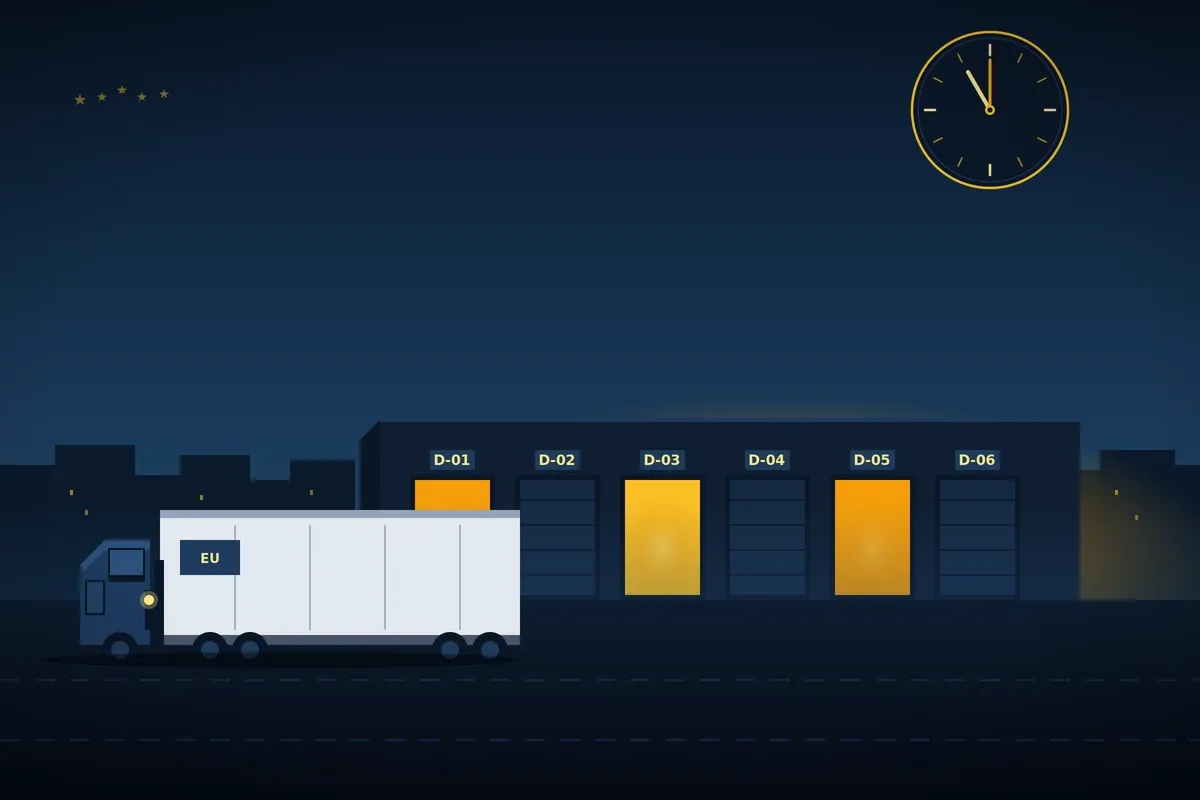
Your German automotive supplier signed a €1.8 million TMS contract eighteen months ago. The Gartner-quadrant vendor promised end-to-end visibility, eFTI-ready integration, and "carrier collaboration." Last quarter, your CFO noticed something nobody on the procurement committee modelled: €217,000 in detention and demurrage charges across four distribution sites, plus three formal infringement notices under the EU Mobility Package's driver rest-time provisions. The TMS dashboard shows everything green. The drivers' tachographs tell a different story.
This is the execution gap every European shipper is about to discover. From 1 July 2026, international freight transport performed by vans up to 3.5 tonnes enters the tachograph regime, and second-generation smart tachographs (G2V2) become mandatory across light commercial vehicles. Combined with the eFTI Regulation's full application from 9 July 2027, your driver-hour exposure is no longer a carrier problem. Every minute a driver waits at your dock is now a regulatory, financial and reputational liability that lands on your balance sheet.
The numbers paint a stark picture. There were 444,000 vacant truck driver positions across Europe in 2025, and the IRU projects this shortage will triple by 2026 if no corrective action is taken. Carriers are no longer absorbing detention costs quietly — they are repricing them into spot rates, contractual minimums and refusal-to-load clauses that hit shippers with chronic dock delays. Your TMS procurement decisions in 2025–2026 will determine whether you absorb these costs or eliminate them. Most won't, because the platforms you're evaluating treat the loading dock as a black box.
The Mobility Package Reality Check
The EU Mobility Package's driver-hour enforcement framework has been tightening since 2022, but enforcement asymmetry hid the impact from shippers until now. National inspectorates focused on hauliers — checking tachograph downloads, cabotage limits and posting declarations at the roadside. The 2026 G2V2 mandate changes the asymmetry. Second-generation smart tachographs transmit position data in real time, automatically log border crossings, and integrate directly into the European Labour Authority's cross-border enforcement platform.
For transport directors managing €10 million+ freight budgets, this creates three immediate exposures. First, drivers who exceed daily driving time because of unscheduled dock waits generate digitally verifiable evidence linked to your facility's GPS coordinates. Second, mandatory weekly rest periods that get compressed because of upstream dock delays become traceable to the loading-event timestamp on the carrier's eFTI record. Third, the Posted Workers Directive applies the moment a driver is delayed long enough at your site to trigger a posting obligation in your member state.
Enforcement is no longer hypothetical. The European Labour Authority confirmed in its 2025 annual report that joint cross-border inspections of road transport operations increased 38% year-on-year. National inspectorates from the Netherlands, Belgium, Germany and France are sharing real-time data through the Internal Market Information System. The legal doctrine of joint liability — already established in posted-worker case law — is being extended through national implementing acts to dock-side delays caused by consignor coordination failures.
Smart European shippers are flipping this constraint into operational advantage. While competitors wait for clarifying guidance, you can build dock and yard coordination architectures that eliminate driver-hour exposure entirely. Your TMS selection — and the execution-layer tooling that sits underneath it — must account for this new reality.
Why Your TMS Treats the Dock as a Black Box
Every TMS evaluation framework currently used by European procurement teams ends at the carrier handoff. You select vendors based on routing optimization, rating engines, eFTI readiness, carrier marketplaces and visibility dashboards. The RFP almost never asks what happens between the moment a carrier accepts a load and the moment the truck pulls away from your loading bay.
This is the execution gap. Cloud-based TMS solutions from Oracle Transportation Management, SAP TM, Blue Yonder, MercuryGate (now part of Körber's Infios), and the recently consolidated WiseTech/E2open entity all assume the dock is somebody else's problem. Even European-native platforms like Alpega and Transporeon, which handle cross-border complexity better than their North American counterparts, focus their core capability on what happens on the road — not what happens at the bay.
The result: your TMS reports a successful shipment when the carrier accepts the order, but it has no visibility into the 90 minutes the driver spent waiting outside your facility because three other carriers showed up at the same window. Your detention invoices arrive 30–60 days later. Your Mobility Package infringement notices arrive when the cross-border inspectorate completes its quarterly review. By that point, the root cause — fragmented dock and yard coordination — is invisible to the procurement team that approved the TMS.
The Dock-Yard Distinction Most Procurement Teams Get Wrong
Here is the operational reality most TMS evaluation frameworks miss: dock scheduling and yard management are two different problems requiring two different control systems. Confusing them — or assuming one capability covers both — is the single most expensive mistake in the procurement playbook.
Dock scheduling determines when a carrier is allowed to arrive at a specific loading or unloading point. It controls appointment windows, dwell-time forecasting, lead-time enforcement and carrier self-service booking. Yard management determines where a trailer goes once it has arrived on site — which gate, which staging zone, which dock door, in what sequence, and how long it can occupy each. The two systems operate on different time horizons, against different constraints, with different operational owners.
A practical guide to the operational difference between dock scheduling and yard management is now essential reading for anyone running a TMS RFP, because most enterprise procurement frameworks confuse the two. Treating dock scheduling as a yard management sub-feature is how Dutch food distributors discovered during the 2024 cross-border enforcement push that their unified "yard appointment" module couldn't prevent driver-hour breaches: the system optimized trailer flow inside the gate but had no control over carrier arrivals outside it. Drivers queued on the public road, tachographs ran, and the consignor absorbed the resulting infringement notices.
For European shippers, the regulatory environment now demands separable control over both. Carriers need a self-service booking interface that operates on lead times the Mobility Package will tolerate. Yard operations need real-time trailer sequencing that respects driver weekly-rest constraints. Bolt-on modules inside an enterprise TMS rarely deliver either properly, because their design constraints come from the routing engine, not the loading bay.
Vendor Consolidation Amplifies the Risk
Market consolidation is accelerating the execution-gap problem. WiseTech Global's $2.1 billion acquisition of E2open and Descartes Systems Group's $115 million acquisition of 3GTMS — its 32nd acquisition since 2016 — concentrate procurement leverage in the hands of mega-vendors whose product roadmaps are dictated by integration timelines, not customer compliance pressure. Post-acquisition integration typically spans 12–18 months, during which platform development stagnates while resources get redirected to harmonizing systems.
For execution-layer capability — dock scheduling, yard management, carrier coordination at the loading point — consolidation makes things worse, not better. Mega-vendor roadmaps prioritize the modules that drive enterprise license revenue: ratings, optimization, cross-border tax engines. Loading-dock execution is a low-revenue, high-effort domain. Expect it to be the last module updated, the first module quietly deprecated, and the most likely to get bundled into a premium tier you didn't budget for.
European-native specialists provide better insulation, but only if they are evaluated against the right capability matrix. Look for proven dock-side execution rather than promises of future appointment-booking functionality. The execution layer — carrier self-booking, dwell forecasting, yard sequencing under driver-rest constraints — should be procured as a distinct capability rather than waiting for the consolidated mega-vendor to ship a feature its roadmap won't prioritize.
Risk Mitigation Framework
Effective driver-hour compliance requires contingency-first architecture. Your TMS should automate carrier rebooking when dock capacity constraints emerge, manage cross-dock sequencing under driver-rest constraints, and integrate Mobility Package compliance monitoring that flags exposures before they become infringement notices.
Test contingency scenarios during vendor demonstrations. How quickly can the system reschedule an appointment when a driver's remaining drive time will no longer cover the original window? Does the platform alert the yard supervisor automatically, or require manual intervention? Can a carrier self-cancel and rebook without phoning your dispatch team — and does the cancellation feed back into the routing engine before a replacement load gets dispatched?
Demand demonstrable integration between dock-side execution and Mobility Package compliance fields in the eFTI dataset. By 9 July 2027, Member State authorities must accept electronic freight information via certified eFTI platforms, and the loading-event timestamp will become legally consequential. Platforms that can't write to the eFTI record from the dock event will create reconciliation work your operations team cannot absorb at scale.
Implementation Timeline: The 90-Day Window
Market dynamics and regulatory deadlines create a narrow procurement window. Those who delay face increasingly limited options as vendor acquisition activity accelerates and inspection regimes tighten. Your 90-day framework should address execution-layer assessment, vendor evaluation and contract protection before the July 2026 G2V2 enforcement date locks your exposures in place.
Phase 1: Execution-Layer Assessment (Days 1–30)
Document your critical loading points and their current dock-yard coordination architecture. Map which sites already generate detention exposure, which carriers are repricing into your contracts, and which facilities sit on Mobility Package corridors where enforcement is intensifying. Quantify the cost of continued fragmentation versus integrated control. Most European shippers managing five or more sites discover annual detention exposure between €120K and €280K once they instrument the measurement properly.
Phase 2: Vendor Evaluation (Days 31–60)
Evaluate platforms separately for routing capability and dock-side execution capability. Compare Oracle TM, SAP TM and the consolidated WiseTech/E2open entity against European specialists like Alpega and Transporeon, but score the dock-and-yard execution layer as a distinct capability rather than a TMS sub-feature. Demand live demonstrations of carrier self-booking, real-time dwell forecasting, and integration with the eFTI loading-event record.
Phase 3: Contract Protection (Days 61–90)
Structure agreements with acquisition-resistant terms and execution-layer guarantees. Include functionality clauses that prevent dock and yard modules being moved to premium tiers without equivalent replacement, advance notice of acquisition discussions, and price protection during ownership transitions. Tie service-level credits to measurable dwell-time and detention-event metrics rather than uptime statistics that hide root-cause coordination failures.
Future-Proofing Your Driver-Hour Compliance Architecture
Build systems that survive both the 2026 enforcement window and the longer 2027 eFTI transition. The post-2027 transport landscape will reward organizations that decoupled dock-side execution from enterprise TMS routing, integrated both with the eFTI data layer, and built carrier self-service interfaces that respect driver-hour constraints by design. Your competitive advantage depends on building this resilience now, before the consolidation wave eliminates your specialist vendor options and the Mobility Package enforcement regime turns your detention exposure into formal infringement liability.
Your next step: instrument detention measurement across your five highest-risk sites this quarter, and separate dock-and-yard execution capability from your TMS RFP before the July 2026 G2V2 enforcement deadline turns measurement into liability. The vendor landscape will look dramatically different by mid-2026, and the driver-hour problem isn't going anywhere.