The European Shipper's Strategic Guide to API-First TMS Integration: How to Replace Legacy EDI Systems and Cut Implementation Time by 70% While Building Consolidation-Resistant Technology Architecture

The WiseTech Global acquisition of E2open in early 2025 and Descartes' $115 million purchase of 3GTMS in March 2025 represent more than routine market consolidation. This unprecedented vendor consolidation wave is eliminating choice and creating new risks for procurement teams who thought they had plenty of time to evaluate options, while European manufacturers managing significant transport operations face the perfect storm: eFTI Regulation full application on July 9, 2027, ICS2 version 3 messaging becoming mandatory from February 3, 2026, with current EDI-based TMS integrations unable to handle these requirements efficiently.
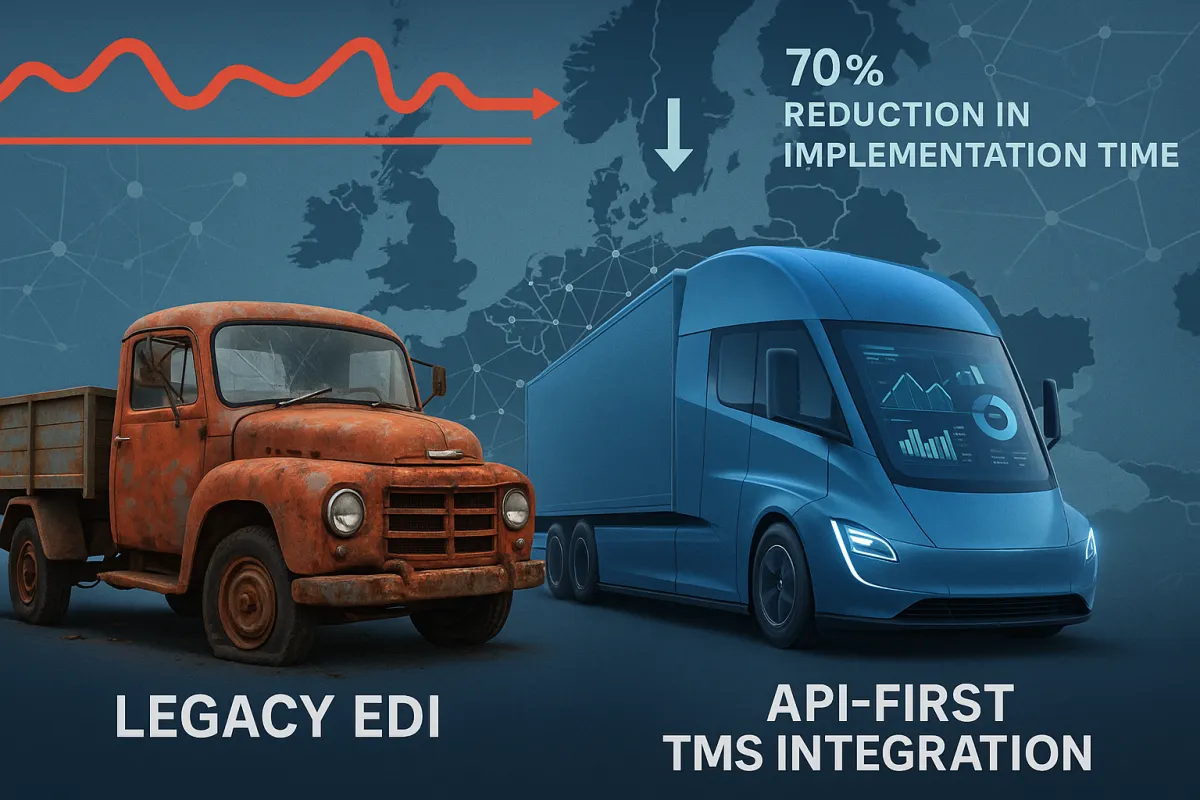
EDI integrations may take several months, whereas API integrations can take a matter of weeks, if not days. Yet most European procurement teams remain focused on feature comparisons rather than implementation speed. When regulatory deadlines operate on fixed timelines that ignore your IT project schedules, this 70% time advantage becomes business-critical.
The Current Market Disruption Reshaping TMS Procurement
The European TMS market, valued at €1.4 billion in 2024 and growing at 12.2% CAGR, is forecasted to reach €2.5 billion by 2029. These acquisitions are fundamentally altering the competitive landscape that European shippers rely on for carrier connectivity, pricing leverage, and implementation flexibility, with product roadmap uncertainties already surfacing.
When two TMS platforms merge, customers face decisions about system standardization, feature deprecation, and support duration. Product roadmap uncertainties are already surfacing when two TMS platforms merge, forcing customers to decide which system to standardize on, what features will be deprecated, and how long dual support will continue.
The post-consolidation landscape reveals three distinct vendor categories:
- Global mega-vendors (Oracle TM, SAP TM, Descartes, WiseTech/E2open)
- European specialists (Cargoson, Alpega, nShift, Transporeon)
- Regional niche players facing acquisition pressure
API-First Integration: The Speed and Flexibility Advantage
The technical contrast between EDI and API integration affects every aspect of your implementation timeline. APIs transmit data in milliseconds, allowing transportation management systems to run on real-time data for tracking updates, load building, or spot quotes.
EDI integrations may take several months whereas API integrations can take weeks or days, and when you need to onboard a new carrier urgently for eFTI compliance, APIs give you that flexibility. APIs can be set up and configured by your IT department or any tech-savvy analyst, while EDI generally needs expensive, specialized consultants to set up or change anything.
Real-World Cost Comparison
Budget planning reveals significant differences: Basic API integrations cost €5,000-€15,000, while complex ERP connections exceed €50,000. However, the alternative costs more. European operations often require 15-25% of their transport budget for emergency reactive changes when regulatory deadlines arrive without preparation.
Compare this to proactive implementation: 8-12% budget allocation for planned API-first transitions versus emergency costs exceeding 25%. For companies with €10M+ annual transport spend, this represents €500,000+ savings through proper planning.
European Regulatory Pressures Creating Implementation Urgency
As of July 9, 2027: The eFTI Regulation will apply in full, with Member State authorities required to accept information shared electronically by operators via certified eFTI platforms. Version 2 was permanently decommissioned on February 3, 2026, so any system still referencing it is non-compliant.
The eFTI Regulation will transform freight transport within the EU by replacing paper-based documentation with electronic data across road, rail, inland waterway, and air transport, reducing administrative burdens for operators and authorities.
Your implementation timeline operates against these fixed deadlines:
- January 2026: eFTI platforms and service providers can start preparing for operations, with Member States authorities potentially starting to accept data stored on certified eFTI platforms for inspection
- July 2027: National authorities will be required to accept freight documentation in electronic form via certified eFTI platforms
European manufacturers typically manage transport across 8-15 countries simultaneously, with each country implementing eFTI and ICS2 requirements with slight variations in timing and technical specifications.
The Three-Phase Implementation Framework
Phase 1: Core Functionality Validation (Q2-Q3 2025)
Phase 1 focuses on core functionality validation during Q2-Q3 2025, connecting your primary TMS to 3-5 major carriers through API endpoints and testing data formatting accuracy, error handling, and system performance under typical load volumes.
Start with your highest-volume carrier relationships. API connectivity allows you to validate data quality and system stability before expanding to additional partners. API allows transportation management systems to transmit data in less than a second with cloud-based solutions, but integration quality matters more than speed.
Phase 2: Regulatory Readiness (January 2026)
Phase 2 targets regulatory readiness by January 2026, with the new version (v3) of ICS2 messages starting February 3, 2026, requiring integration that handles messaging format updates automatically.
Member States authorities may start accepting data stored on certified eFTI platforms for inspection from January 2026, providing a voluntary period for real-world testing and staff training.
Phase 3: Advanced Features Integration (July 2026-2027)
QR code generation and machine-readable format requirements become mandatory by July 2027, requiring your TMS to generate these automatically for every shipment across all transport modes.
Use the voluntary acceptance period for operational testing. Carriers who are already running eFTI-conformant platforms by mid-2026 will spend the second half of 2026 and first half of 2027 helping their customers transition, while carriers who wait will be told by their customers which platform to use.
Vendor Selection During Market Consolidation
Financial stability assessment extends beyond traditional metrics. Descartes' acquisition of 3GTMS for $115 million and WiseTech's strategic acquisition of E2open combines two of the most acquisitive players, underscoring WiseTech's vision to be the operating system for global trade and logistics.
Evaluate European regulatory compliance readiness. Consider providers like Cargoson, Alpega, and nShift that specifically address European compliance requirements. Modern solutions provide existing carrier connectivity, with TMS solutions enabling businesses to manage freight management, route optimization, carrier selection, shipment tracking, and cost management across diverse transportation modes.
Contract Protection Strategies
Include 12-18 month advance notice clauses for ownership changes. Specify functionality preservation guarantees and migration assistance rights. When your vendor becomes an acquisition target, you inherit integration risks without directly managing the project.
Integration architecture that survives ownership changes becomes essential. High interoperability ensures eFTI platform compatibility with existing ERP and TMS systems, with modern configurable solutions reducing traditional integration complexity and integrating seamlessly with supply chain technologies.
Managing the Hybrid Transition Period
Going "API-only" promises real-time updates and cost savings, but the reality is rarely binary, with time-sensitive events like dock appointments and GPS pings benefiting from API speed, while invoices and customs forms remain comfortable in EDI's structured format.
Parallel system operation requires careful planning. Prioritize carrier onboarding for high-volume routes first. Enterprise logistics teams managing multi-carrier operations maintain 15 to 30 concurrent point-to-point integrations on average, creating coordination overhead that grows with every carrier or warehouse system added.
Combining EDI and API offers logistics companies several advantages, with EDI integrations automating data transmission between multiple systems for faster communication and allowing businesses to gain market foothold and open opportunities with new trading partners.
Future-Proofing Your Integration Architecture
Orchestration layers above individual API connections make real-time allocation and routing decisions from unified data, converting static connection infrastructure into a live operational decision engine.
Regulatory change adaptation capabilities matter. Carriers release API version updates on their own schedules, with FedEx, UPS, and USPS all increasing version release frequency heading into 2025 and 2026, with each update potentially affecting rate logic, address validation schemas, label formats, and service definitions.
Performance monitoring becomes essential. A degraded carrier API during peak season can cost over $100,000 per hour in fulfillment disruption. Build monitoring systems that detect performance degradation before it affects operations.
Your API-first TMS integration strategy determines whether you control your technology transition or respond to external pressures. Industry bodies urge hauliers to start preparing now by training drivers, updating back-office systems, and selecting software providers likely to be certified under the eFTI framework. Companies planning proactive transitions will spend 2026-2027 helping their carriers adapt, while those waiting will accept whatever platform their partners select.