The European Shipper's Complete Guide to API-First TMS Integration: How to Transition from Legacy EDI to Modern Carrier Connectivity That Cuts Implementation Time by 70% Before 2027's Regulatory Deadlines

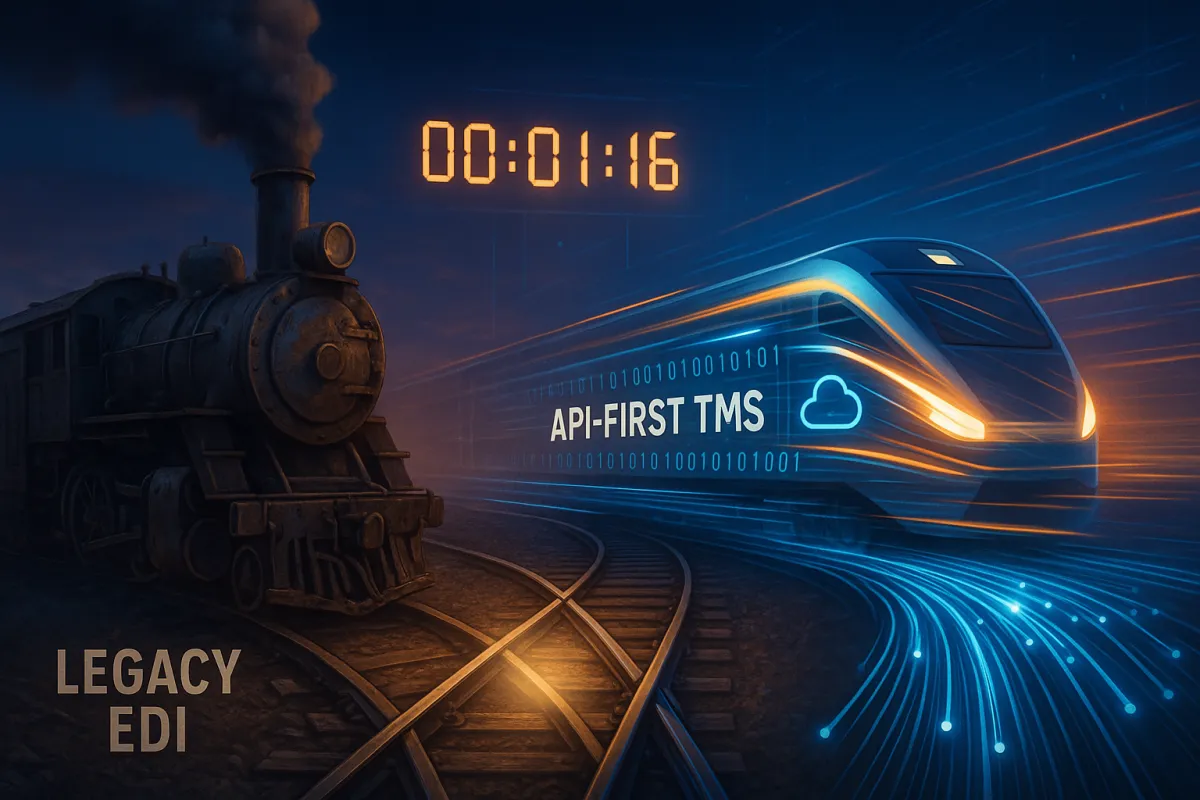
European manufacturers managing significant transport operations are facing the perfect storm: as of 9 July 2027, the eFTI Regulation will apply in full, ICS2 version 3 messaging becomes mandatory from 3 February 2026, with version 2 permanently decommissioned, and your current EDI-based TMS integrations cannot handle these requirements efficiently. While your procurement team debates whether to upgrade, carriers across Europe are already investing in API-first platforms that will leave EDI-dependent shippers scrambling for connectivity.
Basic API integrations cost €5,000-€15,000, while complex ERP connections exceed €50,000, but the alternative costs more. European operations often require 15-25% of their transport budget for emergency reactive changes when regulatory deadlines arrive without preparation. Here's your systematic framework for transitioning from legacy EDI to API-first TMS connectivity before these regulatory deadlines eliminate your flexibility.
The Regulatory Storm Driving API-First TMS Adoption in Europe
Your regulatory deadline pressure operates on fixed timelines that ignore your IT project schedules. From 2027, authorities in all EU Member States must accept electronic freight data shared via eFTI-compliant platforms, while Version 2 was permanently decommissioned on the 3rd of February 2026, so any system still referencing it is non-compliant.
The scope affects every mode of transport you operate. This digital shift will apply to road, rail, inland waterway, and air transport, meaning your entire multimodal network needs preparation. European manufacturers typically manage transport across 8-15 countries simultaneously. Each country implements eFTI and ICS2 requirements with slight variations in timing and technical specifications.
Why EDI Systems Cannot Handle Europe's 2026-2027 Compliance Requirements
The technical limitations of EDI become apparent when facing these regulatory demands. EDI, having been standardized around the 1970s, works by establishing a secure and reliable peer-to-peer connection to transmit data from physical documents, which creates fundamental issues for real-time compliance requirements.
EDI integrations may take several months, whereas, API integrations can take a matter of weeks, if not days, and files may have complex formats requiring the labor of specialists. When you need to onboard a new carrier urgently for eFTI compliance, APIs give you that flexibility. Member State authorities must accept information shared electronically by operators via certified eFTI platforms starting July 2027, while the EU permanently switched off old ICS2 message formats on February 3, 2026, requiring automatic system adaptation rather than manual updates.
The Business Case for API-First TMS Architecture
API allows transportation management systems (TMS) to transmit data in less than a second with cloud-based solutions. This speed advantage translates into operational benefits that EDI simply cannot match. APIs will expand a company's ability to automate manual pieces of their business that cannot be offered through EDI connections. For example, requesting spot quotes through an API can eliminate hundreds of calls and emails that take place on a weekly basis.
The financial calculations are stark. European TMS implementations using API-first approaches show measurable improvements: European operations often see 15-25% improvements in transport administrative efficiency within the first year of successful TMS data integration. Consider that traditional freight procurement processes consuming 18-28 hours per tender can be compressed to 45 minutes through marketplace-connected TMS automation.
Measuring ROI from EDI to API Migration
The cost structure breaks down clearly when you examine integration complexity. Basic API integrations cost €5,000-€15,000, while complex ERP connections exceed €50,000. Compare this to full EDI transformations ranging from USD 50k for a single‑lane pilot to USD 500k for a global rollout, while more accessible projects starting with dock‑scheduling data begin in the low five figures and often pay back inside a year.
Implementation timelines reveal the true advantage. Integration through APIs is generally less complex than EDI integrations. Once a public API is available, anyone with credentials can build solutions to leverage that API, whereas EDI requires unique data mapping for each integration. This scalability becomes crucial when managing carrier networks across multiple European markets.
Navigating Vendor Consolidation Risks During API Migration
The TMS vendor landscape is undergoing dramatic restructuring right now. WiseTech Global's $2.1 billion acquisition of e2open and Descartes Systems Group's acquisition of the transportation management solutions (TMS) software vendor 3GTMS for $115 million, marking Descartes' 32nd acquisition since 2016.
These acquisitions create specific risks for European shippers implementing new TMS platforms. When your TMS vendor becomes an acquisition target, you inherit integration risks without directly managing the project, with post-acquisition integration timelines typically spanning 12-18 months. During these periods, platform development stagnates while resources get redirected to harmonizing systems.
Building Acquisition-Resistant API Integration Strategies
Contract protection becomes essential in this consolidation environment. Acquisition-resistant contracts require specific protections including 12-18 months advance notice for ownership changes, guaranteed functionality preservation for minimum periods, and migration assistance rights.
European TMS vendors offer distinct advantages during this consolidation wave. European specialists maintain development resources focused exclusively on European market needs, while global vendors like Descartes or WiseTech spread development efforts across multiple geographic priorities. This focus translates into faster feature development for European-specific requirements and more responsive customer support during regulatory transitions.
Platforms like Cargoson, alongside Alpega and nShift, represent this European focus advantage. Their regional specialization becomes more valuable as regulatory complexity increases and acquisition pressure intensifies.
Step-by-Step Implementation Framework for API-First TMS
Your API migration strategy must align with regulatory milestone dates rather than internal IT schedules. As of January 2026: eFTI platforms and service providers can start preparing for operations, with Member States authorities potentially accepting data stored on certified eFTI platforms for inspection. Use this voluntary period for real-world testing.
Phase 1 focuses on core functionality validation during Q2-Q3 2025. Connect your primary TMS to 3-5 major carriers through API endpoints. Test data formatting accuracy, error handling, and system performance under typical load volumes. API allows transportation management systems to transmit data in less than a second with cloud-based solutions, but integration quality matters more than speed.
Phase 2 targets regulatory readiness by January 2026. Start of application of the new version (v3) of ICS2 messages on 3 February 2026, and decommissioning of older version (v2) means your integration must handle messaging format updates automatically. Your API connections must adapt to regulatory changes without manual intervention.
Managing the Hybrid EDI-API Transition Period
The practical reality for European shippers is that pure API adoption isn't always immediate. While many trucking companies are adopting APIs when and where they can, EDI is still widely used in the transportation industry, and that's not likely to change anytime soon. This creates a mixed environment where your TMS must handle both integration types effectively. Your integration strategy shouldn't be an either/or decision.
Smart hybrid approaches leverage the strengths of each method. Live, decision-driving data travels via API while audit-critical records that make more sense in a document anyway stay on EDI. The portal doesn't kill EDI, it supplements it with data EDI can't deliver in real time.
Pushing status straight into your TMS API cuts delay, though many teams keep the EDI 214 stream running as a backup for legacy carriers. This dual-track approach ensures operational continuity while building API capability for future requirements.
Future-Proofing Your API-First TMS Investment
The transport regulatory landscape will continue evolving beyond 2027. The use of eFTI platforms is expected to save the EU transport and logistics sector €1 billion annually by enabling real-time data sharing, improving logistics planning, and strengthening multimodal transport coordination, but this is just the beginning of European transport digitalization.
Platform selection becomes more critical as vendor options diminish through continued acquisitions. European specialists including Cargoson, alongside Alpega and nShift, maintain development focus on regional requirements, while global vendors spread resources across multiple geographic priorities. This focus differential becomes more important as complexity increases and vendor options decrease through continued acquisitions.
The procurement window for securing optimal TMS platforms before vendor consolidation eliminates choices and capacity shortages worsen cost structures runs through Q1 2026. With the European TMS market reaching around € 1.4 billion in 2024 and growing at a compound annual growth rate (CAGR) of 12.2 percent, forecasted to reach € 2.5 billion in 2029, the stakes for making the right integration choice have never been higher. European shippers need clarity on whether to double down on EDI, embrace APIs, or navigate a hybrid approach when implementing their TMS API integration strategy.
Start your API-first TMS evaluation now. The regulatory deadlines are fixed, the vendor landscape will look dramatically different by 2026, and the operational advantages of API integration compound over time. Your competitive advantage lies not in waiting for perfect market conditions, but in building the flexible integration architecture that thrives on European transport complexity while meeting every regulatory requirement automatically.