The European Shipper's Dual Compliance Crisis: How to Navigate ICS2 and G2V2 Implementation While Leveraging Vendor Consolidation for Strategic TMS Advantage Before July 2026's Bottlenecks Triple Your Costs

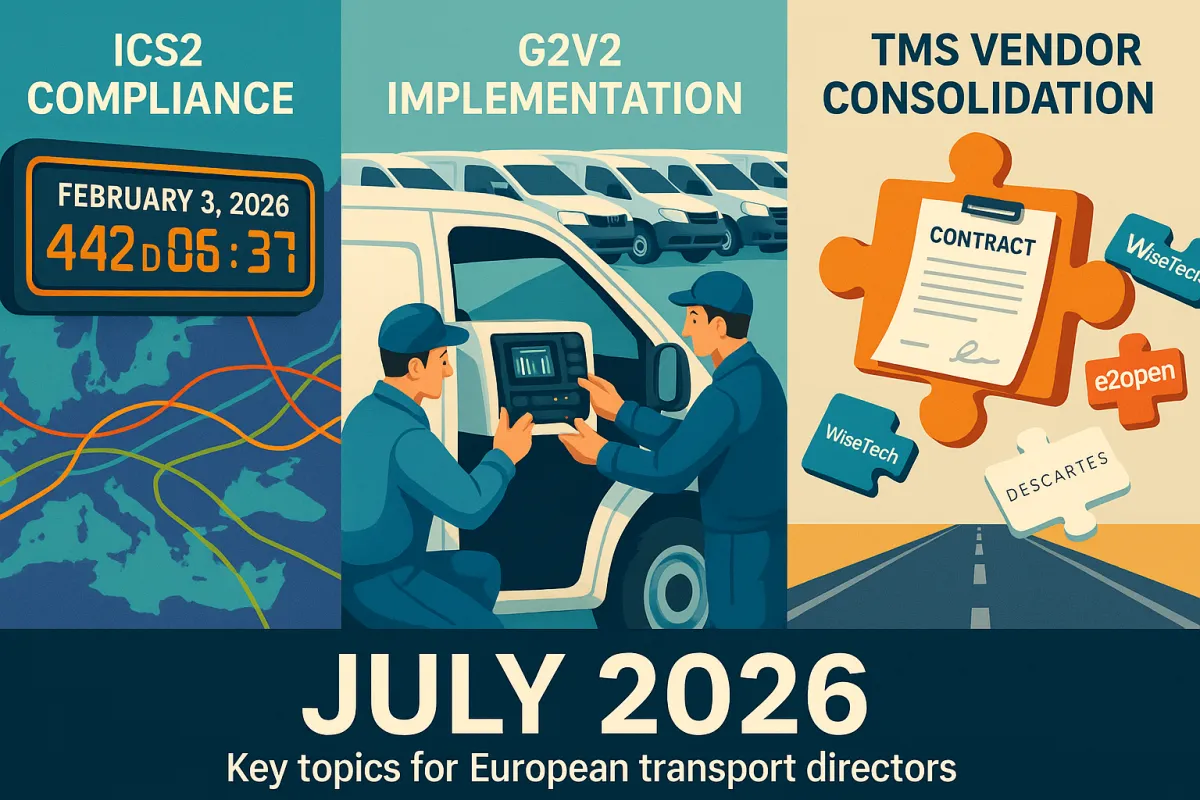
European transport directors managing cross-border operations face a regulatory crisis unlike anything the industry has experienced. In 2026, it is fully consolidated as a mandatory framework, with exclusive adoption of v3 messaging as of February 3, 2026 for all modes of transport. Simultaneously, from July 1, 2026, vans between 2.5 and 3.5 tonnes used for international goods transport or cabotage must carry a second-generation smart tachograph (G2V2). This perfect storm of compliance deadlines collides with the most aggressive TMS vendor consolidation wave in market history.
While most shippers view these deadlines as expensive compliance burdens, procurement teams who understand the strategic implications can leverage this regulatory pressure into significant TMS contract advantages before vendor options disappear permanently. WiseTech's acquisition of e2open for $3.30 per share in cash equating to an enterprise value of $2.1 billion marks the largest TMS industry acquisition to date, while Descartes Systems Group has acquired Columbus, Ohio-based 3Gtms for $115 million USD in cash.
The Perfect Storm: Why 2026's Regulatory Convergence Changes Everything
The numbers tell an uncomfortable story. Carriers and importers must integrate ERP and TMS systems with the ICS2 platform, with failure to report potentially resulting in a fine of up to 5,000 euros. Simultaneously, installation workshops across Germany, Poland, and the Netherlands are warning of capacity constraints that are pushing Q2 installation costs 40–60% above what early movers paid. Your procurement window is closing faster than most teams realize.
What makes 2026 particularly challenging is that these aren't isolated compliance requirements. Start of application of the new version (v3) of ICS2 messages on 3 February 2026, and decommissioning of older version (v2) means your integration must handle messaging format updates automatically - not through manual system adjustments. For G2V2 tachographs, this affects up to three million vehicles across Europe, creating unprecedented demand for specialized workshops and certified installations.
The Cost Explosion Reality Check
European manufacturers consistently underestimate the multiplication effects of dual compliance. For vans (2.5–3.5t), the all-in cost — hardware unit, certified installation, initial calibration, and company lock — ranges from €3,500 to €4,700 per vehicle, according to fleet industry data. The timing matters significantly: Operators booking installation in Q2 2026 should expect to pay 40–60% more than those who booked in the second half of 2025, due to workshop capacity constraints as the July deadline approaches. Those waiting until Q2 2026 faced installation costs 40-60% higher than early adopters.
The ICS2 side carries hidden costs most procurement teams miss. ICS2 becomes mandatory from 1 January 2026, while basic API integrations cost €5,000-€15,000, while complex ERP connections exceed €50,000. When you factor in the penalty structure, non-compliance becomes financially unsustainable across large shipment volumes.
The ICS2 Implementation Framework: Turning Customs Compliance Into Competitive Advantage
Smart European shippers approach ICS2 implementation as an operational transformation rather than a regulatory burden. The implementation of ICS2 forces companies to review their internal processes and the way they manage logistics and customs information. Anticipation and data quality become a critical element of daily operations. The key lies in building automated ENS filing capabilities through TMS integration rather than treating customs compliance as a separate manual process.
Your TMS must handle detailed description of goods per commodity, the respective six-digit Harmonized System (HS) code, and the EORI Number for consignees automatically through ERP integration. Modern platforms from vendors like Oracle TM, SAP TM, Cargoson, Alpega, and Transporeon now include dedicated ICS2 modules that automate this data collection and submission process.
Critical Data Quality Requirements
ICS2 compliance demands precision that manual processes cannot reliably deliver at scale. Under this new system, all air cargo destined to or transiting through the European Union, Switzerland, or Norway, requires line-item, electronic submission of all pre-arrival security filings to European customs authorities prior to shipment, including a detailed description of goods per commodity, the respective six-digit Harmonized System (HS) code, and the EORI Number for consignees at both the master air waybill and the house air waybill.
The technical integration requirements go beyond basic connectivity. Your TMS must validate HS code accuracy, ensure description specificity meets customs requirements, and automatically flag potential compliance issues before submission. Customs will then review the information submitted and, if appropriate, provide approval for cargo to depart origin. Cargo cannot depart until customs provides approval. This creates operational pressure that demands automated validation rather than manual checking.
G2V2 Tachograph Strategy: Avoiding the July Bottleneck
European fleet managers who learned from the heavy vehicle rollout understand that timing determines total cost of ownership. Workshops in Germany, Poland, the Netherlands, and Belgium are reporting June availability is limited. Email or call this week and get written confirmation of your booking. The installation capacity shortage isn't theoretical—it's happening now across major European logistics corridors.
The scope extends beyond obvious candidates. From July 1, 2026, yes — if the van has a gross vehicle weight above 2.5 tonnes and is used for the commercial carriage of goods across an EU border, it must be fitted with a second-generation smart tachograph (G2V2). Vans used solely for domestic transport or for own-account non-commercial purposes may be exempt, but any cross-border paid freight operation in a 2.5–3.5t van is in scope from the July deadline.
The TMS Integration Opportunity
While most companies view tachograph compliance as a regulatory burden, smart European shippers are leveraging TMS integration to transform this obligation into operational advantage. Modern TMS solutions from vendors like Cargoson, nShift, Transporeon, and Alpega now include dedicated tachograph data management modules that automatically download, process, and archive compliance data.
The operational benefits extend beyond compliance. European operations often see 15-25% improvements in transport administrative efficiency within the first year of successful TMS data integration. These improvements come from reduced manual data entry, automated compliance reporting, and enhanced visibility across transport networks. Modern G2V2 devices provide real-time data streams for compliance monitoring and route management, seamlessly connecting tachograph information to their existing fleet management software.
Vendor Consolidation as Procurement Leverage
European transport directors face an uncomfortable truth about market dynamics. The deal marks Descartes' 32nd acquisition since 2016. This creates a fundamentally different vendor landscape for European shippers. The post-consolidation landscape reveals distinct vendor categories with different risk profiles for strategic planning.
The post-consolidation landscape reveals three distinct categories: global mega-vendors (Oracle TM, SAP TM, E2open/WiseTech, Descartes), European specialists (Alpega, nShift, Transporeon), and emerging European-native solutions like Cargoson that maintain development focus specifically on European regulatory requirements. Each category offers different advantages for compliance implementation and long-term stability.
The procurement window is narrower than most teams realize. Companies undergoing integration often experience 12-18 months of reduced innovation while they harmonize platforms and teams. Post-acquisition integration timelines typically span 12-18 months, during which platform development stagnates and support quality deteriorates. This timing creates unique negotiation leverage for European buyers who understand the regulatory pressure vendors face.
Contract Protection Strategies
Standard TMS procurement contracts leave European shippers vulnerable to post-acquisition changes without recourse. Acquisition-resistant contracts require specific protections including 12-18 months advance notice for ownership changes, guaranteed functionality preservation for minimum periods, and migration assistance rights.
Your contract protection strategy should include specific protections including 12-18 months advance notice for ownership changes, guaranteed functionality preservation for minimum periods, and migration assistance rights. Include specific clauses requiring 12-18 months advance notice of ownership changes, with automatic contract review rights triggered by acquisition announcements. Price protection clauses should lock pricing for 24 months following ownership changes.
Use regulatory requirements as contract leverage. If a vendor can't deliver eFTI compliance by January 2026 or tachograph integration by July 2026, that's grounds for contract adjustment or termination. Contract terms should protect against compliance cost escalation and include specific deliverables for G2V2 data integration capabilities.
Implementation Timeline and Action Plan
The phased approach that avoids budget disasters starts with immediate action. The phased implementation approach that works: fleet analysis in Q2 2025, workshop booking by Q3 2025, TMS vendor selection by Q4 2025, and integration testing starting Q1 2026. This timeline accounts for both regulatory deadlines and vendor availability constraints.
Your procurement timeline must account for consolidation disruption. This procurement window running through Q1 2026—after which your leverage disappears as regulatory pressure forces decisions. Companies that haven't initiated TMS selection processes by mid-2026 will find significantly fewer viable options as vendors focus on existing customer compliance rather than new acquisitions.
Platform evaluation should include the full vendor landscape while options remain available. This includes established platforms like MercuryGate, Descartes, E2open, Manhattan Active, Oracle TM, and SAP TM alongside European specialists like Alpega, nShift, Transporeon, and modern alternatives including Cargoson that focus specifically on European cross-border operations.
The Q2 2026 core functionality deployment timeline provides regulatory readiness before July's G2V2 mandate creates additional operational pressure. Plan for 15-20% budget increases in 2026-2027 if reactive, or 8-12% if proactive with proper contract protection. Companies that secure implementation capacity early avoid the workshop bottlenecks and cost premiums hitting reactive competitors.
European manufacturers who build comprehensive dual compliance frameworks early position themselves for sustained competitive advantage. The companies that act decisively within the next 90 days secure implementation capacity, avoid vendor consolidation risks, and transform mandatory compliance into strategic procurement leverage. Those who wait face cost overruns, installation delays, and missed optimization opportunities that could impact profitability for years.