
The European SME's Guide to TMS Services Success: How the 11.4% Fastest-Growing Market Segment Can Transform Your Implementation from High-Risk to High-Value Before Vendor Consolidation Changes Everything

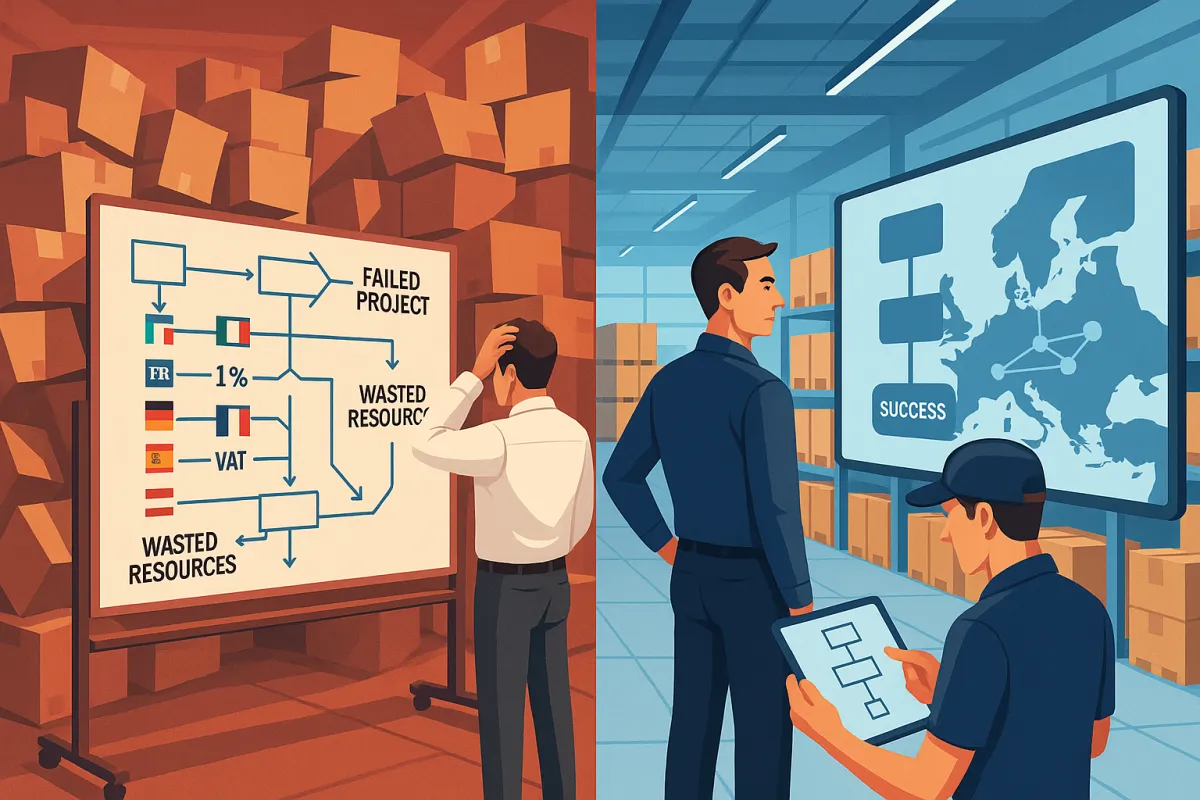
European SMEs managing annual transport spends above €10 million face an uncomfortable truth: while TMS services are projected to grow at 11.4% CAGR through 2034, 66% of technology projects end in partial or total failure, while a staggering 76% of logistics transformations never meet their budget, timeline, or performance targets. Yet the same market data reveals an opportunity hidden beneath these statistics. Companies leveraging strategic TMS services implementation achieve success rates approaching 85%, while those following traditional approaches remain trapped in the failing majority.
Your procurement window narrows as vendor consolidation eliminates choice and regulatory requirements become mandatory. This isn't abstract market theory - it's the practical reality facing European supply chain directors who need working systems before July 2027's eFTI compliance deadline.
Why TMS Services Are Outpacing Software Sales (And What This Means for European SMEs)
The numbers tell a clear story: the services segment is projected to expand at a fastest CAGR of 11.4% from 2026 to 2034 owing to the increasing complexity of TMS deployments, the need for continuous system customization, and the rising demand for managed services. Meanwhile, SMEs leverage modular SaaS pricing, open-source telemetry APIs, and government vouchers to cut integration costs, leading to a 9.67% CAGR in this segment.
This growth reflects a fundamental shift. Europe's ICT professional deficit exceeding one million workers, forcing shippers to rely on external expertise rather than internal development. Technology evolution requires frequent upgrades and ERP system reconfigurations that internal teams cannot handle.
European regulatory complexity amplifies this dependency. Starting August 19, 2025, all heavy-duty vehicles registered in the EU and operating in Member States other than their registration must be fitted with G2V2 devices, while eFTI Regulation applies in full as of July 9, 2027. From July 1, 2026, vans weighing 2.5-3.5 tons performing international transport will be subject to second-generation smart tachographs.
The complexity extends beyond compliance. Consider the vendor landscape: platforms like Cargoson deliver purpose-built European cross-border functionality, while Oracle TM and SAP TM require extensive customization for similar capabilities. When evaluating cloud options, compare Transporeon's European carrier network against nShift's e-commerce focus, while platforms like Cargoson deliver purpose-built European cross-border functionality that often requires months of customization in global systems.
The Hidden Costs of DIY TMS Implementation
European manufacturers routinely underestimate implementation complexity. European manufacturers are discovering that a basic domestic shipper requires 10-15 integrations minimum, potentially totaling 1,000-1,500 hours of labor. For shippers with freight spend exceeding $250M annually, implementation can cost 2-3 times the subscription fee.
API integrations alone consume substantial resources. Basic connections cost €5,000-€15,000, while complex ERP integrations frequently exceed €50,000. European SMEs face unique complications that amplify these failure rates. Cross-border operations span 27 different VAT rates, multiple languages, and varying carrier protocols. European transport operations compound complexity through 27 different VAT rates, multiple languages, varying carrier protocols, and emerging eFTI compliance requirements.
The operational impact compounds these direct costs. Speed creates new challenges. Baseline functionality in 6-8 weeks is realistic. Full value realization (integrations, training, adoption, process change) takes 4-6 months minimum. European shippers rushing to meet regulatory deadlines risk joining the three-quarters of these digital transformation projects [that] fail to meet their objectives.
Mapping the TMS Services Landscape: From Basic Support to Full Managed Operations
European SMEs can choose from three distinct service delivery models, each addressing different organizational capabilities and risk tolerances.
Software-Only Model: Traditional licensing with internal implementation. Best suited for companies with dedicated IT resources and proven change management capabilities. Cloud TMS pricing ranges from $1.00 to $4.00 per freight load booked in the system, while licensed options demand significant upfront investment plus ongoing maintenance fees. Cloud TMS implementations often conclude within eight weeks, compared to 6-18 months for traditional systems.
Managed TMS Model: Combines cloud software with implementation services, ongoing support, and regulatory compliance management. The pace of growth for services is greater than that of the solutions segment, indicating an increase in the complexity of TMS deployment as well as greater integration needs and a greater reliance on the expertise of others. As organizations continue to modernize how they manage transportation processes, their need for services to support TMS rollout, adoption and optimization will continue to grow.
Full Managed Freight Model: End-to-end logistics management where service providers handle technology, carrier relationships, and operational execution. This model appeals to companies seeking to outsource complex logistics functions entirely.
Regional specialists maintain advantages during regulatory transitions. European vendors like Alpega, nShift, and Transporeon understand local compliance requirements inherently, while global players often treat European regulations as additional features requiring custom development.
Government Funding Opportunities: The EU Digital Europe Program Advantage
European SMEs can leverage substantial funding to reduce implementation risks. The EU Digital Europe program offers up to 50% cost reimbursement for cloud software deployments, making managed TMS services financially attractive for qualifying organizations.
The SMEs segment is growing the fastest because of the increased availability of cloud-based TMS platforms that offer SaaS pricing models with no upfront IT cost. Adoption is being accelerated due to the short deployment cycle of 3-6 months for many of the cloud-based TMS systems. Users also benefit from simplified user interfaces, pre-configured workflow templates and modular capabilities.
Microservices architecture allows SMEs to license only required functions - route optimization, freight auditing, or compliance reporting - keeping total ownership below €50,000 while maintaining upgrade flexibility. Open-source telemetry standards reduce proprietary middleware costs, enabling cost-effective integration with existing systems.
Building Your SME TMS Services Strategy: The Phased Implementation Framework
European SMEs achieve higher success rates through structured, phase-based approaches that balance operational continuity with transformation speed.
Phase 1: Core Functionality (Q2-Q3 Timeline)
Focus on basic shipment management, carrier communication, and reporting. Establish data quality foundations and user adoption patterns. Target 80% of daily transport activities within core system.
Phase 2: AI Features Activation (Q4 Timeline)
Implement predictive analytics, route optimization, and automated decision-making. Baseline functionality in 6-8 weeks is realistic. Full value realization (integrations, training, adoption, process change) takes 4-6 months minimum.
Phase 3: Regulatory Compliance (eFTI by Q1 2026)
Activate automated compliance reporting, eFTI integration, and Smart Tachograph data processing. Ensure audit-ready documentation and real-time regulatory updates.
Change management investment alongside technical implementation proves decisive. Include power users from day one rather than treating training as a post-implementation activity. Poor onboarding could cost up to 213% of the employee's salary, making early involvement critical for European SMEs with limited staff resources.
Vendor Selection Criteria That Actually Matter
Beyond standard functionality comparisons, European SMEs need vendor evaluation frameworks addressing long-term strategic risks and opportunities.
Native eFTI Integration Capabilities: Evaluate vendors on integrated compliance capabilities, not bolt-on modules. Platforms demonstrating native eFTI integration and automated tachograph data processing show commitment to European market requirements beyond basic transport management.
Acquisition Resistance Evaluation: Current consolidation creates three distinct vendor categories: global mega-vendors (Oracle TM, SAP TM, E2open/WiseTech), European specialists and emerging solutions. Assess vendor financial stability, product roadmap certainty, and customer service capacity during potential ownership transitions.
European Market Commitment Indicators: Look for vendors with local development teams, European data residency compliance, and multi-language support as baseline requirements rather than premium features.
Real-World Success Factors: What Separates the 85% Success Rate from the 24% Average
Successful European TMS services implementations share specific characteristics that distinguish them from failed projects.
Outcome Delivery vs Feature Deployment Focus: High-performing implementations measure success through operational improvements rather than software feature adoption. Companies achieving 85% success rates target specific business outcomes - reduced freight costs, improved delivery performance, enhanced compliance - while failed projects focus on system functionality.
Continuous Optimization Capabilities: This growth reflects a fundamental shift from one-time software purchases to recurring outcome delivery. Successful vendors provide ongoing optimization services, market condition adaptation, and proactive performance management rather than reactive support.
Carrier integration depth determines long-term value. True API/EDI connections enable automated rate shopping, real-time visibility, and exception management. Basic account relationships require manual intervention and limit optimization capabilities.
Competitive differentiation emerges through specialized regional capabilities. While global players like MercuryGate and Alpega offer broad functionality, European specialists like Cargoson provide deeper cross-border compliance integration and local carrier connectivity.
Cost Management and ROI Measurement
European SMEs require different financial models than enterprise implementations. Cloud TMS pricing ranges from $1.00 to $4.00 per freight load booked in the system, while licensed options demand significant upfront investment plus ongoing maintenance fees.
Hidden cost avoidance often exceeds direct savings. Automated carrier integration eliminates manual rate requests, reducing labor costs. ERP connection fees disappear when platforms include native integration. Compliance automation prevents regulatory penalties averaging €15,000-€30,000 per incident.
SME-specific ROI calculations should include:
- Avoided implementation failure costs (€50,000-€200,000)
- Regulatory penalty prevention (€15,000-€30,000 annually)
- Productivity improvements from automated processes
- Carrier relationship optimization benefits
Timeline advantages compound financial benefits. Cloud TMS implementations often conclude within eight weeks, compared to 6-18 months for traditional systems. Faster time-to-value enables earlier ROI realization and reduced project risk exposure.
Future-Proofing Your Investment: Preparing for the Post-Consolidation Landscape
The TMS vendor landscape will fundamentally change by 2026's end. WiseTech's acquisition of E2open in 2025, Descartes' purchase of 3GTMS for $115 million in March 2025, and Körber's transformation of MercuryGate into Infios following their 2024 acquisition represent just the beginning of a fundamental market restructuring.
Three vendor categories will dominate: mega-vendors offering global platforms, European specialists maintaining regional focus, and emerging solutions targeting specific market segments. European shippers who act decisively in 2026 secure favorable contract terms and compliance-ready platforms before market consolidation eliminates choice.
Contract protection strategies become essential. Include acquisition protection clauses, service level guarantees during ownership transitions, and regulatory compliance cost caps. Vendors confident in their stability will accept these terms; those refusing reveal uncertainty about their future.
Long-term strategic positioning requires balancing vendor stability with innovation capability. Large vendors offer financial security but slower European compliance adaptation. Regional specialists provide regulatory agility but face acquisition risks. Emerging vendors deliver cutting-edge functionality with higher failure probability.
Your 2026 procurement window represents the final opportunity to secure optimal vendor relationships before consolidation reshapes the market permanently. European SMEs acting strategically now position themselves for competitive advantage while those waiting face limited options and unfavorable terms.